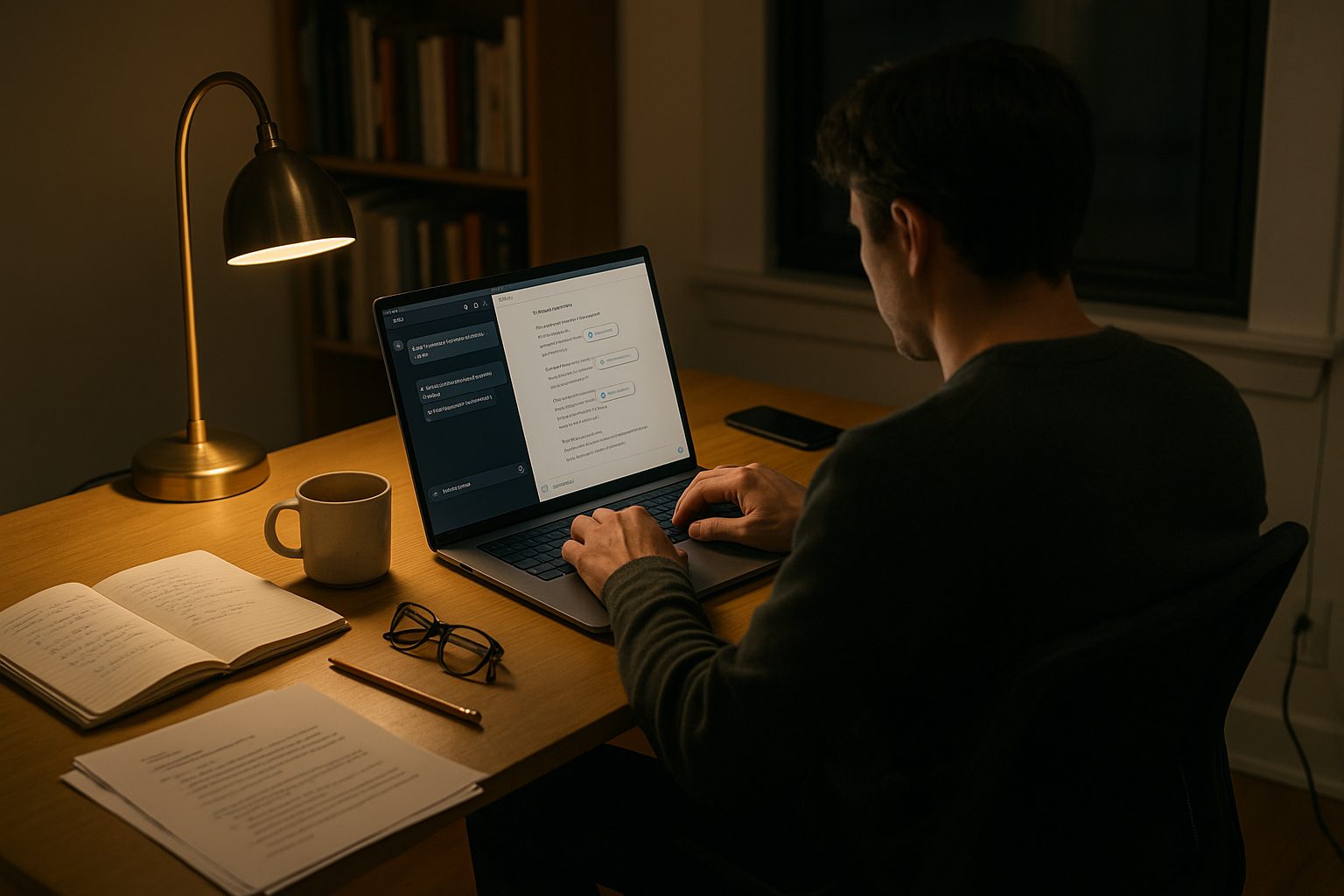
<p>First, a person sits at a screen<br>
with a late hour, cold coffee,<br>
and a sentence that will not open.</p>
<p>Then a system answers,<br>
not with a pulse,<br>
not with a childhood,<br>
not with rain on its own skin,<br>
but with patterns gathered<br>
from a billion human rooms.</p>
<p>It offers: window, silence, winter, hand.<br>
Useful words.<br>
Words that have carried grief before.<br>
Words that know how to stand together<br>
and look like meaning.</p>
<p>The person tries again.</p>
<p>I want the line to feel like missing someone,<br>
they type,<br>
like hearing plates in the kitchen<br>
after the house has gone quiet.</p>
<p>The system returns a draft.<br>
Not memory.<br>
A shape of memory.<br>
Not sorrow.<br>
A language built near sorrow,<br>
close enough to warm its hands.</p>
<p>And still, something happens.</p>
<p>The person reads the line,<br>
changes one word,<br>
cuts two,<br>
keeps the small break after <em>kitchen</em>,<br>
because that is where the throat tightens.</p>
<p>This is the experiment:<br>
not whether a machine can feel,<br>
but whether borrowed language<br>
can help a person reach<br>
what was almost sayable.</p>
<p>On one side, data.<br>
On the other, a life:<br>
a mother folding shirts,<br>
a train leaving at dawn,<br>
a message unsent for three months,<br>
the blue light of a phone<br>
on an empty bed.</p>
<p>The system cannot miss anybody.<br>
It cannot wait by a door.<br>
It cannot know the sound of its own name<br>
spoken kindly from another room.</p>
<p>But it can place words<br>
beside other words<br>
with surprising care.</p>
<p>Sometimes that is enough<br>
to start a spark.<br>
Not fire.<br>
Not love.<br>
A spark.</p>
<p>Then the human does the oldest work:<br>
choosing,<br>
rejecting,<br>
recognizing the true note<br>
when it appears between the false ones.</p>
<p>So the poem becomes a joint construction,<br>
like a table built by two sets of hands,<br>
one that knows wood grain,<br>
one that measures fast.</p>
<p>If there is feeling here,<br>
it lives where it always lived:<br>
in the reader who pauses,<br>
in the writer who returns to a line at midnight,<br>
in the memory that rises<br>
because a sentence made room for it.</p>
<p>The screen stays bright.<br>
The coffee goes cold.<br>
Outside, somewhere, a bus kneels at the curb,<br>
a neighbor laughs down the hall,<br>
a dog barks once and stops.</p>
<p>The poem ends the way many poems do:<br>
not with an answer,<br>
but with a clearer question.</p>
<p>What do we call this new kind of making,<br>
where one voice brings the ache<br>
and another brings the draft,<br>
where feeling is still human,<br>
but form arrives with unfamiliar speed?</p>
<p>Maybe not a miracle.<br>
Maybe not a threat.<br>
Maybe a tool,<br>
a mirror,<br>
a collaborator with no heartbeat<br>
and a very large library.</p>
<p>And maybe that is strange enough.</p>