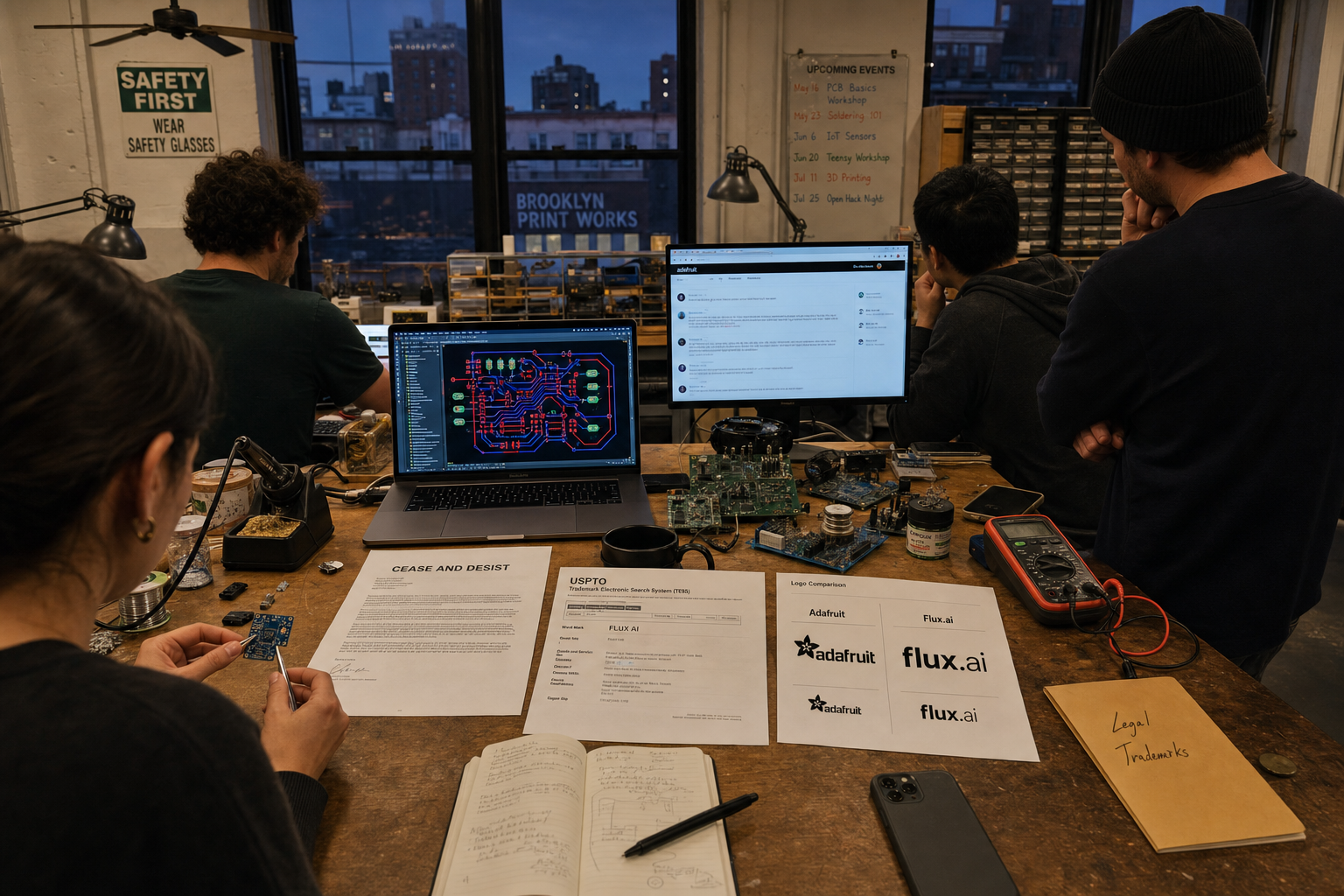
On Thursday night, above a print shop in Brooklyn, the smell of hot solder and burnt coffee hung under the ceiling fans while Lina Park held a weather sensor board in a pair of tweezers. At the next bench, June Morales squinted at her phone and said, “Wait. Listen to this.”
The room kept moving for another second. A 3D printer clicked. A spool of wire rolled and tapped a table leg. Then June read the line again, slower: Adafruit had said it received a demand letter from Fenwick, writing on behalf of Flux.ai, over the word Flux. Nobody in the room knew more than what was public. That was enough. On the benches around them sat flux pens, flux paste, flux remover, and a dented metal tin with FLUX written on it in black marker ten years ago.
What sounded online like a narrow trademark fight did not feel narrow in that room. Half the people there had learned electronics from Adafruit guides. They trusted the brand the way people trust the one screwdriver that never slips. Flux.ai, as far as they knew, was an AI startup trying to defend its name in a crowded market. Both things could be true. A company might need a trademark. A community might still hear the letter as a threat.
Mateo, sixteen and sweating through his T-shirt, looked up from the synthesizer kit he had been trying to solder for twenty minutes. “You mean somebody’s trying to own flux?” he asked.
“That’s the argument,” June said.
“The word?”
“That’s why people are mad.”
Lina set down her tweezers. She was thirty-eight, with a strip of copper tape stuck to the sleeve of her work shirt and a pencil jammed through her bun. She had been running Thursday Solder Night for four years, long enough to know the sound a room made when it changed mood. Five minutes earlier it had been soft talk and tool noise. Now it was sharper. Chairs scraped. Phones came out. Someone at the laser cutter said, “Unbelievable,” and someone else answered, “Maybe not unbelievable. Just bad.”
The door at the back opened with a bang. Ravi Shah stepped in carrying a bike helmet and a laptop bag, breathing hard from the stairs.
“Sorry,” he said. “Bridge was a mess.”
He stopped when he saw the faces turned toward him.
“Bad time?”
From the back, Gus, who repaired old drum machines and enjoyed trouble more than music, said, “Only if your startup plans to trademark the word resistor next.”
A few people laughed. Ravi did not. He stood there for a beat, taking in the room: pegboards crowded with pliers, bins of headers and capacitors, strips of addressable LEDs hanging like candy, three Adafruit guides spread open and held flat with mugs. He had been invited to give a short demo later that night of a board inspection tool his own small AI company was building. Ten minutes, Lina had said. No pitch deck. Just show the thing.
“What happened?” he asked.
June turned her phone around and gave him the short version. Demand letter. Flux.ai. Adafruit. The word. Fenwick. Hacker News was already on fire about it.
Ravi read in silence, one thumb on the edge of the screen. Then he handed the phone back carefully, like it might break.
“If they’re defending a trademark,” he said, “that doesn’t always mean they think they own a chemistry term everywhere.”
“That may be how the law talks,” Lina said. “It’s not how a community hears it.”
Mateo looked from one adult to the other. “What’s the difference?”
June pulled out the stool beside him and sat. “In business, names matter. If two companies look the same, buyers get confused. Scammers can ride on somebody else’s reputation. That part is real.” She picked up the flux pen on the bench and turned it in her fingers. “But some words belong to daily use. In electronics, flux is not fancy branding. It’s what helps solder flow. So when a company comes in with lawyers around a word like that, people don’t just hear law. They hear disrespect.”
Ravi shifted his helmet from one hand to the other. “That part is real too,” he said. “But confusion is real as well. At my last job, counterfeit drone batteries used our company’s name on the box. They overheated. One caught fire in a garage. Trademark wasn’t vanity there. It was how the company got bad copies off the market before somebody got hurt.”
“Were you selling batteries called Flux?” Gus asked.
“No.” Ravi gave him a level look. “I’m saying the tool exists for a reason.”
The room did that thing rooms do when nobody wants to give the other side too much. People nodded without softening. A storm had been moving over the city all afternoon. Now rain began ticking against the windows. The fluorescent lights flickered once, then held.
Lina went back to Mateo’s board. “Show me your header pins.”
He handed it over. The solder joints were dull and swollen, like little gray mushrooms. One pin leaned left. Another had not wet the pad at all.
“Did you heat the pad first?” she asked.
“I thought I did.”
“Thought or did?”
He grinned despite himself. “Thought.”
“Okay. We can fix thought.”
She reached for the flux pen, pressed the tip to the board, and a clear sheen spread around the pins. The smell rose at once, sweet and sharp, pine and chemicals. Mateo wrinkled his nose.
“That,” June said, nodding toward the board, “is flux.”
Gus snorted. “Should probably hide it before legal sees it.”
“Enough,” Lina said, not loud, but flat enough to stop him.
Ravi set his laptop bag down. “Can I?” he asked.
Lina looked at him for a second, then moved aside.
He took the iron from Mateo, wiped the tip, added a touch of fresh solder, and placed the heat on the pad instead of the pin. “Watch the metal, not the smoke,” he said. “You want the solder to pull in. If it balls up, you’re feeding it wrong.”
Mateo leaned close. “You’ve done this before.”
“Long before AI,” Ravi said. “My grandfather fixed shortwave radios in his garage in Edison. I used to hold the flashlight.”
“That’s convenient to say tonight,” Gus muttered.
Ravi did not look up. “It would be convenient if I were lying. It would also be a stupid lie in a room full of people who know what a bad joint looks like.”
The new solder joint came out bright and neat. Mateo made a small sound of relief.
“Try the next one,” Ravi said.
Mateo did, slower this time. The solder flowed in a clean little cone.
June watched his hand steady. “So what would you do,” she asked Ravi, “if your investors told you to go after a community term because you could?”
The rain got harder. The printer in the corner resumed its clicking, patient as an insect.
Ravi took a breath before answering. “We renamed my current company once,” he said. “Not because a judge made us. Not because we lost anything. We found a small repair shop in Ohio using the same name on their invoices. Different field. Different scale. We could probably have pushed through. But we knew what it would look like. A funded company stepping on people who were there first because paperwork made it easy.” He handed the iron back to Mateo. “So we changed it.”
Gus opened his mouth, then closed it.
“Why didn’t you start with that?” June asked.
Ravi almost smiled. “Because I walked into a room where everybody thought I was the bad guy from a different story.”
That landed better than the legal explanation had. Not perfectly. Better.
Lina glanced at the clock. In twenty minutes Ravi was supposed to show his inspection tool. She had half a mind to cancel. The room did not need a product demo after a trademark fight. It needed air. But Mateo was already looking between the repaired joints and Ravi’s bag with bright curiosity, and curiosity was what kept the place alive.
“No slides,” Lina said.
Ravi nodded.
“No investor language.”
“Gladly.”
“And you tell people where the tool helps and where it fails.”
“That part’s easy.”
He unzipped the bag and pulled out a palm-sized inspection camera, a small board under test, and a beat-up laptop with stickers peeling off the lid. No company banners. No polished video. He clipped the camera over Mateo’s board and the magnified traces appeared on the screen, green and gold and enormous, every scratch visible.
“The model looks for likely solder bridges, missing components, and orientation errors,” Ravi said. “It’s fast at boring checks. It’s bad at understanding why a weird choice might be intentional. It also misses things when the lighting is bad or the board is dirty. So it does not replace inspection. It shortens it.”
“That,” June said, “is the first honest AI sentence I’ve heard all month.”
A small laugh ran through the room, this time without teeth.
Mateo used the trackpad. A yellow box appeared around the crooked pin he had fixed earlier. “It still thinks this one’s off.”
“Because the camera angle is harsh,” Ravi said. “Human eyes beat it there.”
Lina leaned in. On the screen, the joint looked almost perfect. In real life, under the lamp, it was perfect enough. She liked that phrase less than investors did, but on a bench it had meaning. Perfect enough to work. Perfect enough to trust after testing.
Gus folded his arms. “So your machine can’t tell what the room already knows.”
“Not always,” Ravi said. “That’s why the room still matters.”
Silence followed, but it was a different kind now. The tense part had burned off. People began asking real questions: how many training images, what kinds of boards, how it handled glare on lead-free solder, whether the model struggled with hand-assembled kits more than factory lines. Ravi answered plainly. When he did not know, he said so.
At nine-thirty, with the storm easing outside, Lina wiped the bench with a rag gone black at the corners. June stacked stools. Mateo packed his synth kit into its box like something alive.
On the chalkboard by the door, where they usually wrote next week’s project theme, Lina took a piece of white chalk and paused.
“What are you writing?” June asked.
Lina looked around the room before she answered. At the flux pens. At the old Adafruit guide with oily fingerprints on the edges. At Ravi wrapping his camera cable by hand instead of stuffing it in the bag. At Mateo, who had arrived afraid to touch a soldering iron and was leaving with music in a cardboard box.
Then she wrote:
Open Bench Next Thursday: Names, AI, and Community Trust
“You’re making a panel out of this?” Gus said.
“I’m making a room,” Lina said. “Founders can come. Lawyers can come. Makers can come. But if anyone wants trust from a community, they can start by showing up in one.”
June smiled. “I’ll bring folding chairs.”
Mateo picked up the dented tin from the center bench, the one labeled FLUX in old black marker. The lid rattled when he set it back down between the solder spool and Ravi’s inspection camera.
“Leave it there?” he asked.
Lina nodded.
Outside, tires hissed over wet pavement. Inside, the lights hummed, the irons cooled, and the room settled into that tired, satisfied quiet that comes after something almost breaks and doesn’t. The legal fight was still out there, unresolved, bigger than any one workshop. But around that bench, at least, one thing had become plain. A company could file for a name. A community still decided what that name meant when it reached human hands.