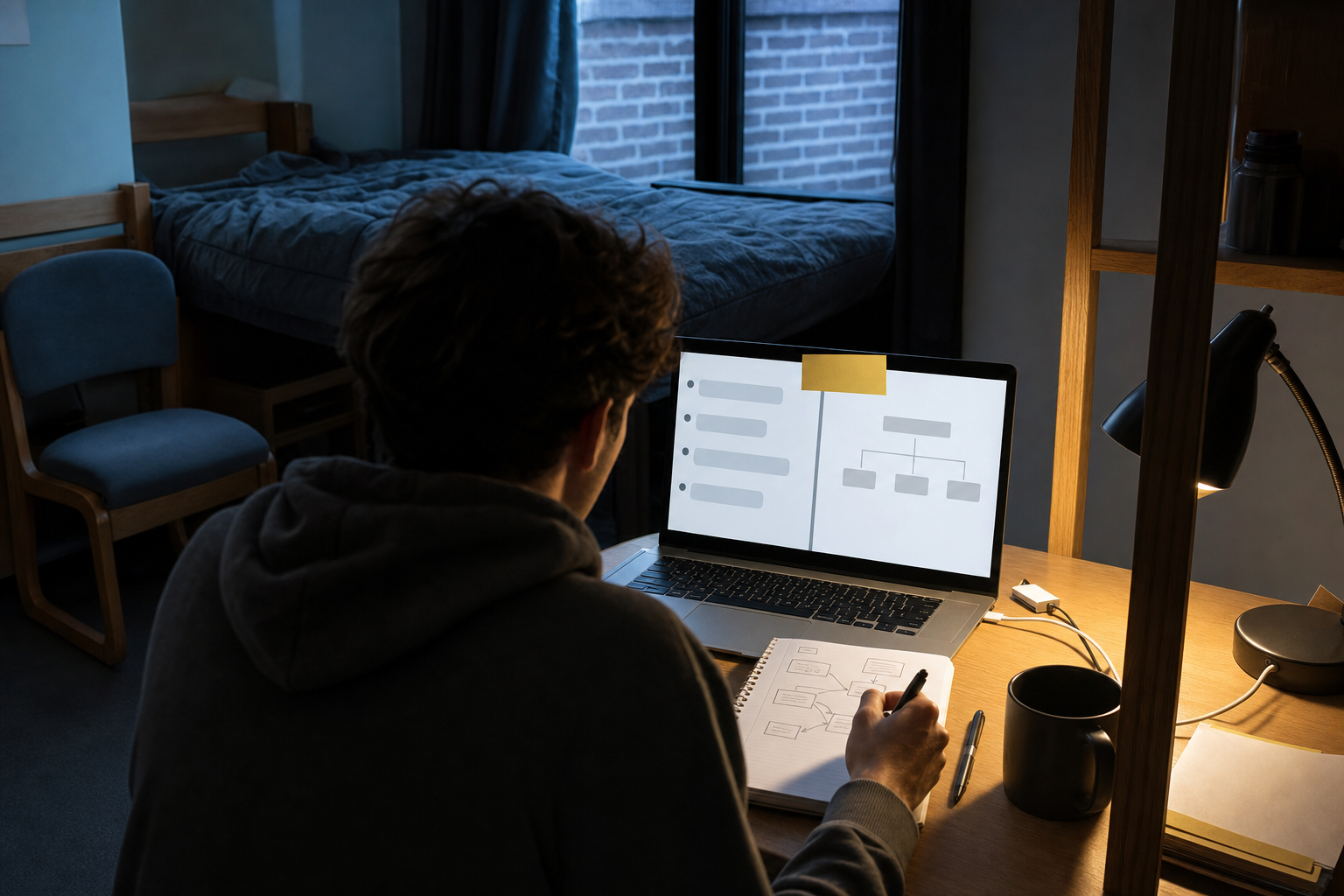
On Monday morning, before the sun reached the brick wall outside our dorm, I stuck a yellow note above my laptop screen. In thick black pen, I wrote: Explain, don’t decide.
Nina, my roommate, was on the top bunk, wrapped in a gray blanket with her hair standing out in all directions. She looked down at me through one half-open eye.
“Is that for a person,” she said, “or for your chatbot?”
“Both,” I said.
Midterms had turned everyone strange. In the dining hall, people ate with one hand and prompted chatbots with the other. In the library, screens glowed with half-written essays, copied summaries, instant flashcards, and suspiciously clean outlines. Every conversation sounded the same.
“It wrote my intro.”
“It fixed my code.”
“It picked my thesis.”
“It did my discussion post in thirty seconds.”
I understood the temptation. I was a second-year student with a statistics quiz on Friday, a history essay due the same day, and a scholarship that did not care whether I was tired. The easier option sat one browser tab away. But I also knew the feeling of submitting something polished that I could not fully defend. It was like wearing someone else’s coat: neat from a distance, wrong as soon as you moved.
So I made myself a rule for one week. I could ask the chatbot to explain. I could ask it to compare, quiz, simplify, challenge, and clarify. But I could not ask it to choose my argument, write my paragraphs, or tell me what I thought.
Monday
My first test came at 7:10 a.m., with coffee that tasted burned and a statistics problem that looked like a personal insult. I was hunched over my desk in socks, working through confidence intervals. The numbers kept slipping around on the page. I erased so often that the paper had gone soft in the middle.
Nina climbed down the ladder and peered over my shoulder.
“Why are you making this hard?” she asked. “Paste it in. It’ll solve it.”
“That’s the thing,” I said. “I don’t want it to solve it.”
“That is exactly what solving tools are for.”
I laughed, but I still turned to the chatbot and typed carefully: Explain confidence intervals in simple steps using this problem. Don’t give me the final answer unless I ask.
The response came back in clean sections. It broke the problem into parts: what the sample mean was doing, why the standard error mattered, what the interval was trying to represent. It showed the logic before the formula. Then it stopped.
That last part mattered more than I expected.
I worked the numbers myself. My pencil moved more slowly, but it moved. I got stuck on one step, asked a narrower question, and tried again. After twenty minutes, the answer on my page matched the answer in the back of the textbook. Not because something had handed it to me, but because the fog had lifted just enough for me to walk through it.
In class later that morning, Professor Shah filled the board with symbols. Usually, once the symbols multiplied, I gave up quietly. This time, when he asked why we used one value and not another, my hand rose before I had time to think better of it.
He nodded at me. “Yes, Salma?”
My voice came out small but steady. “Because we’re estimating the range around the sample result, not pretending the sample is the whole population.”
He tapped the board with the marker. “Exactly.”
It was one sentence. But it felt like finding a stair in the dark with your own foot.
Tuesday
On Tuesday afternoon, the rain came down in thin silver lines, and the library smelled like wet coats and old paper. I took a desk on the third floor by the history shelves and spread out two journal articles, a notebook, and a bag of sour gummies I had promised myself not to open until page twelve.
The essay prompt for Modern Europe was simple enough to sound dangerous: Why did some factory reform movements succeed while others failed?
Simple prompts are where panic enters quietly. There were too many angles. Working conditions. City politics. Church groups. Newspapers. Wages. Timing. I could feel myself reaching for the easy escape: Give me three strong thesis statements.
Instead, I typed: Compare these two articles. What does each author think matters most, and what evidence does each one use?
The answer was useful in the way a whiteboard can be useful. It laid things out. One historian stressed local alliances. Another focused on employer resistance and weak enforcement. Seeing the disagreement side by side did something the articles had not done on first reading. It gave the mess shape.
I closed the laptop.
A boy two tables over was whispering into his phone as if negotiating with a hostage. “No, no, make it sound more human,” he said.
I looked back at my notes and wrote, in my own cramped handwriting: The reform movements that lasted were not simply morally stronger. They were locally organized enough to survive after the headlines moved on.
It was not a perfect thesis. But it was mine.
That evening, in the cafeteria, Nina slid into the seat across from me with a bowl of tomato soup and a face full of triumph.
“I asked my bot to outline my psychology paper,” she said. “Best choice of my week.”
“Did you agree with the outline?” I asked.
She tore a bread roll in half. “I didn’t really think about it.”
“That would bother me.”
“That,” she said, pointing her spoon at me, “is because you enjoy suffering.”
I smiled, but her answer stayed with me. Not because she was lazy. Nina was not lazy. She was overloaded. Everyone was. That was the real danger. Not cheating like a movie villain. Just getting so tired that you stopped noticing when a tool crossed the line from helping you think to replacing the part that mattered.
Wednesday Night
By Wednesday, the experiment was less noble.
My scholarship office had sent a reminder about grade requirements. My mother had called from home to ask if I was eating properly, which is her polite way of asking if I was falling apart. The campus coffee shop had run out of the only tea I liked. And at 11:43 p.m., I was still staring at a blank section of my history essay while the radiator knocked like an irritated neighbor.
Nina was already asleep, one arm over her face. Outside, someone laughed in the hallway and then shushed themselves. My room lamp made a yellow circle on the desk. Everything beyond it looked tired.
I opened the chatbot.
This time, I did type the forbidden version first: Write a 900-word essay arguing that factory reform succeeded when—
I stopped.
The cursor blinked back at me. My throat felt tight, the way it does right before tears or anger.
Then I deleted the sentence and tried again.
Ask me five questions that will help me build my own argument. One at a time. Push back if my answer is weak.
The first question came back: If reform was mainly about moral concern, why did support vary so much from one city to another?
I answered in a few rough lines. The second question pressed harder. The third made me go back to an article I had skimmed too quickly. By the fourth, I had moved from vague ideas to actual claims. By the fifth, I had three body paragraphs mapped out in my notebook.
I still had to write them myself, and that part was slow. Slow in the honest way. I could hear the scratch of my pen, the faint hum of somebody’s mini-fridge, rain ticking against the window. Around 1:20 a.m., I wrote a paragraph that finally sounded like me thinking clearly instead of me hiding behind academic fog.
I leaned back and let out a breath.
From the bunk above, Nina’s sleepy voice floated down.
“Did the robot save your life?”
“No,” I said. “It made me do my homework.”
She made a sound halfway between a laugh and a groan. “Terrible technology.”
Thursday
Thursday afternoon was when I nearly lost faith in the whole idea.
I was polishing the essay in the library basement, where the lights were too bright and the air always smelled faintly of dust and printer toner. I wanted one more supporting detail for a paragraph about small-city reform committees, so I asked the chatbot to help me find a relevant quotation from one of the articles I had already read.
It gave me a sentence in quotation marks, with a page number.
Perfect. Efficient. Exactly what everyone loved about these tools.
I opened the PDF and searched the phrase.
Nothing.
I tried the page number.
Nothing there either.
I sat up straight. The cold from the chair seemed to rise into my back. I searched again, slower this time, then checked the notes I had taken by hand. The quotation did not exist.
Not wrong in a dramatic, obvious way. Wrong in the most annoying possible way. It sounded plausible enough to trust if you were in a hurry.
I shut the laptop and pressed my fingers against my eyes.
At the next table, a student in a red hoodie was copying something from his screen into a document without looking up once. I wondered how many invented quotations were already walking across campus in perfect formatting.
I took my articles and went upstairs to the reference desk.
The librarian on duty, Ms. Alvarez, had silver glasses on a chain and the calm expression of someone who had seen every kind of academic emergency.
“Can I help?” she asked.
I held up the printout. “I think a chatbot made up a citation that sounds real.”
She nodded as if I had told her it might rain.
“Happens,” she said. “Let’s find you a real one.”
For fifteen minutes, she showed me how to trace the argument properly, how to search within related scholarship, how to follow one footnote to another. It took longer than the fake quote had taken. It also worked.
Before I left, she said, “Fast is useful. But if fast sends you in the wrong direction, you pay twice.”
I wrote that down too.
Friday
Friday arrived cold and blue, with the kind of wind that made everybody walk faster between buildings. I printed my essay at 8:15 a.m. The paper came out warm in my hands. There were no ghost quotations in it, no borrowed thesis, no paragraphs I would not know how to defend. It was not the smoothest essay I had ever turned in. A few sentences still bothered me. But when I clipped the pages together, I felt a plain, solid kind of relief.
The statistics quiz came next.
Professor Shah handed out the papers face down. Someone behind me tapped a pencil in quick bursts. Across the aisle, Nina gave me a look that said if this kills me, tell my family I fought bravely.
When I turned the quiz over, my stomach dropped for half a second. The first question was not like the homework examples. Same idea, different shape. The numbers were arranged differently. There was no obvious path if all you had memorized was the pattern.
I heard my own breathing. Then, slowly, I heard Monday morning in my head: sample, uncertainty, range. Not the exact answer. The logic.
I started writing.
After class, students spilled into the hallway with that mix of relief and self-accusation that follows any exam.
“I knew the formula,” Nina said, dragging a hand over her face. “But then they changed the setup and I froze.” She looked at me. “How were you so calm?”
“I wasn’t calm,” I said. “I just understood what the formula was doing.”
She stared at me for a second. “That is an annoyingly healthy sentence.”
I laughed so hard I had to lean against the wall.
In the afternoon seminar, Professor Delaney returned our history essays after brief presentations. My pages came back with blue notes in the margins and one comment at the end: Clear argument. You follow your own reasoning well.
It was not dramatic praise. It was better than that.
When discussion opened, he looked toward me. “Salma, you argue that local structure mattered more than moral energy alone. Why?”
For one terrible second, the room went silent.
Then I answered.
I talked about weak enforcement, local alliances, and why a movement can attract attention without building staying power. I pointed to the articles, then to the gap between them. My voice shook once, then settled. Across the room, Nina lifted her eyebrows as if to say, Look at you.
After class, we stepped out into the sharp evening air. Leaves scraped across the path. Somewhere near the student center, a marching band was practicing badly.
Nina bumped my shoulder with hers. “So,” she said, “what’s the final result of your extremely nerdy experiment?”
I thought about the week: the easier prompts I had not sent, the fake citation, the better question at midnight, the quiz I could actually solve, the essay I could actually explain.
“I think the trick,” I said, “is to ask for light, not legs.”
She looked at me sideways. “That was almost poetic.”
“Don’t tell anyone.”
Back in the dorm, I peeled the yellow note off my laptop. It left a pale square on the lid where the dust had not touched. For a second I held the note between my fingers, soft from a week of being there.
Then I turned it over and wrote a new line on the back.
Explain first. Decide last.
I stuck it up again before I could forget.