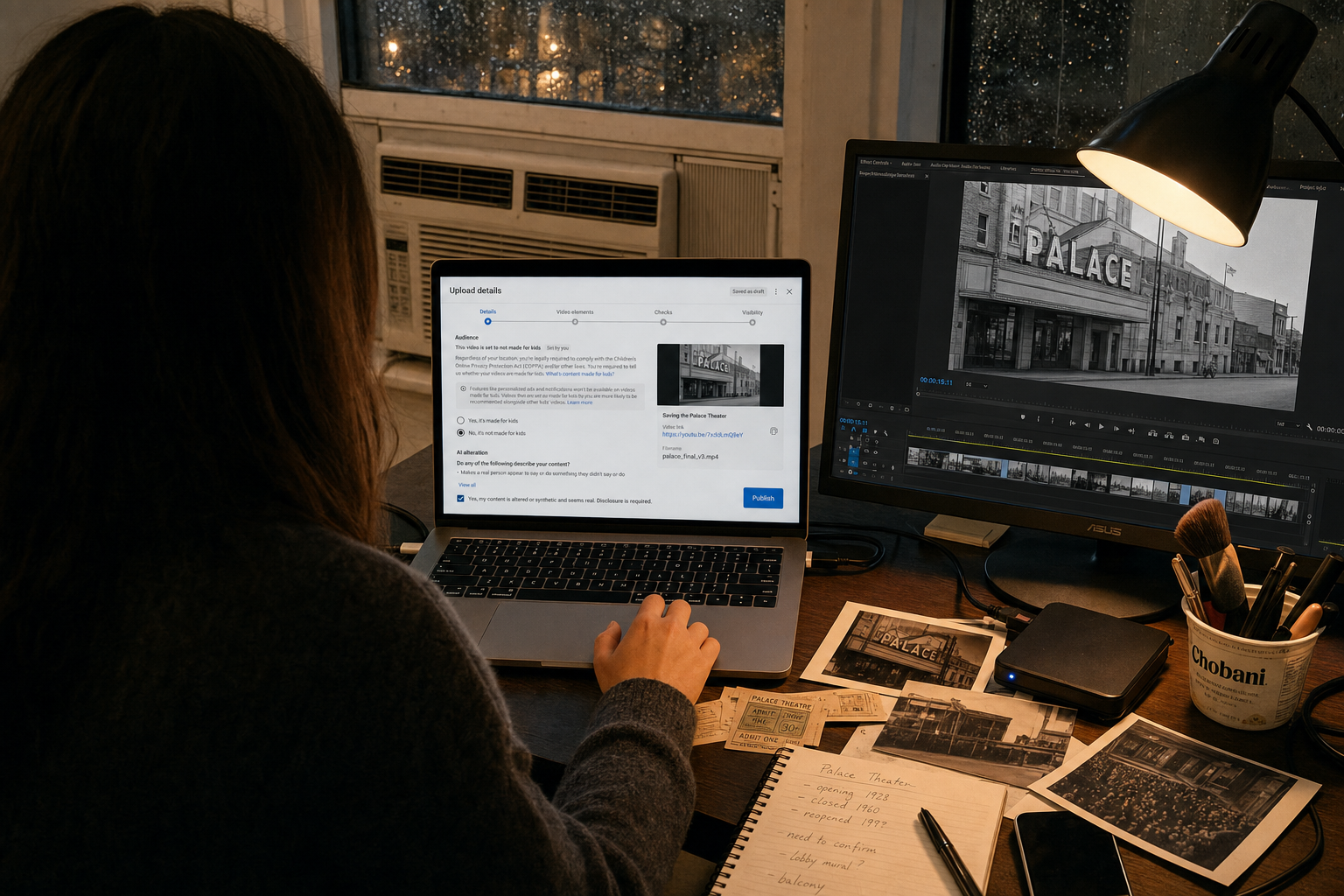
At 11:46 on a wet Thursday night, Salma hovered over the disclosure box beneath her new upload and read the sentence until the letters blurred: This video contains altered or synthetic content.
Her channel had grown on a simple promise. If she said a building had stood on a corner in 1952, she showed the records. If she narrated a lost cinema, she used archive photos, interviews, ticket stubs, whatever she could find. Now she was about to publish a fourteen-minute video about Al-Nasr Cinema, and eighteen seconds of it were rebuilt with AI because the real footage no longer existed. The box did not ask how much. It did not ask why.
Rain ticked against the air conditioner outside her window. On her desk sat an empty yogurt cup with two makeup brushes in it, a notebook swollen with old tram maps, and a mug of coffee gone cold enough to smell metallic. The upload bar glowed blue. Ninety-eight percent.
Her phone buzzed across the desk.
“Did you check it?” Hadi asked the moment she answered.
She kept her eyes on the screen. “I’m still deciding.”
He let out a tired laugh. “You’ve been deciding for three hours.”
“It’s eighteen seconds.”
“Then say it’s eighteen seconds.”
“The label doesn’t say eighteen seconds. It says synthetic content. People will think the whole thing is fake.”
Hadi was quiet for a beat. In the background she heard plates clink, a television, somebody asking if he wanted tea. “And if you don’t label it?” he said.
Salma looked at the export file on her desktop: LAST SHOW FINAL FINAL 4. “Then someone freezes those frames, posts them somewhere, and says I lied.”
“Yes.”
“That’s not advice.”
“No,” he said. “That’s the problem.”
She ended the call and pressed her palms against her jeans.
The eighteen seconds had taken three nights. She had fed the software scans of newspaper ads, a floor plan from a municipal archive, and three crooked photographs from a retired projectionist’s daughter. The first results gave the cinema red velvet walls it had never had. The second invented chandeliers like a wedding hall. One version put English neon over the ticket booth. She had thrown them all out and kept correcting, frame by frame, until the lobby looked close to the Al-Nasr she had pieced together from documents and memory.
Still, when she watched those reconstructed shots in the timeline, she felt the same catch in her throat. They were useful. They were careful. They were also not the original thing.
The upload finished. The video thumbnail appeared: the old cinema facade in dusk light, her title in white letters. Below it, the small square waited.
Salma clicked it.
For a second nothing happened. Then the tick appeared, neat and final.
She scheduled the premiere for Friday at eight, shut the laptop, and sat in the dark long enough for the room to lose its shape.
The next evening, the city was loud in the way only Friday evenings could be. Car horns pressed up from the street. Someone below argued over the price of mangoes. The smell of frying onions drifted in from a neighbor’s kitchen and made her stomach turn, because she had not eaten since noon.
At 7:58, she opened the premiere page. Her subscriber count sat at 62,403. The chat was already moving.
“Been waiting all week for this.”
“My grandmother used to talk about this cinema!”
“Salma, please do a video on the old tram stations next.”
She smiled despite herself. This was the part she knew. The small burst of people arriving together. The shared countdown. The quick little greetings from Jordan, Alexandria, Manchester, São Paulo. Her audience was not huge by platform standards, but it was loyal, and she knew many of the names the way a cafe owner knows regular faces.
The countdown hit zero. Her intro music started. She watched her own hands on screen pushing open a rusted side gate, dust lifting in the flashlight beam. In chat, people typed hearts and lantern emojis and old-film cameras.
Then the label appeared under the title.
It was only one line, smaller than the description, but she could feel the room change.
“Wait. Why is there an AI label?”
“Which part is synthetic?”
“Come on. Not you too.”
“Thanks for disclosing.”
“Is any of this real footage?”
Salma sat forward until her knees touched the desk. The fan inside her laptop whined harder. She could hear her own breathing.
At 6:12, the first reconstructed shot arrived: the cinema lobby restored in warm amber light, ticket booth glass clean, brass railings polished, dust gone. It lasted four seconds. Then came a second shot of the balcony. Then the projector beam sweeping through cigarette smoke that no longer existed outside old stories.
The chat sped up so quickly she had to scroll back.
“Those rebuilt shots are beautiful.”
“Beautiful is not the issue.”
“If you didn’t say this in the video, that’s misleading.”
“She literally labeled it.”
“Label where? I almost missed it.”
Her channel dashboard refreshed in the side panel.
-12 subscribers.
Then -19.
Then -27.
It was not a disaster. People unsubscribed every time she posted something that was not the exact building they wanted. Still, the red numbers landed like taps to the sternum.
A username she knew well appeared in the comments below the player. OldTape79. He had been around since her third video, when she filmed a decaying train depot with a borrowed microphone and wind tearing the audio apart.
“I came here because you showed real things. If I wanted generated scenes, I could get them anywhere.”
She stared at that comment until the letters doubled.
From the kitchen, her younger brother Youssef leaned around the door with a plate of bread in one hand. “How bad?” he asked.
She gave a short laugh that sounded nothing like laughter. “Do you want the dramatic version or the analytics version?”
“The honest version.”
She looked back at the screen. “They think I tried to sneak something past them.”
He came in and set the plate down, pushing aside a stack of printouts. “Did you?”
“No.”
“Then tell them what you did.”
“I did. I checked the label.”
Youssef glanced at the chat, where two strangers were now arguing about whether documentaries were dead. “That label says nothing. It’s like putting ‘contains nuts’ on a five-course meal and walking away.”
Despite everything, she snorted. “That’s stupid.”
“Yes,” he said. “Also correct.”
The video kept playing. Her voice, calm and measured, filled the room from the laptop speakers. On screen, she held up a torn ticket stub under archive-room light and explained how the cinema had closed after a fire code ruling in 1993. Off screen, her hands shook so badly she missed the keys twice.
She opened the comment box to write a reply. Her first sentence came out defensive. She deleted it. The second sounded legal. She deleted that too. Finally she wrote what she wished the platform box had let her say in the first place.
“For clarity: only three short shots in this video are AI-assisted reconstructions, at 6:12, 6:18, and 6:27. They were built from archive photos, a floor plan, and interview notes because no footage of the original interior survives. Everything else is filmed by me or taken from identified archival sources. I labeled the whole video because the platform requires that when any realistic synthetic material is used. If you dislike the reconstructions, I understand. I’m telling you exactly where they are because I don’t want you guessing.”
She pinned it.
Nothing changed for ten seconds.
Then the replies started.
“This is the context I needed. Thank you.”
“Still don’t like it, but I appreciate the timestamps.”
“Could you put text on screen next time for reconstructed shots?”
“Fair enough.”
“I thought the whole video was AI. The platform should show details like this.”
The argument did not vanish. One person called her a fraud. Another said she was overexplaining. A third wrote that any synthetic image poisoned history, full stop. But the temperature dropped. People began talking to her instead of about her.
At 8:21, a new comment appeared from a user named Leila M. Salma knew the name. Leila was the daughter of the projectionist who had let her scan three surviving photos in a flat that smelled of talcum powder and old paper.
“My father would have recognized the lobby railings immediately. You got them right. I’m glad you labeled the recreated parts because memory is fragile. I’m also glad you tried to show younger people what this place looked like. Both things can be true.”
Salma read it twice, then once more out loud. Youssef, tearing bread into pieces without eating it, nodded like he had expected nothing less.
By the time the premiere ended, she had lost eighty-three subscribers.
She had also gained two hundred and forty comments, most of them now discussing a real question: not whether she had hidden the AI shots, but how creators should mark rebuilt scenes so viewers can judge them properly. Several people asked for a behind-the-scenes video. One viewer said they preferred still photographs to generated reconstructions. Another said the recreated shots helped them understand the building’s layout for the first time.
At 11:03, when the street finally quieted and the apartment walls stopped carrying other people’s televisions, Salma recorded a follow-up on her phone. No music. No color grade. Just her at the desk with the archive printouts spread beside her.
“I want to show you exactly what I used,” she said into the lens. “And exactly what I changed.”
She filmed the newspaper clipping with the corner burned off. The penciled floor plan. The rejected outputs with the wrong balcony, the wrong lights, the wrong decade. She circled the details she had corrected and the places she still felt unsure. When she finished, she did not look polished. She looked tired, and very much like a person who had done the work with her own hands.
The next morning, OldTape79 replied to her pinned comment.
“I still don’t want too much of this on the channel. But you told us where it was, and that matters. I’m still here.”
She let out a breath she had been holding since Thursday night.
It was not a perfect ending. The platform label was still blunt. The debate in her comments was still messy. Some viewers would always hear “AI” and close the door. Others would want more of it than she was willing to use.
But the fear that had sat in her chest for two days had changed shape. It was smaller now, and more useful. The real risk had not been the label itself. It had been letting the label do all the talking.
That afternoon, she opened the project file for her next video. Before importing the first clip, she added a text layer to the top of the timeline and typed four words in plain white letters:
Reconstructed from archival sources.
Then she saved the file, stuck a note to the edge of her monitor, and wrote one line on it in blue ink: Be exact.