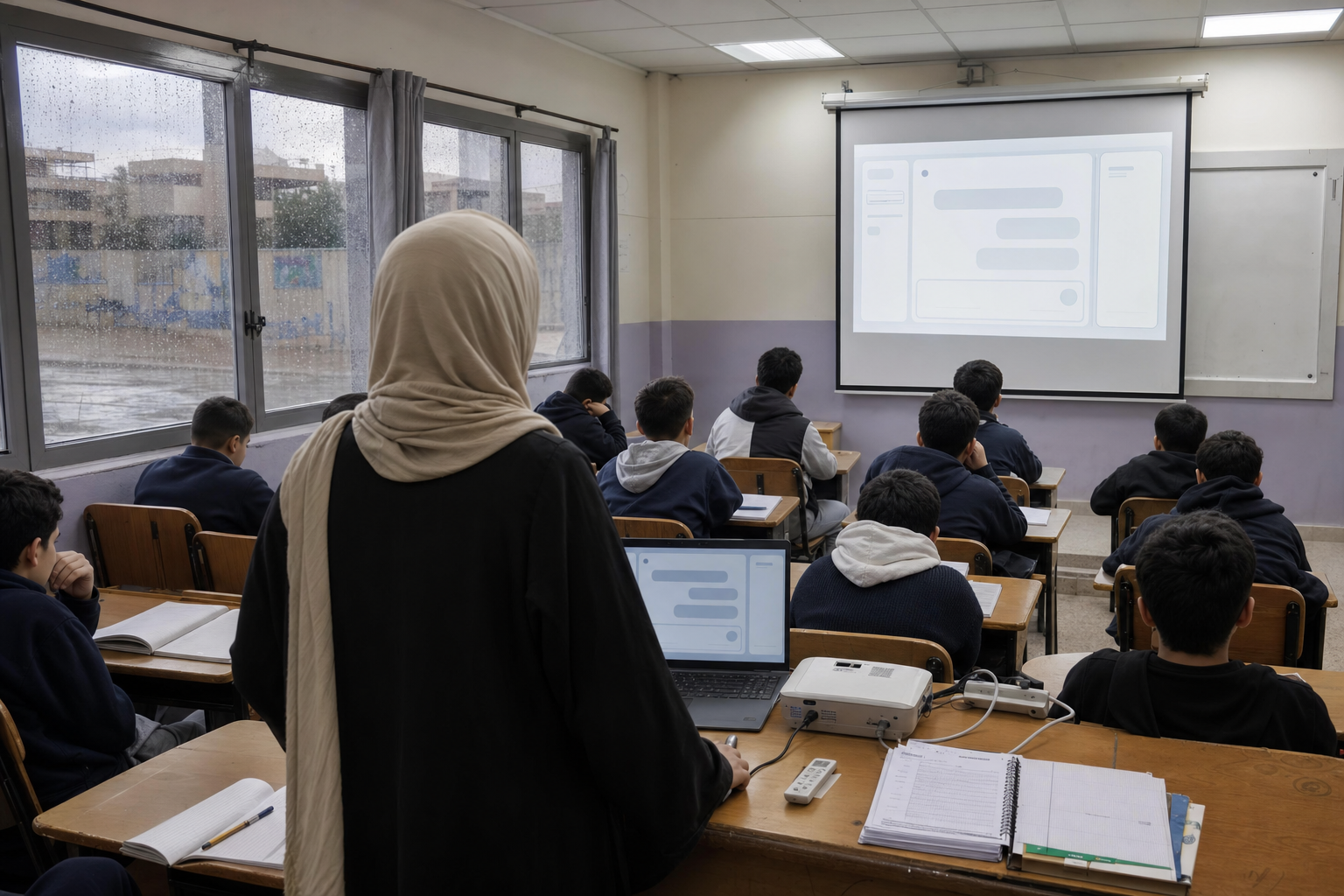
On Sunday morning, rain dotted the classroom windows and turned the courtyard dust dark. Ms. Rania wheeled in a borrowed laptop and a small projector, set them beside the box of blue markers, and told Class 8-B they would spend one week with an AI teaching assistant.
The room woke up at once. Chairs scraped. Someone in the back whistled. Hamza, who treated every new rule as a personal challenge, raised his hand without waiting to be called.
“Can it take attendance too?” he asked.
“If it could,” Ms. Rania said, plugging in the cable, “I would go home now.”
The class laughed. Even Salma smiled, though only for a second. She sat by the window, thin fingers tucked around her pen, her notebook already open to a blank page.
The projector threw a pale square of light onto the green board. Arabic text appeared, neat and bright. Ms. Rania could feel the shift in the room. Usually the first ten minutes of the day belonged to yawns, missing books, and side conversations about football. Today every face pointed forward.
She wrote three rules in thick blue marker. “These stay all week,” she said.
Ask the tool. Check the answer. Rewrite in your own words.
“It can help us practice,” she said. “It can give examples. It can explain a rule in a different way. But it does not hand in homework. It does not replace your thinking. And if it makes a mistake, we catch it.”
Mariam, who sat in the front row and sharpened three pencils before every class, folded her arms. “In Arabic too?” she asked. “Not just English?”
“In Arabic too,” said Ms. Rania.
She typed the first prompt herself: “Give us three simple sentences using the verb kataba in the past, present, and command forms.”
The answer came fast. The students leaned in as if they were watching a goal replay on a phone screen. Past. Present. Command. Clean examples. Then Hamza called out, “Ask it for a hard one.”
So she did. She asked for five sentences that mixed singular, dual, and plural forms. Then she asked for a short explanation of when to use a comma and when not to. Then she asked it to add vowel marks to a sentence from their reading passage. Each time, the answer appeared before the room had time to get bored.
For the first time all month, even the boys near the back were arguing about grammar.
On Monday, Ms. Rania gave them a writing task: describe your street in six lines of clear Arabic. Not a poem, she warned. Not a list. A real description.
Groans rose from half the room. Writing was where the class usually thinned out. The strong students raced ahead. The others stared at the ceiling, chewed pen caps, or copied the first sentence from the textbook and hoped for mercy.
Salma held her pen over the page and did nothing.
Ms. Rania saw it from across the room. She also saw the way Salma looked at other students’ notebooks, not to cheat, but to borrow courage.
She crouched beside her desk. “What do you see when you leave home in the morning?” she asked softly.
Salma shrugged. “The bakery. The old man with pigeons. The water truck.”
“Good. Ask for help starting, not for a full paragraph.”
Salma hesitated, then typed with one finger: “Give me three simple openings for a description of my street in standard Arabic.”
The tool offered three lines. They were decent, but flat. Ms. Rania watched Salma read them, frown, and then cross one out on the screen with her finger though she knew it would not leave a mark. Finally she bent to her notebook and wrote her own version:
“Every morning our street wakes before the sun, when the bakery opens and the smell of bread reaches our window.”
It was not perfect. She forgot a comma. She repeated one word later. But the line was hers.
By the end of the period, the room sounded different. Not louder. Fuller. Students still asked for help, but their questions were more precise.
“Give me another word for crowded.”
“Explain the difference between two similar verbs.”
“Check this sentence for punctuation, not spelling.”
Instead of answering the same small question fifteen times, Ms. Rania moved from desk to desk and asked better ones.
“Why did you choose this detail?”
“Can you make this sentence more specific?”
“Do you mean noise, or do you mean movement?”
On Tuesday, she pushed the experiment further. She asked each student to write one grammar problem they still did not understand on a scrap of paper. By second period she had a pile in her hand: feminine plural, broken plurals, punctuation, weak verbs, how to connect ideas without repeating “and” six times in one paragraph.
She fed the questions into the assistant in batches and got practice drills tailored to the class in minutes.
Yousef, who usually sank lower in his chair whenever reading time came, used the tool to add vowel marks to a sentence from the textbook and then read it aloud, slowly but without stopping. Hamza asked for five extra punctuation exercises after he discovered he enjoyed catching the tool’s suggestions and improving them. Mariam challenged it with a question about why one form sounded formal and another sounded natural in a school essay. For once, the bright students were not waiting around while the rest tried to catch up. Everyone had something exact to work on.
By midday the radiator had made the room too warm. The windows fogged at the corners. The smell of damp coats mixed with dry-erase ink and the thyme from someone’s sandwich box. Ms. Rania stood for a moment at the back and watched thirty-two students bent over real work. She had not seen this kind of concentration since exam week, and this was better than exam week. Nobody was frozen with fear.
Then Wednesday came.
“Today,” she said, “you will write about a family memory. Something small. A kitchen. A visit. A trip. One moment you can still see.”
That was when Salma began to write quickly, almost before the instructions were finished. Her pen moved in short, sure strokes. She wrote about her grandmother in Jerash, about summer afternoons, about flatbread swelling over heat, about being called in from the yard before dark.
Halfway through, she asked the tool to check her paragraph for spelling.
The screen filled with suggestions.
Replace sitti with “my grandmother.”
Replace hakoura with “garden.”
Replace a spoken phrase with a more standard verb.
Replace another with a formal connector.
The more it corrected, the less the paragraph sounded like her.
Salma stared at the screen. The color drained from her face. “Miss,” she said, and her voice was so small that only the front row heard it at first. “It says almost all of it is wrong.”
A few students turned. Hamza leaned sideways to look at her screen. “It made it sound like a textbook,” he said.
One boy laughed. Not cruelly. Just quickly, the way children laugh when they smell trouble and are glad it is not theirs.
Salma closed the laptop halfway. “Forget it,” she said.
Ms. Rania crossed the room at once. “Open it again,” she said gently.
Salma shook her head.
“Please.”
After a moment, Salma lifted the screen.
Ms. Rania read the paragraph, then asked, “May I show one sentence to the class?”
Salma pressed her lips together, then nodded.
On the board appeared the line that had been most heavily corrected: a simple sentence about sitti calling from the hakoura while the smell of bread rose into the afternoon heat.
Next to it, the assistant’s version appeared in polished standard Arabic.
“Which one is clearer?” Ms. Rania asked.
Mariam answered first. “The second one is more formal.”
“And which one feels like a real place?”
The room went quiet.
Then Hamza, of all people, said, “The first one.”
Mariam looked back at the board. “The meaning stayed,” she said slowly, “but the house disappeared.”
Something in Salma’s face changed. She looked up.
Ms. Rania nodded. “Good. Listen carefully. School Arabic has rules. We respect those rules. But the language you hear at home carries people, places, and memory. The tool is useful when it helps you see the difference. It is not the judge of your life.”
She turned back to the screen and typed a new prompt: “Convert this sentence into standard Arabic while keeping the image and local meaning.”
The new version was better. Not perfect, but better. It kept the grandmother. It kept the yard. It kept the bread.
“Now,” Ms. Rania said, “we have two jobs as writers. We learn formal Arabic well. And we protect what only we can say.”
No one laughed after that.
Later that same day, another problem arrived from a different direction. Hamza handed in a paragraph so smooth it practically shone. The verbs were elegant. The transitions were flawless. The tone sounded like a tired newspaper editorial from someone twice Ms. Rania’s age.
She read it once and looked up. “Hamza,” she said, “what does this phrase mean?”
He blinked. “Which one?”
She pointed.
He scratched his eyebrow. “It means... good writing?”
The class snorted.
Ms. Rania did not smile. She slid the paper back to him. “This is neat,” she said. “It is also not yours. Write it again. You may ask the tool for ideas, examples, or corrections. Not for a finished paragraph.”
He flushed red clear to his ears. “My brother said everyone will do this soon.”
“Maybe,” she said. “Then everyone will need teachers who can tell the difference.”
On Thursday, the last day of the school week, she changed the assignment one more time.
“Today you will hand in two things with your paragraph,” she said. “Your writing, and a note saying exactly how you used the assistant.”
She drew a line down the board.
On one side she wrote: “Allowed: examples, explanations, punctuation, spelling, alternate words.”
On the other side: “Not allowed: full paragraphs, hidden copying, fake understanding.”
There was some muttering at the phrase “fake understanding,” but less than she expected.
The room settled. Keys clicked. Pens moved. Outside, boys from another class shouted during break, and a football hit the courtyard wall with a hard rubber thump. Inside, the work felt careful now. Not dazzled. Not suspicious. Just careful.
Salma wrote two versions of her opening line. One kept sitti and hakoura. The other translated them into formal school Arabic. She used the assistant only to fix punctuation and suggest a stronger verb in the third sentence. When she finished, she lifted her hand before she could change her mind.
“Can I read?” she asked.
Ms. Rania nodded.
Salma stood with both pages shaking slightly in her hands. “First the version I would say at home,” she said.
She read about her grandmother’s wrists white with flour, about the low wall warm under the sun, about a call from the yard that meant bread was ready and evening was near. Her voice was soft, but the room did not strain against it. The room leaned toward it.
Then she read the formal version. It was correct. It was graceful. It was ready for school.
When she finished, Hamza lifted a hand.
“The first one made me smell it,” he said.
A few students laughed, but kindly this time.
“The second one is still good,” Mariam added. “But now I know what changed.”
Ms. Rania took both pages. On the corner of the formal version, the assistant had helped fix two commas and one repeated word. That was all. The memory itself had come from somewhere no software could reach.
The bell rang. Books snapped shut. The corridor filled at once with footsteps, rain-damp air, and the smell of za’atar from lunch bags being opened too late.
As Ms. Rania closed the laptop, Hamza lingered by her desk. “Miss,” he said, “are we keeping it next week?”
She looked at the dark screen, then at the notebooks piled in her arms.
“Maybe,” she said. “But only if you remember what it is for.”
“Which is?” he asked.
She tapped his paper with one finger. “To help you ask better questions. Not to save you from writing.”
He grinned. “That sounds harder.”
“It is harder,” she said.
Salma passed by on her way out. The two versions of her paragraph were folded neatly inside her notebook, one behind the other. She touched the edge of the cover as if making sure they were still there, then stepped into the corridor a little straighter than she had walked in on Sunday.
Behind her, on the board, the last rule of the week remained in blue marker:
Use the tool. Keep your voice.