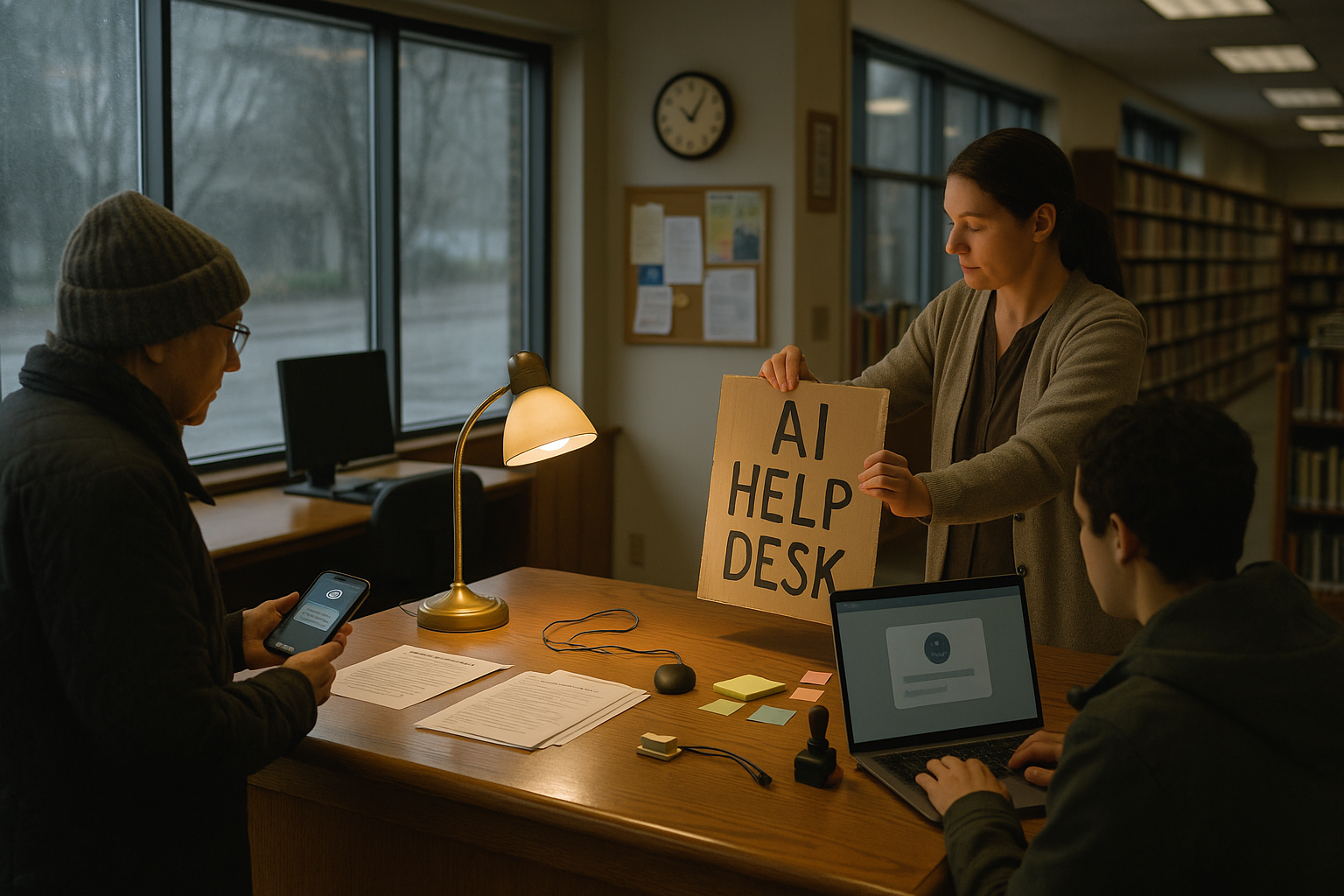
On a wet Tuesday in November, Farah unlocked the public library on Khalifa Street and found a cardboard sign leaning against her desk. AI HELP DESK, it said in thick blue marker. Someone from the municipality had underlined help three times. The smell of floor polish still hung in the lobby. Rain tapped the high windows. Farah stood there with her keys in one hand and the sign in the other and thought, with a dull kind of anger, that the future had arrived in cardboard.
The city had launched the desk after a month of rumors and small panics. A shipping company at the port had cut staff after installing new planning software. Teachers were complaining that students were turning in glossy, empty essays. Older residents were using translation apps to speak to children and grandchildren abroad. People wanted faster answers, better jobs, easier access. They were also afraid of being replaced, fooled, or left behind. Farah, who had spent fifteen years helping people find reliable information, had not been asked what she thought.
She carried the sign to a table near the biography shelves, set out one library laptop, and wiped a ring of dried coffee off the mousepad with the edge of her sleeve. Outside, buses hissed at the curb. Inside, the radiator clicked like an impatient tongue.
The first person through the door was Adnan.
He was in his early fifties, with a rain-dark jacket and hands that looked made for crates and ropes, not keyboards. He held a brown envelope swollen with papers. When he sat, the chair let out a small squeal.
"My nephew says this thing can make me sound modern," he said, tapping the laptop.
"What do you need?" Farah asked.
He opened the envelope. Rejection emails, printed one by one. An old CV with coffee stains. A faded work ID from the port.
"Twenty-three years in dispatch," he said. "Then the company bought a new system. Fewer mistakes, they said. Faster routes. Half the office gone by Friday." He gave a short laugh that had no humor in it. "Now every job post asks for analytics, optimization, digital workflow. I moved trucks and solved problems. I did not optimize anything."
Farah typed in a few lines from his old CV and watched the tool produce a fresh, neat paragraph in three seconds.
"Dynamic logistics leader with extensive expertise in global supply chain transformation, predictive analytics, and cross-border systems integration."
Adnan leaned closer. "That sounds expensive."
"It also sounds false," Farah said.
He rubbed his jaw. "False gets interviews."
Farah looked at him over the top of the screen. "False also gets found out."
For a moment he said nothing. Rainwater slid from the hem of his jacket onto the tile.
"Write this," he said at last. "I handled delays when the roads flooded. I kept drivers from shouting at each other. I knew which warehouse manager was lying before he opened his mouth. I could look at six bad options and choose the least bad one in two minutes."
Farah began again. This time she used the tool like a clerk, not an author. She fed it his real experience and asked for clearer wording, shorter lines, stronger verbs. They kept some suggestions and threw others away. When the machine said he had "led digital transformation initiatives," Adnan snorted.
"Delete that," he said. "I once unplugged a frozen monitor and plugged it back in. That is the full extent of my transformation."
Farah smiled despite herself.
By the time they had a clean first page, a second chair scraped behind them.
A girl in a navy school uniform dropped her backpack to the floor. Her hair was still damp from the rain. She looked sixteen or seventeen, sharp-eyed and tired.
"Is this where you fix essays?" she asked.
"If they need fixing," Farah said.
The girl sat without being invited. "My name is Hiba. My teacher says she can tell when we use AI because the writing goes dead. But when I write by myself, it sounds small. I need a personal statement for a scholarship. Due tonight."
"What is it about?"
"A person who shaped me." Hiba rolled her eyes. "Which is supposed to be moving. Apparently."
Farah turned the laptop toward her. "Who did shape you?"
Hiba picked at a loose thread on her sleeve. "My grandfather. He sold fruit from a cart. He couldn't read well, but he could add numbers faster than any calculator. He used to wake me before dawn in the summer and take me to the market. That's not scholarship material, though."
"Why not?" Adnan said from the next chair. "Sounds like work to me."
Hiba glanced at him, surprised.
Farah typed a plain prompt and the tool offered a smooth paragraph full of empty polish.
"My grandfather taught me resilience, perseverance, and the importance of education in overcoming adversity."
Hiba made a face. "That is exactly what I mean. It sounds like the side of a cereal box."
"Then don't let it write the heart of it," Farah said. "You tell the heart. Let it help with the frame."
Hiba folded her arms. "How?"
Farah leaned back. "Close your eyes. What did the market smell like?"
"Diesel," Hiba said at once. "And bruised peaches. And mint when the herb man cut the strings."
"What did your grandfather's hands look like?"
"His thumbs were cracked in winter. He counted coins with black crescents under his nails."
Farah slid a notepad toward her. "Write that first. Don't look at the screen yet."
While Hiba bent over the paper, the library door opened again.
This time it was Mrs. Sawsan, wrapped in a plum-colored coat, carrying a plastic food container under one arm and a smartphone in her hand. She smelled faintly of soap and cinnamon.
"I brought ka'ak," she announced, as if that settled any argument about whether she belonged there. "And I need help with the internet grandson."
"Video call?" Farah asked.
"No, no. The other thing. The clever thing. He says I should put my recipes online. 'Teta,' he says, 'people will pay for authentic homemade food.' As if I have been waiting seventy years for Toronto to approve my stuffed vine leaves."
Adnan gave a small cough that might have been a laugh.
Sawsan sat and pushed the container onto the table. Warm sesame and anise rose into the air. Even the library seemed less stiff.
"He made me one page already," she said, squinting at her phone. "But the translation is wrong. It says to boil the rice for twenty minutes. Twenty minutes! Then feed it to pigeons."
Hiba looked up from her notebook. "Can I see?"
Sawsan handed her the phone. Hiba read, blinked, and grinned. "It also says, 'Fold each leaf with algorithmic consistency.'"
"Exactly," Sawsan said, triumphant. "Who talks like that in a kitchen?"
For the next half hour, the table by the biography shelves stopped feeling like a service desk and began to feel like a stubborn little workshop. The radiator ticked. The printer hummed. Wet umbrellas dripped by the door.
Farah helped Adnan turn job duties into clear, honest bullet points. Hiba drafted three sharp paragraphs about the market, her grandfather, and numbers scratched on cardboard with a carpenter's pencil. Sawsan dictated recipe notes in Arabic while the tool offered English versions that were almost right and sometimes very wrong.
"Not 'grape paper,'" Sawsan said, stabbing the screen with one finger. "Leaf. Leaf. If it cannot tell the difference, it should stay out of the pot."
Then the real trouble came.
Adnan had found a warehouse supervisor job posted that afternoon. The application closed at midnight. He clicked through the form with his shoulders slowly tightening. Name. Phone number. Experience. Certifications.
The tool, asked to help fill gaps, suggested a line under training:
"Certified in advanced inventory forecasting systems."
Adnan stared at it.
"Are you?" Farah asked.
"No."
"Then delete it."
He did not move. The cursor blinked at the end of the sentence like a tiny impatient light. "How many people leave it in?" he asked quietly.
No one answered.
Beyond the window, a bus roared away from the curb. Somewhere in the children's section, a radiator pipe knocked inside the wall.
"Maybe that's the game now," Adnan said. "Maybe everyone shines themselves up until nobody knows what is true."
Hiba set down her pen. "If they ask you about it in an interview, what will you say?"
"That I learn fast."
"Do you?"
He gave her a tired look. "I came here, didn't I?"
Sawsan took off her glasses and polished them with the edge of her scarf. "A recipe with one wrong spoon can ruin the whole pot," she said. "A person is not easier than a recipe."
Adnan breathed out through his nose. The fight seemed to leave him all at once.
"I hate this," he said.
"I know," Farah said.
She did know. Not the layoff. Not the online forms. But the feeling underneath. The sense that the floor had shifted while you were still standing on it. That the old way you proved your worth no longer fit inside the new boxes.
She reached for the mouse. "Let's do something better."
Together, they rewrote the line. No fake certificate. No borrowed jargon. They listed the software he actually knew, the routes he had managed, the staff conflicts he had resolved, the safety record he had kept. Hiba suggested a phrase from her grandfather's market life.
"What about 'handled high-volume inventory under time pressure'?" she said. "That sounds true and also human."
"Human is not usually what they ask for," Adnan muttered.
"Maybe ask for it anyway," Farah said.
When his CV was done, they turned back to Hiba's essay. The machine had tried once more to sand down her sentences into smooth gray paste. She rejected it with visible disgust and kept only one useful thing: a cleaner structure. The opening line stayed hers.
"Before I knew multiplication tables, I knew the sound of my grandfather stacking coins on a wooden crate at five in the morning."
She read it aloud, then looked up with surprise, as if someone else had written it.
"That's good," Adnan said.
"I know," Hiba said, trying not to smile.
At last they fixed Sawsan's page. No algorithmic consistency. No grape paper. Just a short menu, a neighborhood delivery radius, and a note under each dish explaining where she had learned it and how long it took. Hiba took a photo of the vine leaves arranged in a steel tray. Adnan suggested she offer Friday pickup outside the mosque after noon prayer, when half the neighborhood already passed that corner.
"See?" Sawsan said. "Now this is business. Not pigeons."
The call to prayer drifted in from the street, soft through the rain. The library lights had taken on their evening hum. Farah glanced at the clock and realized they had been working for nearly three hours.
Adnan hovered over the submit button on his application.
"Go on," Hiba said.
He clicked.
Nothing dramatic happened. No music. No triumph. Just a small spinning circle, then a plain message: Your application has been received.
Still, the air changed.
Adnan sat back and rubbed both hands over his face. "Well," he said. "At least if they reject me, they reject the real person."
"That saves time," Farah said.
He laughed then, properly this time.
Hiba packed her notebook and looked less tired than when she had arrived. Sawsan snapped shut the lid of the empty cookie container and promised to return on Thursday with ma'amoul and updated prices. Adnan folded his new CV with care, as if paper still mattered even after the screen had swallowed it.
One by one, they stepped back into the wet evening.
Farah stayed behind to close the library. She pushed in chairs, shut down the laptop, and listened to the room settle. The biographies stood in their rows. The rain had thinned to a mist. On the table, the cardboard sign still leaned against a stack of returned books.
She picked up a black marker from the desk drawer and added three words underneath the blue letters.
AI HELP DESK
WITH A HUMAN
She set the sign back in place, turned off the lights, and locked the door.
On the sidewalk, the city glowed with screens in apartment windows, delivery bikes blinking red at the corners, and the pale rectangles of phones lifting to faces. The tools were not going away. Neither, Farah thought, was the need for judgment, memory, taste, honesty, and another person saying, quietly, that part is true, and that part is not.
Then she put her keys in her pocket and walked home through the rain.