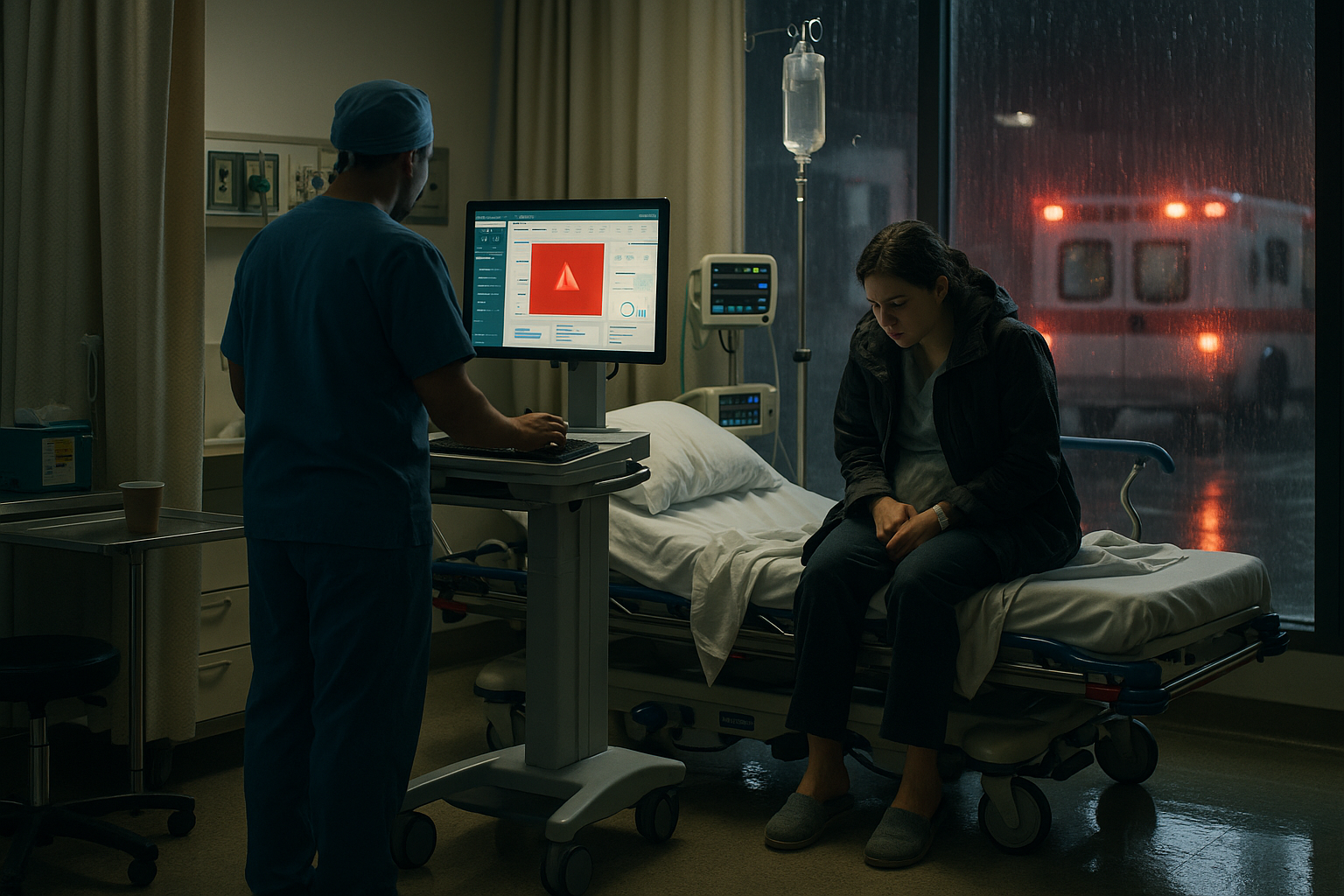
By 2:13 a.m., the rain had turned the ambulance bay into a sheet of black glass. Inside the emergency department, the air smelled of bleach, wet coats, and coffee that had been burning on a hot plate since midnight. Monitors chirped from every corner. A man with a split lip pressed gauze to his face. A child cried behind a curtain. Two victims from a bus crash had arrived ten minutes earlier, and everyone was moving too fast.
That was when Mariam Saleh came in, one hand on the wall, the other gripping the front of her coat.
She was thirty-two, six days home after a C-section, still wearing the plastic hospital bracelet around one wrist. Her hair was tied badly, as if she had fixed it in the dark. Her slippers were soaked from the rain. Sweat had pasted her blouse to her back, but she was shivering so hard her teeth clicked.
“I think I have a fever,” she said to the triage nurse. “Maybe from the milk. I just need something quick. My baby is with my sister.”
Nabil, the night nurse on triage, took one look at her and pulled a chair close before her knees gave way. “Bed seven,” he called. “Now.”
Dr. Leila Faris heard him from the next bay, where she was finishing three stitches above a bus driver’s eyebrow. She tied off the suture, peeled off one pair of gloves, and crossed the room with the tired, fast walk of someone twelve hours into a shift and nowhere near done.
Mariam was on the bed by then, her breath short, her face too pale under the fluorescent lights. Nabil clipped on the pulse monitor and wrapped the blood pressure cuff around her arm. The machine began to print its numbers.
Heart rate: 128.
Temperature: 39.2.
Blood pressure: 96 over 61.
On the workstation beside the bed, the hospital’s sepsis warning system updated with a soft chime. It pulled in the vital signs, the recent delivery note from the maternity ward, and the first nursing observations. Bed seven turned amber.
Sepsis risk elevated. Reassess.
Leila glanced at the screen and exhaled through her nose. “It’s flagging everybody tonight.”
Nabil didn’t look up. He was pressing his fingers into Mariam’s wrist, counting. “Everybody doesn’t feel like this.”
Leila touched Mariam’s forehead. It was burning. Then she took her hand. The fingers were cold enough to startle her.
“Tell me where it hurts,” Leila said.
Mariam swallowed. “Everywhere a little. My back. My stomach.” She shut her eyes for a second. “Mostly I’m tired.”
“Any bleeding?”
“A little.”
“Any smell?”
Mariam opened her eyes again, embarrassed. “Yes.”
That answer landed harder than the others.
Leila pulled the curtain fully closed. Outside, someone called for more gauze. A porter rushed past with a metal trolley that rattled over the cracked floor. Inside the curtain, the room shrank to the yellow light above the bed, the plastic hiss of oxygen from the wall, and Mariam trying not to cry.
“I almost didn’t come,” Mariam said. “My husband said we should wait until morning. The baby only sleeps on me.”
“Morning would have been too late,” Nabil said quietly, as if he already knew it.
Leila examined her. The incision itself looked clean, but Mariam flinched hard at the touch of Leila’s hand lower on her abdomen. There was uterine tenderness. There was the smell, faint but unmistakable. Postpartum infection, Leila thought. Maybe worse. Much worse.
“We need bloods. Cultures. Lactate. Now,” she said.
Nabil was already moving.
By the time the blood tubes were filled, the screen chimed again.
The warning system had rerun the numbers with the new inputs. Bed seven turned from amber to red.
Sepsis risk high. Consider immediate protocol.
“There it is,” Nabil said.
Leila stared at the red box for one beat, then at Mariam’s face. The alert was not a diagnosis. She knew that. The software had been wrong before. It could not smell infection. It could not see the way Mariam pressed her lips together between waves of pain. It could not hear the flatness creeping into her voice.
But it had done one important thing. In a room full of noise, it had forced bed seven to the front.
“Start fluids wide open,” Leila said. “Broad-spectrum antibiotics. Call obstetrics and tell them I want them here, not on the phone.”
Nabil nodded. “On it.”
When he hung the first bag of fluid, Mariam looked at the clear line running into her arm as if it belonged to someone else.
“Am I staying?” she asked.
Leila held her gaze. “Yes.”
“For how long?”
Leila did not answer fast enough.
Mariam turned her face toward the wall. “My son is six days old.” Her voice thinned. “He still smells like soap.”
Leila adjusted the oxygen under her nose. “Then let’s make sure you get back to him.”
A man appeared at the curtain a minute later, damp from the rain, clutching a phone in both hands. “I’m her husband,” he said. “They told me to wait outside.”
“Two minutes,” Leila said.
He stepped in, eyes darting from the IV bag to the monitor to his wife’s face. “Mariam?”
She tried to smile and failed. “Did he wake up?”
“Twice,” he said. “Your sister sang to him.” His voice cracked on the last word. He showed her the phone. On the screen was a picture of a newborn in a yellow cap, mouth open in sleep.
Mariam touched the glass with two fingers.
The blood pressure cuff tightened again. This time the numbers came back lower.
88 over 54.
Nabil looked at Leila. No one spoke for a second.
Then the department seemed to tilt into motion all at once.
More fluids. Second IV line. Antibiotics pushed. A warming blanket. Another call to obstetrics, sharper now. Leila heard her own voice become clipped and hard, the way it did when fear had to make room for work.
“Tell anesthesia we may need support.”
“Call ICU.”
“Where is the lactate?”
A lab tech pushed the result into the system. The number flashed on screen. Too high.
“Come on,” Leila muttered, not to the machine, not to the room, but to time itself.
The senior obstetrician arrived in wrinkled scrubs, hair still flattened from sleep, and examined Mariam quickly. “Postpartum sepsis,” he said. “Likely retained tissue. She needs source control.”
“The main theater is occupied,” Nabil said. “Bus crash case.”
Outside the curtain, a trolley slammed into a door. Somewhere down the hall, a woman shouted for her brother. The whole hospital seemed to be asking for more than it could give.
The obstetrician looked at the monitor, then at the red warning on the screen. “How long ago did this flag?”
“About twenty minutes,” Leila said.
He gave one short nod. “Good. That twenty minutes may be why she’s still talking to us.”
Mariam was no longer talking much. Her skin had turned the gray color people get just before everyone in the room becomes very calm and very fast. Nabil squeezed her shoulder.
“Stay with me,” he said.
Her eyes opened halfway. “I’m here.”
“Good,” he said. “Be annoying. Keep answering.”
That made the edge of her mouth move. Not quite a smile, but enough.
They cleared a procedure room near maternity instead of waiting for the main theater. The air in there was colder. It smelled of iodine and fresh plastic. The lights were painfully bright. Leila helped transfer Mariam across, hearing the small sound she made when the sheet pulled under her back.
“My baby,” Mariam whispered as the anesthetist adjusted the mask.
“Your baby can wait one hour,” Leila said. “You cannot.”
The procedure itself passed in fragments: metal trays, clipped instructions, the steady hand of the obstetrician, Nabil reading out pressure numbers, the soft electronic pulse from the monitor refusing to settle and then, slowly, finally, beginning to do so. Blood pressure climbed by degrees. Oxygen improved. The wild rhythm on the screen eased.
No one in the room celebrated. They had all done this too long for that. But shoulders dropped. Breathing changed. The atmosphere loosened by one inch.
When Mariam reached the ICU, dawn was beginning to thin the windows. The rain had stopped. The city outside was washed silver. Leila stood at the foot of the bed while a new team connected new lines, gave a new briefing, took over the long job of watching and adjusting and waiting.
Nabil came in with two paper cups of machine coffee. He handed one to Leila.
“You were right to examine her,” he said.
Leila took the cup. “You were right to push.”
He leaned against the doorframe. “The alert helped.”
“It did.” She looked through the glass at Mariam, asleep now, color returning in small, stubborn amounts. “But if you hadn’t stopped me, I might have clicked past it.”
Nabil sipped his coffee and made a face. “This coffee could wake the dead.”
Leila let out a tired laugh. It was the first easy sound either of them had made all night.
A week later, Mariam came back to the ward carrying a box of dates and wearing a blue scarf that matched nothing else she had on. She looked thinner, but alive in the solid way that matters: upright, warm, moving under her own strength. Her husband walked beside her with a car seat tucked into one arm.
Inside it, their son slept in a white cap, cheeks full, fists closed.
Nabil spotted them first. “Bed seven,” he said, pointing, and the nurses nearby smiled without needing the rest of the sentence.
Mariam held out the box. “My mother said I must bring something sweet,” she said. “I told her the hospital had enough sugar in its tea already.”
Leila came over from the desk, and for a moment Mariam just looked at her, as if matching the tired doctor from the worst night of her life to the woman standing in daylight.
“I don’t remember everything,” Mariam said. “Only pieces. The cold. The lights. Someone telling me to be annoying.”
Nabil raised a hand. “That was me.”
She smiled properly this time. Then she looked at the monitor bank above the station, rows of names and numbers, one box flashing amber for a patient in another room.
“Who saved me?” she asked.
Leila glanced at the screen, then at Nabil, then at the baby asleep under the white cap.
“The nurse who argued with me,” she said. “The team that moved fast. And the red alert I almost ignored.”
Mariam looked down at her son and touched one finger to his cheek. “Then I’m grateful for all of it,” she said.
The amber box at the desk flashed again.
Leila set down her untouched tea and was already moving before it had time to turn red.