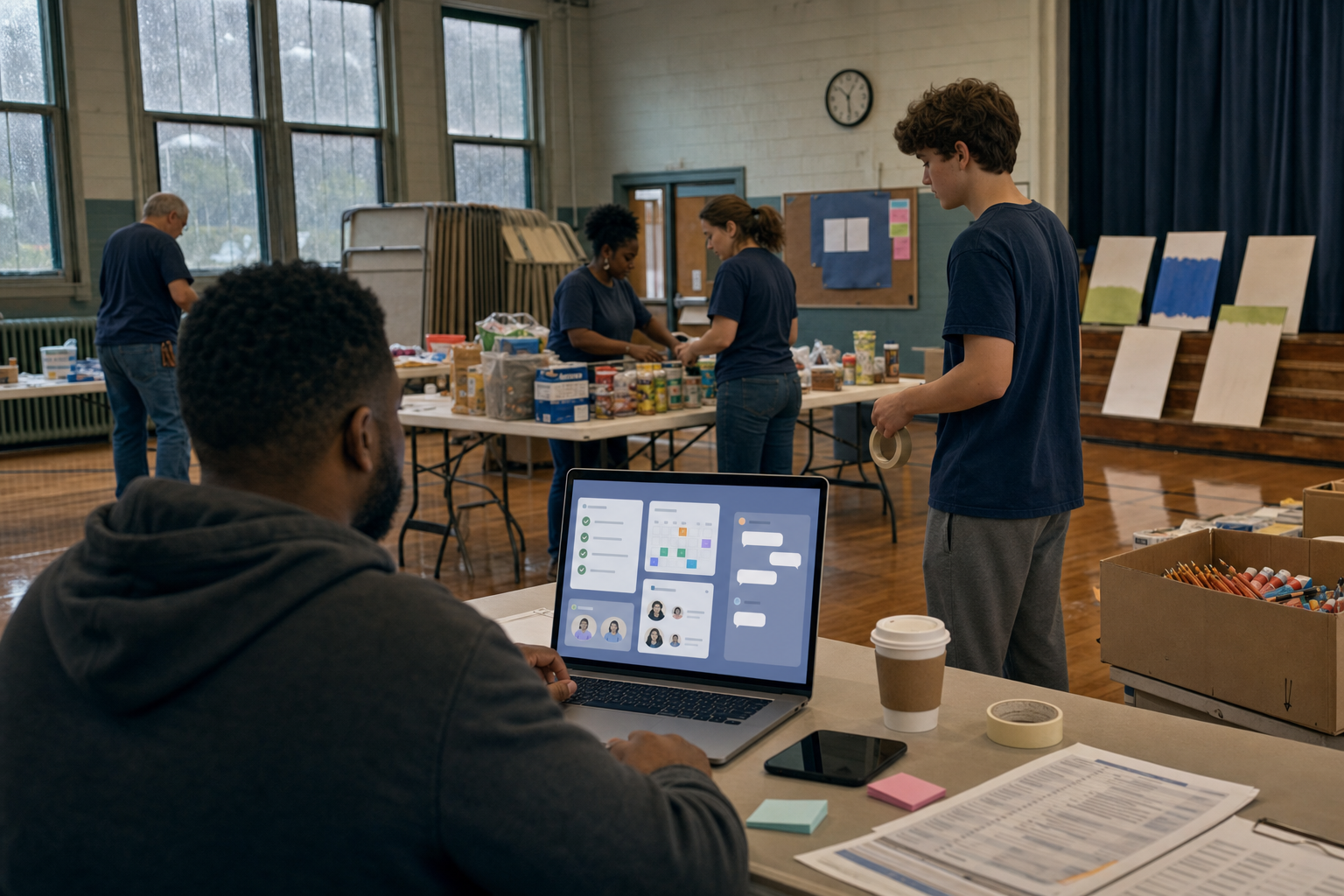
By Tuesday afternoon, the gym at Cedar Street Community House already looked like a place that had run out of time.
Folding tables leaned against one wall. Half-painted signs dried on the stage steps. A box of donated school supplies had burst open near the office door, spilling pencils and glue sticks across the floor. Outside, rain tapped at the windows in a steady gray line.
Nadia stood at the front desk with a paper cup of coffee gone cold in her hand and stared at her laptop.
“How many now?” Malik asked. He was seventeen, tall, and trying hard to look useful while holding a roll of tape between his teeth.
Nadia refreshed her inbox. “One hundred and forty-three.”
“That’s just mean,” he said.
The Saturday Community Day was four days away. It was not just a fair. It was the yearly thing people in the neighborhood counted on without saying so too loudly. There would be a free legal clinic, blood pressure checks, school backpack pickup, a used-clothes swap, food stalls, a table for housing advice, and a stage for local performers. In good weather, it felt like a celebration. In bad weather, it still mattered.
Jin came in from the rain, shaking water from his jacket sleeves. He worked in software downtown and volunteered at Cedar Street because, as he liked to say, “computers are easier than city permits, so this keeps me humble.”
He set his backpack on the counter and glanced at Nadia’s screen. “You still doing everything by hand?”
“I’m doing everything by panic,” Nadia said.
Jin smiled, opened his bag, and pulled out his tablet. “Let me set up the agent for you.”
Nadia looked at him over the rim of her cup. “I said maybe.”
“You said maybe two weeks ago. Today is the day maybe becomes yes.”
Malik grinned. “Please say yes. I don’t want to spend tonight alphabetizing volunteer emails like it’s 1998.”
Ten minutes later, the laptop screen showed a plain dashboard with a text box and a list of tools: email sorting, scheduling, translation, supply tracking, draft messages. Nothing magical. Just fast.
Nadia folded her arms. “Fine. But we keep this straight. It gets tasks. We keep judgment.”
Jin raised both hands. “That should be printed on the wall.”
She typed: Summarize unread emails by urgency. Draft replies for vendors, volunteers, and service tables. Translate the updated flyer into Spanish and Arabic. Build a volunteer schedule based on availability. Flag conflicts, don’t resolve them.
The screen moved almost at once.
In less than a minute, the inbox that had looked like a flood became neat categories: permit questions, table requests, no-show risks, donations, last-minute changes. A draft schedule appeared with color blocks. The updated flyer came back in three languages. The printer started chattering beside Malik’s elbow.
He pulled the pages out with both hands. “Okay,” he said softly. “That is rude.”
Nadia took the schedule, scanning it. “Useful,” she said. “Still rude.”
For the next two hours, the office changed shape around the work. Jin checked the translations. Malik called volunteers from the new list. Nadia moved through the drafts with a red pen, crossing out lines that sounded too stiff and adding names where names mattered.
“Don’t say ‘Dear Participant,’” she muttered, editing one message. “It’s Mrs. Alvarez. We know Mrs. Alvarez.”
The rain thickened. The building smelled of wet coats, copier heat, and poster paint. By seven o’clock, the unread count had dropped from 143 to 19.
“I love this machine,” Malik said.
Nadia looked up from the screen. “Careful.”
He laughed. “Right. I strongly respect this machine at a professional distance.”
Then the first problem appeared.
A new column on the dashboard was labeled Recommended declines.
Nadia clicked it.
At the top was Rosa Alvarez, food stall, documents incomplete.
“No,” Nadia said at once.
Jin leaned in. “What’s wrong?”
“Rosa renewed her permit. The city changed the upload portal and the confirmation email never came. She brought me the paper copy herself.” Nadia clicked the vendor file. No scan attached. “I forgot to upload it.”
Below Rosa was East Block Youth Boxing, insurance unclear.
“Also no,” Nadia said. “Coach Terry handed me that form on Friday. It’s probably in the blue folder.”
Malik was already digging through a stack on the side table. “This blue folder?”
He held up a bent packet, and there it was.
Jin rubbed the back of his neck. “So the agent found incomplete records.”
“Yes,” Nadia said. “And if I let it send those declines automatically, it would turn my bad filing into someone else’s punishment.”
No one said anything for a second. The printer clicked and went quiet.
Nadia looked back at the screen. It had saved them hours. It had also shown its limit in under a minute.
She opened the settings and turned off automatic sending.
“Draft only,” she said.
“Draft only,” Jin agreed.
By Thursday, the event had started to come together again.
The agent built a packing list for the health clinic. It matched the number of volunteers to the busiest hours. It sorted donation pledges and found that they had enough juice boxes but not enough extension cords. It drafted reminder texts in plain language, and Nadia sent them after reading every one.
Then, on Friday morning, the weather alert came.
Severe rain. Strong wind. High chance from ten in the morning through late afternoon.
Malik read the notice over Nadia’s shoulder and let out a long breath. “That is very bad.”
The agent, drawing from the forecast and their outdoor plan, generated a recommendation: Consider cancellation. Liability risk elevated. Estimated attendance decrease: 42 percent. Draft cancellation messages ready.
Three neat buttons sat at the bottom of the screen.
Send in English.
Send in Spanish.
Send in Arabic.
Nadia stared at them.
Her phone buzzed. A voicemail. Then another.
The first was from a mother asking if backpack pickup would still happen because she worked double shifts and had arranged a ride. The second was from Mr. Rahman, who wanted to know if the housing adviser would still come because his rent hearing was next week. A third message came in while she listened: the nurse from the clinic confirming they were packed and ready unless told otherwise.
Malik looked at the screen. “Should we cancel?”
Nadia turned to the gym doors. Through the narrow window she could see the empty lot where the tents were supposed to go. Rain blew across the asphalt in hard silver streaks.
“If this were only music and food,” she said, “maybe.”
Jin nodded slowly. “But it isn’t.”
“No. It isn’t.”
She sat down and began typing.
New plan. Move essential services indoors. Prioritize clinic, legal table, backpack pickup, housing advice. Build staggered schedule by room capacity. Separate quiet services from stage performances. No open-flame cooking indoors. Identify overflow options within one block.
The screen filled with a revised layout.
Gym: backpack pickup, clothing swap. Classroom A: legal clinic. Classroom B: blood pressure and health screening. Hallway tables: housing advice, school registration. Basement: youth performances. Kitchen access: limited prep only.
It was fast. It was clean. It was wrong in three different ways.
“No stage sound in the basement during counseling hours,” Nadia said. “The walls are thin.”
“And no clothing swap in the gym until after the clinic tables unload,” Jin added. “That entrance jams up.”
Malik pointed at the screen. “Kitchen access says limited prep, but Rosa’s tamales can work. Samir’s grill can’t.”
“Right,” Nadia said. “And the gym can’t take wet stroller traffic and clothing racks at the same time.”
She stood up, already moving. “We need the church hall.”
“Will they say yes on this short notice?” Malik asked.
Nadia was reaching for her coat. “Father Miguel still owes me for helping with the winter blanket drive.”
That part, the agent could not know.
An hour later they had the church hall for the clothing swap and a side room for children’s activities. The mosque two blocks over offered extra volunteers for crowd flow. Rosa agreed to bring coffee, tamales, and foil trays instead of the full outdoor setup. Coach Terry moved the boxing demo to the end of the day. Nadia called every service table herself. The agent drafted the updates. She rewrote the opening lines so people would understand, quickly, what had changed and what had not.
Community Day is still happening.
Services first. Come even if it rains.
On Saturday morning, the building smelled of bleach, wet pavement, and coffee strong enough to wake the whole block.
By nine-thirty, umbrellas were crowding the entrance.
Malik stood under a handwritten sign that said Backpacks This Way and directed families toward the gym. Rosa handed out paper cups from silver urns, steam curling around her face. Somewhere down the hall, a child was crying because his shoe was soaked through. Somewhere else, two volunteers were laughing while wrestling a folding table through a classroom door.
The agent tracked check-ins on Nadia’s laptop and updated wait times for each room. Useful. Clean. Quiet.
At ten-fifteen, it suggested opening a digital-only line to reduce congestion at the front desk.
Nadia looked up from the crowd. Mrs. Green from Building Six was standing in line with a flip phone and a cane. Next to her, a man in work boots held a paper housing notice folded into quarters. Behind them, three teenagers dripped rainwater onto the mat and tried not to look lost.
“No digital-only line,” Nadia said.
Malik heard her and grabbed clipboards. “Paper check-in on the left!” he shouted. “If you need help, come to me.”
At eleven, the power flickered once, then steadied.
At eleven-thirty, one of the legal volunteers got stuck in traffic, and the agent shifted appointments to later slots. Nadia approved it, then called the two earliest walk-ins herself to explain. At noon, the line for health screening got too long, and Jin used the schedule tool to pull two volunteers from setup duty. At one, a man complained that his table had been moved away from the entrance. Nadia listened, apologized, and told him why the blood pressure station needed the quieter corner. He looked past her at the row of waiting elders and nodded.
By two-thirty, the storm was still hammering the street, but the rooms were full.
Children left the gym with backpacks almost as big as their shoulders. Mrs. Green sat with a volunteer who read forms aloud without rushing her. Coach Terry’s boxing demo happened in the basement after the counseling room had cleared, and the cheers bounced warmly off the low ceiling. Rosa kept pouring coffee. Mr. Rahman came out of the housing room holding a folder with three new papers clipped inside and a look on his face that was not relief exactly, but close enough to count.
Near the end of the day, when the lines had thinned and the rain had finally softened, Malik dropped into a chair by the front desk and laughed the tired laugh of someone who had no energy left to be dramatic.
“We actually pulled it off,” he said.
Jin leaned against the counter. “The agent saved us.”
Nadia closed the laptop halfway and looked out at the wet street, where people were still leaving with plastic bags, backpacks, flyers, and half-finished cups of coffee.
“It saved us time,” she said.
She nodded toward the gym, the classrooms, the church hall across the street, the volunteers carrying boxes, Rosa wiping down her table, Malik re-taping a sign that had come loose in the damp.
“That part did the rest.”
The laptop chimed with one last prompt.
Would you like to send thank-you messages to all participants and volunteers?
Nadia smiled, tired and certain.
“Draft them,” she said.
Then she reached for the keyboard.