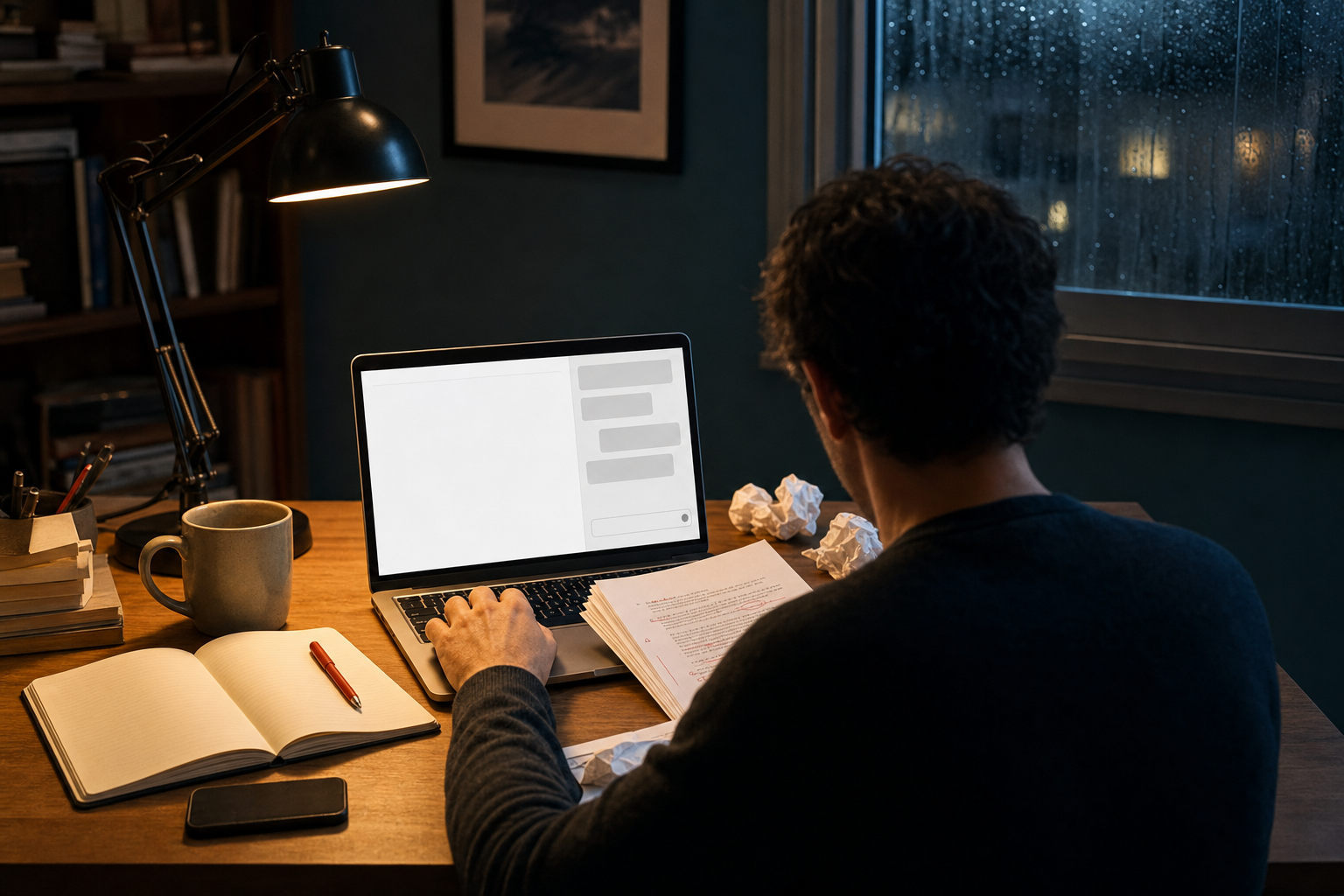
On Monday morning, I opened my laptop, named a blank document after a deadline I was already late on, and decided to spend one week writing with AI beside me. I did it for a simple reason: I had work to finish, my confidence was low, and too many people were talking about AI as either a miracle or a threat. I wanted to know what it actually felt like in the room.
By Friday night, I had a finished script, three discarded openings, one fight with myself, and a clearer answer than I expected. AI helped me move faster. It also made me sloppy when I let it do the thinking for me. That was the tension all week: not human versus machine, but speed versus judgment, convenience versus voice.
Monday: The Blank Page Gets Company
The rain had started before dawn and stayed there, tapping at the kitchen window like a patient visitor. My apartment smelled faintly of burnt toast and coffee grounds. On the table: my notebook, my phone, a chipped mug, and my laptop with its screen reflecting my tired face back at me.
I am a creator in the least glamorous sense of the word. I write newsletter essays, scripts for short videos, and branded copy when rent is due. That week, I needed to draft a personal piece on creative burnout for a client who liked “warmth, insight, and practical takeaways” and paid in a tone that suggested all three should be effortless.
I stared at the page for eleven minutes. Then I opened the AI tool.
“Help me start an essay about creative burnout,” I typed.
The answer arrived at once. It was polished. It was organized. It was also dead on the page.
I read the first sentence out loud. “In today’s fast-paced digital landscape, creators often find themselves navigating the complex intersection of passion and productivity.”
I leaned back and laughed once, without humor.
“Absolutely not,” I said to the room.
I tried again. “Make it sound like a person, not a panel discussion.”
This version was better. Still too smooth. Still too eager to conclude something I had not yet felt. But buried in the middle was one usable line: Burnout can look like laziness from the outside and panic from the inside.
I copied that into my draft.
That was the first surprise of the week. The tool was not good at writing for me. It was occasionally useful at giving me something to argue with.
Tuesday: Fast Help, Thin Ideas
By noon the next day, I had settled into a rhythm. Write a paragraph. Ask for five alternatives. Steal half a sentence. Delete the rest. Ask for examples. Keep one. Change it until I could not hear the original voice underneath.
It felt efficient in the way online shopping feels efficient. Click, scroll, receive. No walking, no waiting, no weather. Also no texture.
I was working at a small café two streets from my apartment, where the grinder screamed every six minutes and the window fogged up from the heat. The man at the next table was editing wedding photos. Every few minutes, a bride in bright white flashed across his screen and disappeared again.
My friend Dina called while I was cutting a paragraph apart.
“How’s your robot co-author?” she asked.
“Useful,” I said.
“That sounded sad.”
“It writes faster than I do.”
“So does a printer,” she said. “That doesn’t mean it knows what you mean.”
I looked back at my screen. She was right, and I hated that she was right.
I had two clean pages by then, which should have made me feel relieved. Instead, I felt a thin, metallic kind of discomfort. The draft held together. It also slid past itself. Every paragraph said the next sensible thing. Nothing resisted. Nothing surprised me.
I highlighted a section and read it slowly. The ideas were accurate enough. The sentences were balanced. The problem was that the piece could have been written by anyone who had spent six minutes near the internet.
I deleted eight paragraphs.
My coffee had gone cold. Outside, a bus sprayed rainwater against the curb. Inside, the barista called out someone’s name three times before realizing no one was coming.
I opened a fresh section and typed without asking for help:
The worst week of my burnout, I answered a friend’s message with “Sorry, just saw this,” while I was looking directly at it.
Now we were somewhere.
Wednesday: The Argument
Wednesday was the bad day.
I had promised my editor, Mara, a near-final draft by six. At two thirty, my document was a patchwork of sentences that did not trust one another. Some were mine. Some had been generated and rewritten. Some had been generated, admired, and left in because I was tired.
The room had that late-afternoon grayness that makes every object look slightly disappointed. My radiator hissed. A siren passed and faded. I asked the AI for a stronger ending.
It gave me one with a lesson tied neatly in the last line. I almost kept it.
Then Mara emailed.
How’s it going? Send what you have, even if messy.
I sent the draft before I could lose my nerve.
She called seven minutes later.
“Do you want the kind version or the useful version?” she asked.
“Useful.”
“It’s competent,” she said.
I winced.
“That is not a compliment from you.”
“No.” Papers rustled on her end. “The middle is strong. The opening is trying too hard to be universal. And there are lines here that sound like they were assembled in a very clean waiting room.”
I covered my eyes with one hand.
“How obvious is it?” I asked.
“Obvious enough that I’m asking.”
There it was. Not scandal. Not shame. Just exposure. The mild humiliation of being caught leaning on something that had not carried my weight well.
“I used it to push through the slow parts,” I said.
“That’s not the problem,” Mara replied. “The problem is that you stopped arguing with it.”
I sat up.
She continued, “When you’re good, I can feel you choosing. Here, sometimes, you’re accepting.”
After we hung up, I went for a walk without my phone. The rain had finally stopped, leaving the street glossy and dark. A fruit seller was dragging crates back under his awning. Two teenagers were sharing fries from a paper bag, talking over each other. The air smelled like wet concrete and frying oil.
By the time I got home, I knew what I had been doing wrong. I had treated the tool like a substitute for the hard part, when the hard part was still mine: deciding what was true, what was cheap, what only I could say because I was the one who had actually lived it.
That night, I opened the document and started marking every sentence that felt merely acceptable.
There were many.
Thursday: Better Questions
On Thursday, I changed the rules.
- I would not ask for finished paragraphs.
- I would ask for lists, contrasts, examples, questions, and structure.
- I would only keep a line if I could say it out loud without flinching.
The difference was immediate.
Instead of typing, “Write a section on why creators procrastinate,” I wrote, “Give me six concrete ways procrastination shows up when someone is ashamed of their work.”
The answers were uneven, but alive enough to work with:
- renaming files instead of drafting
- researching microphones for a podcast episode already recorded
- replying to easy emails first
- cleaning the desktop, both digital and literal
- calling it perfectionism when it is actually fear
I could use that. Not as truth handed down, but as material. Prompts. Fragments. Sparks.
I wrote for three solid hours. The radiator clicked. The light shifted from pale gold to amber on my desk. My upstairs neighbor practiced the same piano phrase until I thought I might scream, then finally got it right and moved on.
At five, I read the new draft aloud. It sounded like me again: less polished, more precise. Less eager to conclude, more willing to stay with the mess long enough to make something honest from it.
I messaged Dina: I think I figured it out.
She replied at once. Are you in love with the machine now?
No, I wrote back. But I know what job to give it.
Friday: The Line I Wouldn’t Have Found Alone
Friday morning was bright for the first time all week. Sunlight hit the edge of my desk and warmed the spiral binding of my notebook. The city outside sounded sharper too: a delivery scooter, a car horn, someone laughing in the alley below.
I was revising the last section, the place where the piece had kept becoming either too tidy or too bleak. I did not want a sermon. I did not want a warning label. I wanted an ending that sounded true after a week of use.
I asked for one last set of prompts: “Give me ten ways to describe the feeling of getting momentum back after creative paralysis. Keep them concrete.”
Most were forgettable. One stopped me.
It feels like finding your keys in the pocket you already checked, and being annoyed before you are relieved.
I stared at it.
Not because it was perfect. It wasn’t. But it had a crooked, human shape to it. Irritation before relief. That was exactly the feeling. Not triumph. Not breakthrough music swelling in the background. Just motion returning, with a little embarrassment attached.
I rewrote the line in my own words and built the ending around that emotional truth.
When I sent the final draft to Mara, I was nervous in a cleaner way. Not because I feared being exposed, but because the piece now contained my actual judgment.
Her reply came twenty-four minutes later.
This is it. You sound awake in this version.
I read that twice.
Then I shut the laptop and stood in the middle of the kitchen with no dramatic reaction at all. Just a long exhale. The fridge hummed. Somewhere downstairs, a door slammed. My coffee had gone cold again.
The week had not turned me into a new kind of writer. It had made an older fact harder to avoid: tools can reduce friction, but they cannot decide what matters. They can offer options. They cannot take responsibility.
What the Week Changed
By the end of the experiment, I trusted AI more in some ways and less in others.
I trusted it to help me start when the page was empty, to generate angles I might miss, to give shape to a messy outline, and to act as a fast, tireless source of variations. That promise is real. If you write for a living, speed matters. So does momentum.
I trusted it less with tone, memory, confession, and anything that required moral weight. The risks were real too. It could flatten a strong idea into something generic. It could make me accept a sentence just because it was plausible and smooth. It could tempt me to confuse movement with progress.
Most of all, it changed how I think about revision. I used to imagine editing as refinement. This week reminded me that editing is also refusal. You keep cutting away anything that sounds easy but false.
The Last Entry
On Sunday evening, I opened the final published piece on my phone while waiting for bread at the corner bakery. The line moved slowly. A child pressed both hands against the glass pastry case. The woman in front of me was arguing softly with someone on her earbuds about whether six rolls were enough for dinner.
I read my essay again, this time as a reader. I could still spot the places where the tool had helped me think, where it had widened the road just enough for me to keep going. I could also see the places where I had taken the wheel back.
That, in the end, was the part that mattered.
If I co-write with AI again next week, I will not ask it for a voice. I already have one, even on the days I cannot hear it clearly. I will ask it for pressure, contrast, options, and speed. Then I will do the slower work myself: choosing, cutting, doubting, and deciding when a sentence is finally honest enough to stay.