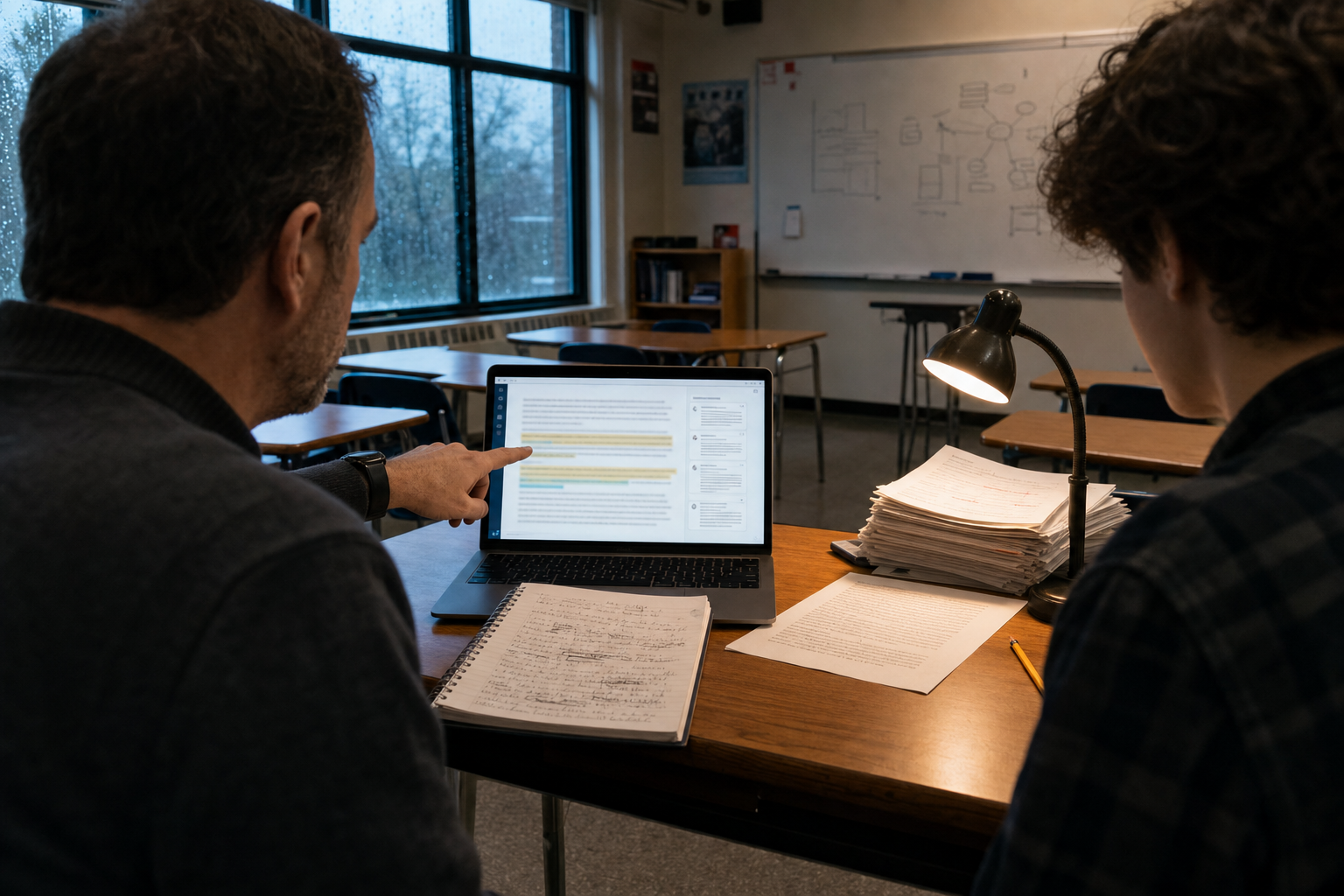
By the second week of October, I could spot AI-smoothed writing before I reached the second paragraph. It had a clean shine to it. Every sentence was balanced. None of them sounded like the teenagers in Room 204.
That bothered me because I had been the one to tell my students to try the district’s new feedback tool. We were told it could save time, catch grammar mistakes, and help nervous writers revise. It could do those things. But when Omar handed in a polished essay about his father’s barbershop and I could no longer hear Omar anywhere on the page, the question changed. The problem was not whether the tool worked. The problem was what happened to a student’s voice when the tool worked too well.
Three days earlier, rain had needled the classroom windows while the radiator knocked like someone trapped inside it. “Place essay drafts face down,” I said, and thirty-one Chromebooks clicked shut at once. Omar lingered after the bell to hand me his first draft on paper. He had written about Saturdays in his father’s shop on Walnut Street.
The pages were crowded with cross-outs and arrows. His grammar wandered. His paragraphs sagged in the middle. But one line made me stop: “When my father snaps the cape open, it sounds like a bird trying to get out of his hands.” Another said, “The chess men at the back table never move fast, even when the clock on the wall is shouting.” I smiled in my empty classroom and wrote, You can really see this place. Keep these details.
The next morning, I showed the class how to use the new feedback program. “Use it for help,” I said. “Not for a replacement brain.” A few students laughed. A few looked relieved. We had a mix in that room: strong readers, new English learners, students who wrote fast and messy, students who stared at a blank page until the bell rang. For some of them, instant feedback felt less scary than a teacher’s red pen.
Omar turned in his revision on Friday. The title was the same. Everything else had changed.
“The barbershop functions as a meaningful community hub,” the first paragraph began. “Through intergenerational interaction, I have developed a deeper appreciation for labor, discipline, and cultural identity.”
I read those lines twice. Outside, students pounded past my door toward lunch. The hallway smelled of bleach, wet coats, and cafeteria pizza. Inside my room, I could hear only the small electric buzz from the ceiling lights.
Omar was not a perfect writer. He was, however, a precise observer. He knew the sound of clipper guards dropping into a jar. He knew which men asked for hot towels and which ones asked for gossip. The new draft was cleaner. It was also empty.
I found him in the cafeteria, poking at fries with a plastic fork. “Can you come by after lunch?” I asked.
He arrived with his hood up and his backpack hanging from one shoulder. “Am I in trouble?” he said.
“No,” I said. “Sit down.”
I laid both drafts side by side. “Talk me through what you changed.”
He looked at the pages for a long moment. Then he tapped the second one. “I put the first draft into the tool.”
“And?”
“And it said my sentences were informal. It gave me better ones.”
“Better?”
He shrugged, but his face tightened. “More academic.”
I pointed to the line about the cape sounding like a bird. “Why did this disappear?”
He looked down. “It said it was too conversational.”
“Did you agree?”
He took his time answering. In the hallway, a locker slammed. “I don’t know,” he said. “It sounded more serious the other way.”
“More like school?”
That got a quick smile. Then it vanished.
“Miss, every time I write how I actually want to write, somebody circles something,” he said. “A word is wrong. A sentence is weird. I thought maybe if it sounded less like me, it would sound smarter.”
On my desk, next to the drafts, sat my first set of comments. I had praised his details. I had also marked six grammar problems on the first page alone. The red ink was hard to ignore. So was the lesson inside it.
I leaned back in my chair. The radiator hissed. “The tool helped your grammar,” I said. “It also sanded off the best part.”
He frowned. “So we’re not allowed to use it?”
That was the easy answer. It was also the wrong one. I had already seen quieter students use the tool to check verb tenses before sharing their work aloud. I had watched one boy who never asked for help finally revise a paragraph instead of giving up on it. The problem was not help. The problem was handing over the steering wheel.
“You can use it,” I said. “But we’re going to use it differently.”
The next day, I wrote three rules on the board before first period had fully settled down.
- Keep three original sentences that sound like you.
- Use the tool to ask questions, not to replace whole paragraphs.
- If you accept a major suggestion, be ready to explain why it is still yours.
Groans rose from the back row.
“That sounds like more work,” said Talia.
“It is more work,” I said. “Writing is work.”
A few students laughed. Omar did not. He had already pulled out his draft.
I gave them a new exercise. “Write about a place you know well,” I said. “Before you revise, underline the lines only you could have written. Protect those.” The room settled into the thin, scratchy quiet of real concentration: keys tapping, chairs squeaking, someone sniffling by the window, the sharp smell of dry-erase marker still hanging in the air.
Omar opened a blank document and typed, Saturday starts before the sun does in my father’s shop. He stopped, deleted starts, and wrote begins. Then he deleted begins and put starts back. I pretended not to notice. That was the kind of fight I wanted him to have.
When he had a paragraph down, he pasted it into the feedback box and typed a question instead of a command: What is unclear here?
The tool highlighted a confusing time jump and suggested he explain who the men at the chess table were. It also flagged two comma splices. It did not rewrite the paragraph for him. This time, he did the next part himself.
After school, he stayed back again. “Can I read you the new intro?” he asked.
I nodded.
He read from the screen, not fast, not hiding behind it. “By noon the floor is full of black curls and gray ones, and the old men by the window are still arguing over the same chess game. My father says the shop stays open because people need haircuts. I think it stays open because men need somewhere to sit while they tell the truth in pieces.”
He looked up before I could answer. “Too much?”
“No,” I said. “That sounds like you.”
The following week, we held a read-around. Students sat in a loose circle with their papers trembling slightly in their hands. When Omar got to the line about men telling the truth in pieces, two boys in the back stopped whispering. Talia looked up. Nobody asked whether it sounded academic.
After class, Omar handed me his final draft. The grammar was better. The structure held. One sentence still ran a little long. I left it alone.
At the bottom of the page, I wrote, Use tools to sharpen the work. Keep the parts only you can give.
He read the note, folded the paper once, and slid it into his backpack. “My dad wants to put this one on the counter if I get an A,” he said.
“Then give him the version that sounds like his son,” I said.
That afternoon, after the halls emptied and the building settled into its usual after-school hum, I looked at the stack of drafts waiting on my desk. I still used the feedback tool. So did my students. The grammar got cleaner. The paragraphs got clearer. But from then on, before any screen lit up, I started revision with a different question: Which line is yours, and how will you keep it?