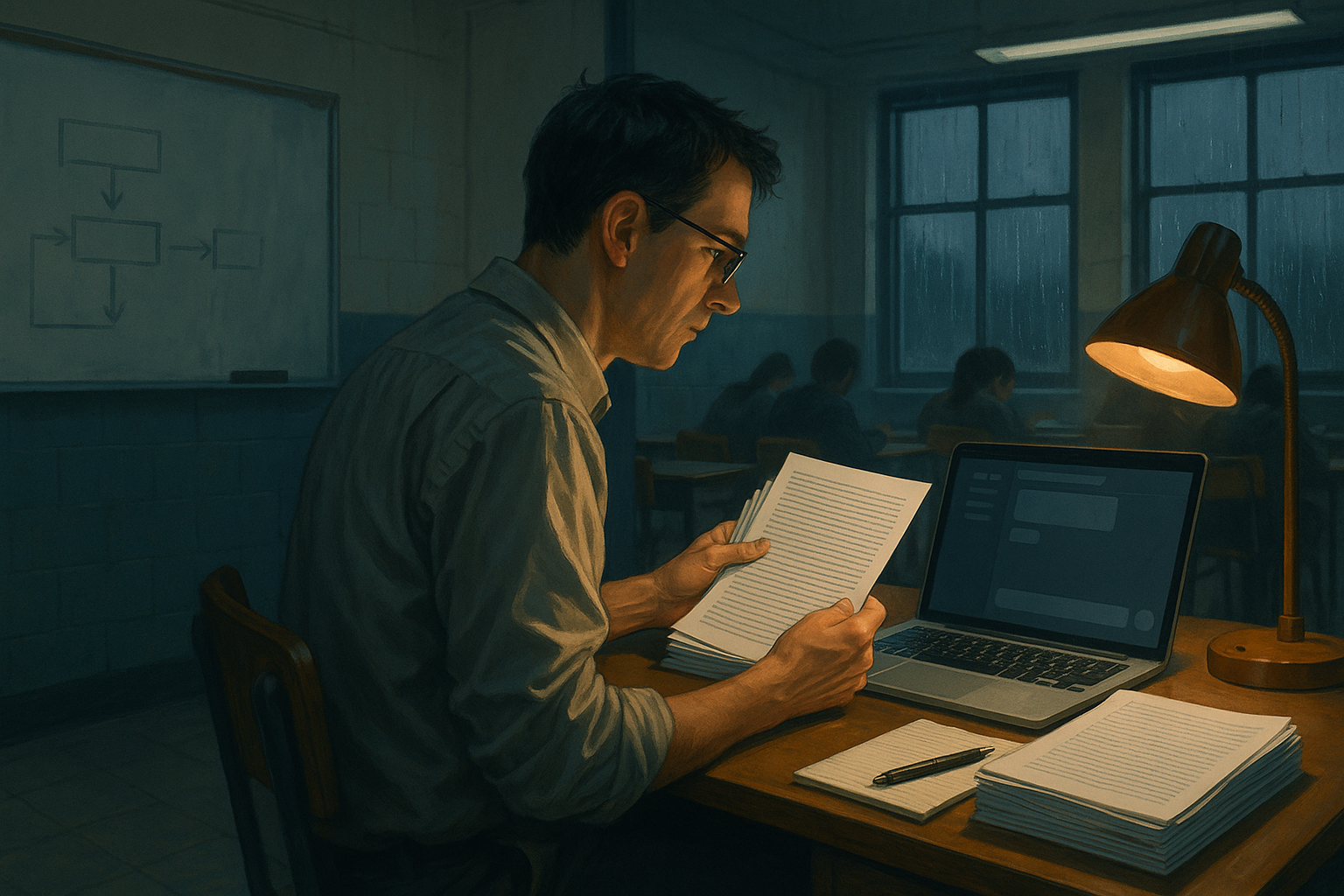
On a wet Tuesday in October, I stood at the front of Room 204 with twenty-seven student essays in my hands and the uneasy feeling that something in my classroom had shifted before I was ready for it.
The essays were supposed to be messy. I had asked my tenth-grade students to write about a family memory. I expected uneven sentences, crossed-out thoughts, details that wandered, maybe a few clichés. Instead, six papers sounded polished in exactly the same way. The grammar was too clean. The transitions were too smooth. Even the mistakes felt borrowed. By lunch, one question sat in my mind like a stone: had my students started handing their thinking to a machine?
I teach English at a public school on the edge of the city, in a building with cracked cream walls and windows that rattled when the buses pulled away. My classroom smelled faintly of dry-erase markers, old paper, and the coffee I reheated too many times. I had taught there for fourteen years. Long enough to know who tapped their pencil when they were nervous, who pretended not to care, who wrote best when the room was quiet enough to hear the radiator click.
I also knew my students lived in a different world from the one I entered as a new teacher. They had phones in their pockets, answers one search away, and now, suddenly, tools that could write a paragraph in seconds.
That afternoon, I spread the essays across my desk and looked at the names.
One belonged to Maya, who usually wrote with such energy that her pages felt like they were leaning forward. Another was from Tariq, who often forgot periods but never forgot a sharp opinion. The neatest of the six belonged to Elena, a quiet transfer student who still stopped to translate unfamiliar words under her breath before she spoke.
I called Maya in first during study hall.
She dropped into the chair across from me, backpack still on one shoulder. “Am I in trouble?”
I slid her essay toward her. “Did you write all of this yourself?”
Her eyes flickered down the page, then back up. “I mean... mostly.”
“Mostly?”
She pulled at a loose thread on her sleeve. “I wrote what I wanted to say. Then I put it into an AI tool and asked it to make it sound better.”
“How much better?” I asked.
She gave a weak smile. “A lot better.”
By the end of the day, I had heard versions of the same answer four more times.
“I only used it to fix grammar.”
“I used it because I didn’t know how to start.”
“My brother told me everybody does it now.”
Then Elena came in.
She sat with both hands folded in her lap. Outside, rain tapped softly against the window.
“Did you use AI on your essay?” I asked.
She nodded almost at once.
“Why?”
Her face tightened, and for a second I thought she might cry. “Because in my head, the story is there,” she said. “In Spanish it is there. In English, it breaks.”
I said nothing.
She looked at the paper. “I wrote notes first. About my grandmother’s kitchen. The blue cups. The oil popping in the pan. The radio. But when I try to make the sentences, I feel stupid.” She swallowed. “The tool made the sentences sound like school English.”
The room went very quiet. In the hallway, someone laughed too loudly, and a locker slammed shut.
“Did it say what you meant?” I asked.
“Some of it.” She touched the top of the essay with one finger. “But not the part about the radio. It changed it to ‘music filled the room.’ My grandmother never played music. She listened to the news every morning. It mattered, but I didn’t know how to explain that.”
That line stayed with me all evening. Not the polished sentences. The missing radio.
I went home with a stack of papers and a headache. My husband found me at the kitchen table, still wearing my school ID badge, staring at Elena’s essay under the yellow light.
“You look like someone canceled literature,” he said, setting a bowl of soup beside me.
“Maybe they did.”
He sat down. “Bad day?”
“My students are using AI to write.”
“All of them?”
“Enough.” I rubbed my forehead. “And I can’t decide if I’m looking at cheating, help, or both.”
He leaned back. “What’s the real problem?”
I almost answered too quickly. That they were taking shortcuts. That writing mattered. That school still needed honest work. All of that was true, but not complete.
“The real problem,” I said slowly, “is that I don’t know how to teach writing in a room where a machine can produce clean sentences faster than a student can think.”
The next morning, I walked into class with a plan that was held together mostly by nerve.
The students were half awake. Hoodies up. Water bottles on desks. A smell of wet sneakers and cafeteria pancakes floated in with them.
I stood by the board and said, “We need to talk about the essays.”
Chairs shifted. A few students stared at their desks.
“Some of you used AI,” I said. “Some of you used it a little. Some of you used it a lot. I’m not going to pretend this isn’t happening. It is happening.”
Tariq muttered, “So now what?”
“Now,” I said, “we figure out what writing class is for.”
That got their attention.
I picked up Elena’s paper, though I did not use her name. “Here is my issue. A polished sentence is not always a true sentence. If a tool helps you fix grammar, fine. If it helps you brainstorm, maybe fine. But if it removes your voice, your memory, your choices, then something important is gone.”
Maya raised her hand. “But what if our voice is bad?”
A few students laughed, but not cruelly. The kind of laugh that covers real fear.
“Your voice is not bad,” I said. “It may be unfinished. It may need work. That is different.”
“What if English isn’t your first language?” Elena asked quietly from the second row.
I looked at her. “Then you deserve tools that help you express what you mean. But the meaning still has to come from you.”
The room settled.
“Here’s what we’re going to do,” I said, turning to the board. “Starting today, if you use AI for an assignment, you will say how you used it. Brainstorming. Outline. Grammar check. Question generation. Whatever it is. And for major essays, I want the process.”
I wrote the new rule in large letters:
- Notes
- First draft
- AI use, if any
- Final draft
- Reflection: What changed, and why?
Tariq squinted at the board. “So we can use it?”
“Yes,” I said. “But you cannot hide behind it.”
He gave a slow grin. “That’s annoying.”
“Good,” I said. “Learning usually is.”
The real test came two weeks later with a new assignment: write about a place that shaped you.
Instead of sending them home with a prompt and a warning, I built the whole process into the class.
First, they described their place without naming it. I told them to give me the sounds, the light, the smell, the texture under their shoes. The room filled with the scratch of pens. Someone wrote about a barber shop where clippers buzzed like angry bees. Someone else described a grandmother’s balcony with damp towels brushing her knees. Tariq wrote three lines about the basketball court behind his apartment building and then stared at the ceiling until I told him to stop waiting for brilliance and write one true thing. He wrote six more lines without looking up.
The next day, I let them use AI, but only for specific tasks. Generate questions. Suggest an outline. Offer clearer transitions. Find repeated words. Nothing went in untouched. Every student had to compare the suggestion with their own draft and decide what to keep.
I walked the room while screens glowed blue on their desks.
“It says to start with a hook,” Maya told me.
“Do you need one?” I asked.
She read her opening line again. “‘My mother cuts mangoes over the sink because the juice runs to her elbows.’” She looked up. “Actually, I think I’m fine.”
“You are,” I said.
At the back of the room, Elena had two windows open side by side. Her notes were on the left. On the right, an AI tool had suggested a smoother version of her paragraph.
“What do you think?” I asked.
She pointed at one sentence. “It changed ‘the hallway smelled like bleach and boiled beans’ to ‘the hallway had a strong smell.’”
I raised an eyebrow.
She smiled for the first time that week. “Mine is better.”
“Yes,” I said. “Yours is better.”
When final drafts came in, I sat at my desk after school and read until the late sun turned the windows orange. These essays were not perfect. Some were clumsy. Some were too long. A few still had awkward transitions. But they were alive.
Maya wrote about the narrow kitchen where three sisters learned to dance while rice boiled over on the stove. Tariq wrote about the court lights clicking on one by one as the sky darkened, and how he stayed outside until his mother called his full name from the fourth-floor window. Elena wrote about the apartment building where every door sounded different when it shut, and the old man downstairs who watered one plant as if it were a garden.
And there it was again, in her final paragraph: the radio in her grandmother’s kitchen.
Only this time, she had written it herself.
“She listened to the news every morning,” she wrote, “because she believed that if you knew what the world was doing, you would not feel so small inside it.”
I put the paper down and let out a long breath I had not realized I was holding.
A month later, our principal asked me to speak at a staff meeting about AI in the classroom. The library was too cold, as always. Teachers sat with crossed arms and tired faces, balancing notebooks on their knees.
“So,” the math department chair said before I even started, “is it the end of writing?”
A few people chuckled.
I thought of the six suspicious essays on my desk. I thought of my anger, and my fear, and the relief of finding a better question than How do I stop this?
“No,” I said. “But it is the end of pretending writing is only the final draft.”
The room grew still.
“If we only grade the clean copy, then of course students will use whatever gives them a clean copy. If we care about thinking, we have to teach the thinking where we can see it. We have to ask what the tool helped with, what it erased, and what still belongs to the student.”
After the meeting, a science teacher stopped me by the door.
“Do you really think kids can use it without letting it do all the work?” she asked.
“Not all of them,” I said. “Not right away. But they also can’t learn responsible use if the only message they hear is ‘don’t touch it.’”
She nodded slowly. “Fair point.”
By December, the language in my classroom had changed.
Students no longer said, “Can I use AI?” as if asking for a forbidden object from a locked cabinet. They asked better questions.
“Can it help me organize this?”
“Can I use it to check whether this paragraph is clear?”
“It suggested this sentence, but I think mine sounds more like me. What do you think?”
That last question was the one I had been waiting for.
On the final day before winter break, snow started falling during third period. Big, lazy flakes drifted past the windows, and even the loudest students kept turning to look.
I gave them ten minutes to write about anything they had learned that semester. Not for a grade. Just to mark the day.
When the bell rang, most left their pages behind.
After the room emptied, I gathered the papers. Some were funny. Some were rushed. One simply said, “I learned commas are evil.” That was from Tariq.
At the bottom of Elena’s page, in careful handwriting, I found this:
I used to think good writing meant hiding every mistake. Now I think it means keeping the part that is really yours.
I looked around the room: the scuffed desks, the half-dead plant by the window, the board still dusty at the edges. Nothing had changed, and everything had.
AI had not saved my classroom. It had not ruined it either. What it did was force me to see, with uncomfortable clarity, what I was actually trying to teach.
Not perfect sentences.
Not performance.
Not speed.
I was trying to teach students how to think, how to choose, how to tell the truth in their own words, even when help was available at the click of a button.
That year, I stopped asking whether AI belonged in school. It already did. The better question was whether we were brave enough to teach students how to use it without losing themselves.
In Room 204, at least, that work had begun.