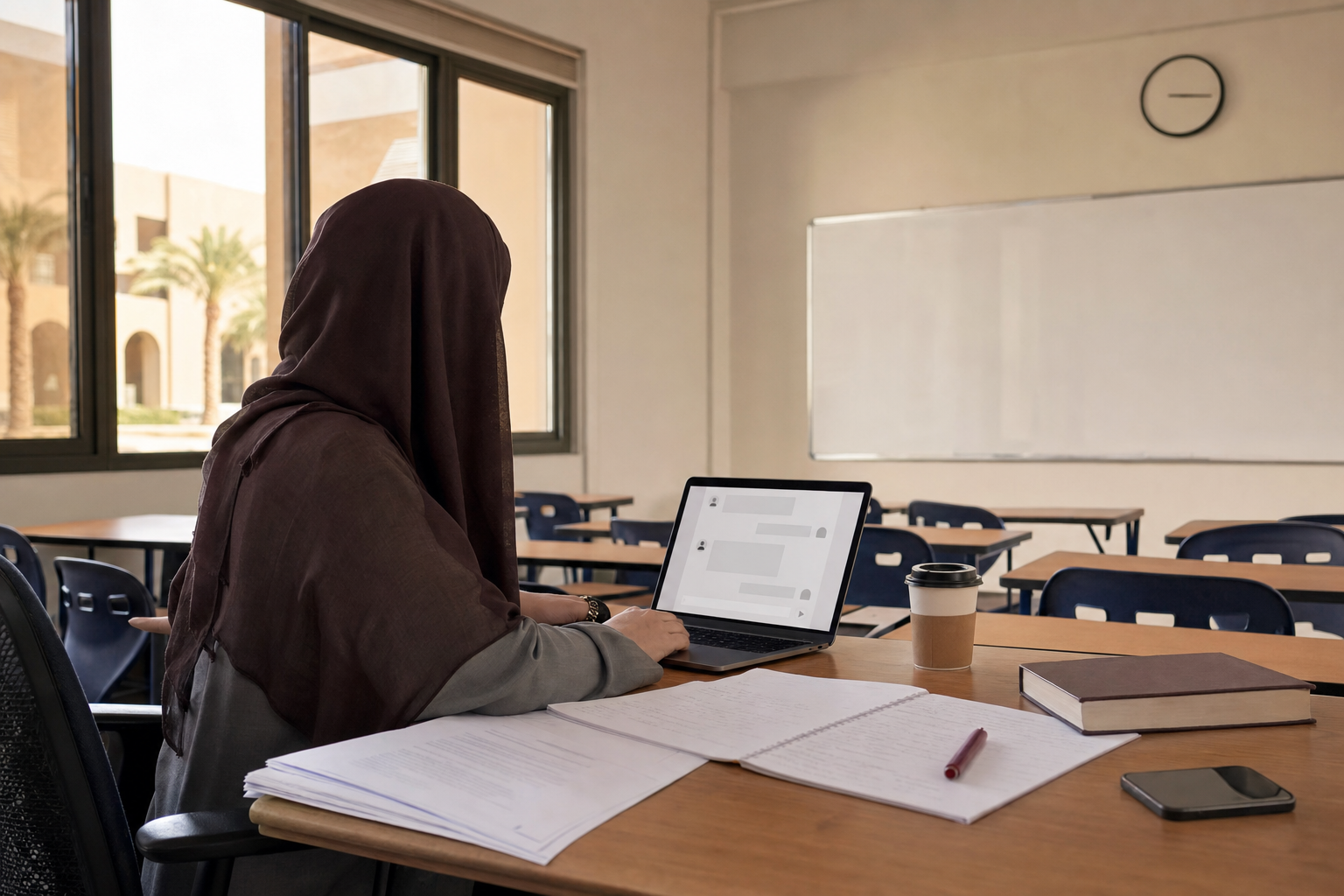
At 6:10 on a Tuesday morning, Mariam unlocked Classroom 8 before the hallway lights had fully warmed. The room smelled faintly of whiteboard ink and last night’s floor cleaner. Outside, boys were shouting over a football in the courtyard. Inside, twenty-six plastic chairs waited in crooked rows, and on Mariam’s desk sat a paper cup of cardamom coffee, her laptop, and a stack of essays on descriptive writing in Arabic.
Today’s lesson was supposed to be simple: help fourteen-year-olds write a short paragraph that could actually be seen, heard, and felt. But half her class wrote in stiff textbook phrases, three students still mixed spoken Arabic with formal Arabic in every line, and one boy in the back, Sami, had not handed in a full paragraph in weeks. Mariam opened her laptop, looked at the clock, and decided to ask AI for help. Not to teach the lesson for her. Just to help her build it faster. The lesson would still rise or fall on three things only she could judge: what language level her students could handle, what example would make them care, and when a quiet student needed dignity more than correction.
She typed in Arabic first, then in English when the first answer felt too stiff: “Create a 40-minute lesson plan for Grade 8 Arabic descriptive writing. Students need concrete examples, simple exercises, and support moving from everyday speech to formal written Arabic.”
The reply came quickly. Warm-up question. Model paragraph. Vocabulary list. Pair activity. Exit ticket.
“Fast,” she said to the empty room. “Too fast.”
She scrolled. The structure was useful. The sample paragraph was about a public library with “high shelves of knowledge” and “silent halls of ambition.” Mariam leaned back and laughed once into her coffee.
“No fourteen-year-old has ever said ‘halls of ambition,’” she muttered.
She tried again. “Make it more natural. Use a scene students in Amman might know.”
This time the model paragraph described a neighborhood bakery at dawn. Sesame. Heat. Metal trays. A baker calling out orders. Better. Much better. Mariam could almost smell the bread through the screen.
Still, she did not copy it.
That was the first decision.
She highlighted one sentence: “The mother placed manaqeesh on the wooden table while the children prepared for school.” It was fine, but too neat. Too clean. Her students knew crowded kitchens, missing socks, late buses, grandmothers giving instructions from the doorway, and brothers stealing the last piece before anyone sat down.
Mariam opened a blank document and rewrote the paragraph herself.
“Steam fogged the window above the sink. My sister searched for her notebook with one hand and tore bread with the other. From the street below, the vegetable seller called out tomatoes, cucumbers, mint...”
She stopped, read it once, and smiled. That was a room her students could enter.
At 7:02, Huda from the science department appeared at the door, balancing attendance sheets and a handbag slipping off one shoulder.
“You’re here early again,” Huda said.
“I’m bargaining with a machine before first period.”
Huda stepped in. “Winning?”
Mariam turned the laptop so she could see. “It gave me a good structure. Then it tried to make my students sound like miniature deans of literature.”
Huda laughed. “So, same as the old textbooks.”
“Exactly.”
She showed Huda the plan. Warm-up. Model text. Sensory word bank. Writing practice. Quick share.
“This part is useful,” Huda said, pointing at a vocabulary table sorted by sense: sight, sound, smell, touch. “You’ll save time.”
“Yes,” Mariam said. “But it still doesn’t know which words my class will actually use, and which ones they’ll pretend to understand.”
“That part is still your salary.”
After Huda left, Mariam worked on the second decision.
The AI had suggested a list of formal vocabulary: “fragrance,” “radiant,” “adjacent,” “commotion.” Not wrong. Not right either. She pictured her students, especially Lina and Yazan, both bright, both quick to joke when work became too polished to trust. If she began with words that sounded imported from exam guides, she would lose them in two minutes.
So she split the list into two columns on the board before the students arrived.
They say: smells good, very loud, crowded, hot.
We can write: fragrant, noisy, packed, warm.
Not perfect formal Arabic from the start. A bridge. Something they could cross without fear.
At 7:25 the first wave of students came in trailing cold air, deodorant, and the rustle of notebooks. Chairs scraped. A pencil box fell. Someone argued about a football score. Sami slipped into the last row and kept his hood up until Mariam gave him a look that was firm but not sharp. He pulled it down and stared at the desk.
Mariam stood at the front with the bakery photo she had printed from an old calendar, because the projector had failed three times already that month.
“Good morning,” she said.
“Good morning,” came the tired reply.
She held up the picture. “No grammar rule yet. No definitions. Just tell me what you notice.”
Hands went up slowly, then all at once.
“Bread.”
“Steam.”
“A man carrying trays.”
“It’s early.”
“How do you know?” Mariam asked.
“The light,” said Lina. “And people buy bread early.”
“Good. What can you hear?”
“Metal.”
“Traffic.”
“Someone shouting because they’re in a hurry.”
She wrote every usable answer on the board. Then she read her model paragraph aloud. The room settled. Even the boys in the back listened, though one kept drumming his fingers under the desk.
When she finished, Yazan raised a hand.
“Miss, this sounds normal.”
“Thank you,” she said. “I choose to accept that as high praise.”
A ripple of laughter moved through the room.
Then came the exercise AI had helped shape but not finish: turn flat sentences into living ones.
She wrote: “The market was crowded.”
“Make me see it,” she said. “Make me hear it. Don’t tell me ‘crowded.’ Show me crowded.”
Lina tried first. “People moved shoulder to shoulder between boxes of oranges.”
“Good,” Mariam said. “What else?”
“Shopkeepers called over each other,” another student added.
“Better.”
The energy lifted. Pens moved. Words came in bursts. Not always elegant. Often mixed. But alive.
Ten minutes later Mariam walked the rows while students drafted their own paragraphs. She stopped by Sami’s desk. His paper had only one line.
The street was noisy in the morning.
She crouched beside him. “Tell me one real thing from your morning.”
He kept his eyes on the page. “Nothing.”
“Nothing happened from the moment you woke up until you came here?”
A small shrug.
Across the room, two boys were already asking whether “very, very hungry” counted as description. Mariam glanced at the clock. Seven minutes left.
This was the third decision, and the most important one. The AI plan had suggested peer review at this stage. Efficient. Sensible. Wrong for this moment.
If she sent Sami’s thin half-line to a classmate, he would fold into himself for the rest of the period.
So she pulled an empty chair beside him and lowered her voice.
“Did you walk here or come by car?”
“Bus.”
“Good. Start there. What did the bus smell like?”
He frowned, thinking. “Diesel.”
“Write it.”
He wrote.
“What did you hear?”
“The driver’s radio.”
“Write that.”
“And two boys fighting over the window.”
“Excellent. Write before you lose it.”
His pencil moved faster now.
“What did you see when you got off?”
“The bakery near the school.”
“What about it?”
He paused. Then, very quietly, “Steam on the glass. And a man putting sesame bread in bags.”
Mariam nodded toward the page. “There is your paragraph.”
When the bell rang, the room exploded into movement. Backpacks zipped. Chairs pushed back. Someone remembered homework at the last second. Mariam stood by the door collecting exit slips. Most were uneven but honest. One girl had written a beautiful line about rainwater gathering in broken pavement. Another had confused “fragrant” with “burning,” which created an unexpectedly dramatic fruit stand.
Sami waited until the others had gone. He handed over his paper without looking at her.
She read it while he stood there.
The bus smelled of diesel and wet jackets. The radio cracked above the driver’s head, and two boys argued because each wanted the seat by the window. When I got off near the school, steam covered the bakery glass, and the baker dropped hot sesame bread into thin paper bags.
It was not perfect. The punctuation wandered. One verb needed fixing. But it was a paragraph with weight in it. A paragraph that had been somewhere.
“Sami,” she said, “this is real writing.”
He gave one quick nod, almost suspicious, then took his bag and left.
After the hallway noise faded, Mariam sat at her desk again. Her coffee was cold now. Sunlight had finally crossed the window bars and reached the corner where the dictionaries were stacked. She looked back at the lesson plan on her laptop.
The AI had saved her time. That mattered. It had given her a workable frame when the morning was moving fast and her mind was still waking up. It had suggested a structure, an exercise, and a cleaner way to organize vocabulary. That mattered too.
But the best parts of the lesson had come from three choices the screen could not make for her: she replaced a generic example with a scene her students recognized, she built a language bridge instead of forcing perfect form too early, and she changed the activity when one student needed support more than efficiency.
Huda passed the door again during the break and tapped the frame. “So? Did the machine save your morning?”
Mariam glanced at the pile of exit slips, then at Sami’s paragraph on top.
“It helped me prepare a lesson,” she said. “But I still had to teach the class.”
Huda smiled. “Good. Keep it that way.”
Mariam closed the laptop and reached for her red pen. In the margin of Sami’s paper, under the line about steam on the bakery glass, she wrote just four words: Now add what you felt.