Your Voice, Not the Average Voice: How Writers Can Use AI Without Sounding Generic
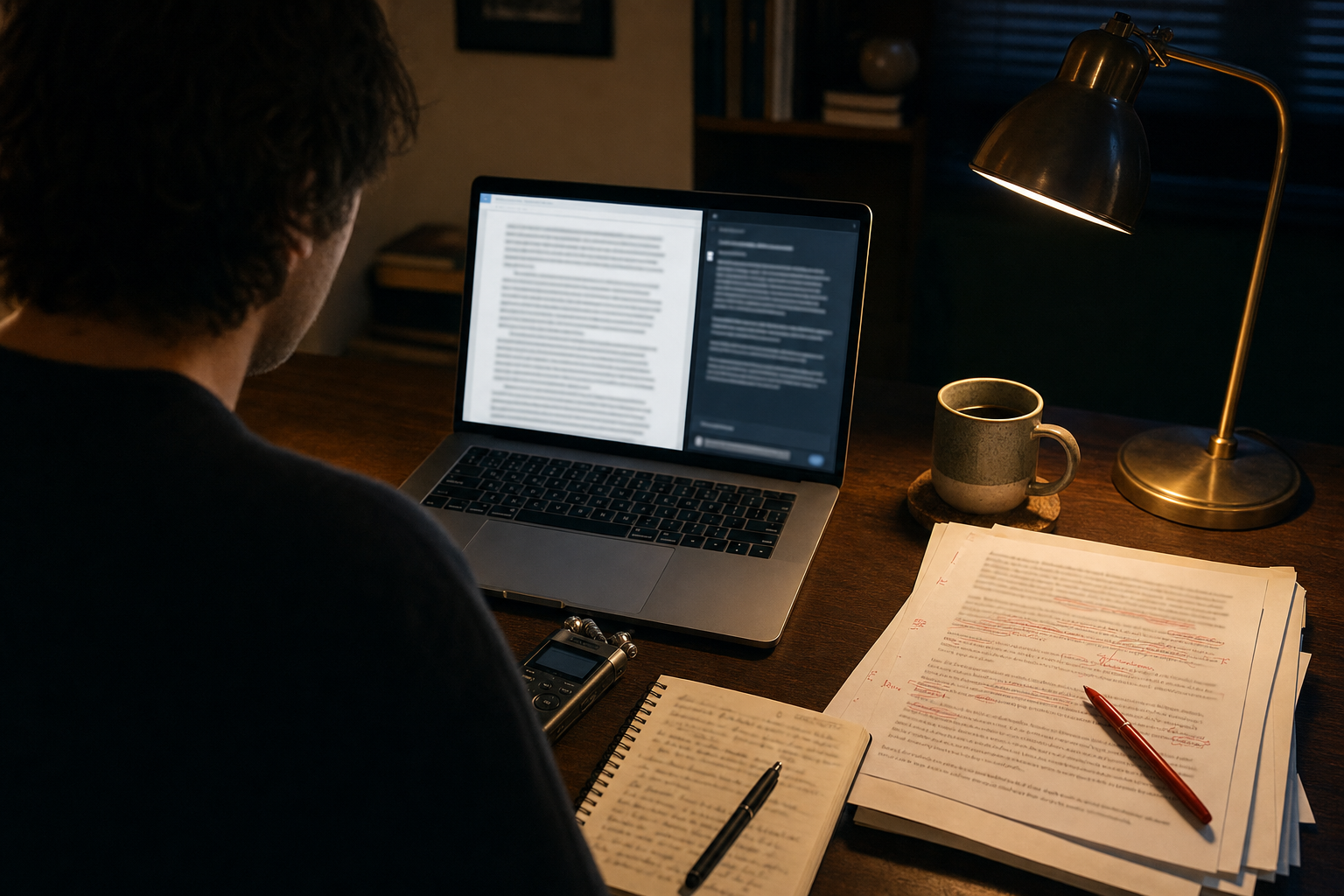
AI-assisted writing has moved from experiment to routine. ChatGPT, Claude, Gemini, Grammarly, and similar tools now sit inside email apps, word processors, and search results. Microsoft’s 2024 Work Trend Index reported that 75% of knowledge workers said they use AI at work. For anyone who writes for a living, for study, or for public audiences, the question is no longer whether these tools exist. It is what they do to the page.
They can help. They reduce the fear of the blank screen, offer outlines in seconds, and smooth awkward sentences. They also create a clear risk: too much help, and the draft starts to sound like everyone else’s draft—clean, balanced, and hard to remember. That matters because voice is not decoration. It is part of how readers decide whether to trust a writer, feel a point, or keep reading. The real debate is not AI versus no AI. It is whether writers can use AI for speed and range without giving up judgment, texture, and lived experience.
Why AI prose drifts toward the middle
There is a simple reason AI writing often feels generic. Large language models are built to predict plausible next words from huge amounts of existing text. That makes them very good at common patterns. Ask for an introduction, and you often get a balanced setup, a few broad claims, and a safe transition. Ask for a conclusion, and you may get a tidy summary with a soft final line. The result is usually readable. It is also often interchangeable.
You can hear the pattern in familiar filler: “it is important to note,” “this raises significant questions,” “in today’s fast-changing landscape.” Even when those exact phrases are gone, the deeper problem remains. The prose often has no real stake in the subject. It sounds informed, but it has not truly noticed anything.
That is why writers sometimes feel uneasy after using AI on a draft. The sentences are smoother, but the piece feels less like theirs. The model has optimized for average fluency. Good writing usually needs something less average than that.
Give AI the jobs that suit it
The best way to use AI is narrow and practical. Use it for range, structure, and pressure-testing. Do not ask it to supply the part of the work that depends on your taste, reporting, or point of view.
- Good jobs for AI: generating headline options, comparing structures, summarizing source material, listing missing questions, suggesting sharper verbs, spotting repetition, and compressing overlong paragraphs.
- Bad jobs for AI: inventing reported details, writing a personal scene, deciding what you truly think, creating quotes, and producing the final emotional turn of the piece.
This is not a moral panic about tools. It is a craft decision. If you outsource the center of the work, the result usually sounds outsourced.
Start with material only you have
The easiest way to get generic writing is to begin with a generic prompt. “Write 800 words about remote-work burnout” will almost always produce a familiar article. The system has to fill the empty space with averages.
A better method is to begin away from the AI tool. Spend ten minutes making a rough note dump in your own words. Write down the moment that made the topic real, the example you trust, the claim you disagree with, the question a reader will ask, and the line you keep circling back to. If you are writing about burnout, that may include the Friday night Slack messages, the manager’s exact phrase, the week you answered email from a waiting room, and the change that finally reduced the pressure.
Those details are not decoration. They are the raw material of voice. AI can help arrange them. It cannot responsibly invent them for you.
Ask for choices, not replacement prose
Many writers lose their voice at the prompt stage. They ask for a finished article in a “smart” or “professional” tone, then spend the next hour trying to remove the synthetic shine. It is usually better to ask for options around your draft rather than a draft that replaces it.
- For structure: “Here are my notes and rough argument. Give me three possible outlines with different emphasis. Do not draft the article.”
- For clarity: “Point out sentences that feel vague, repetitive, or overexplained. Keep the tone direct.”
- For line work: “Give me five alternatives for this sentence, including one tighter version and one more conversational version, without changing the meaning.”
- For headings: “Suggest ten headline options: three plain, three sharp, two surprising, and two conservative.”
These prompts keep the writer in charge. The system becomes a fast assistant, not a substitute author.
Use AI to pressure-test the draft
One of the most useful jobs for AI is not writing. It is criticism. A draft is often weak not because the sentences are ugly, but because the argument has soft spots. A model can help find them quickly.
Ask the kind of questions a sharp editor would ask. Where does this overclaim? Which paragraph sounds like a cliché? What important context is missing? What would a skeptical reader say? Which example is carrying too much weight? Where does the logic jump too fast?
This works especially well for essays, newsletters, speeches, and opinion pieces. A writer may know the subject well and still miss the obvious objection. Getting that objection early is useful. You can answer it, narrow the claim, or cut the weak line before a human reader does it for you.
Protect the sentence-level signs of you
Voice is not just vocabulary. It is what you notice, how fast you move, how certain you sound, which details you keep, and where you place the sharp sentence. AI often smooths those signals away because smoothing is one of the things it does best.
Compare these two lines:
Generic: “My concerns were validated by recurring operational issues.”
Human: “I stopped trusting the product after support tickets piled up for three straight Fridays.”
The second line gives time, texture, and judgment. It has a real-world anchor. The first line may be grammatically fine, but it could belong to almost anyone. When you revise AI-assisted writing, this is the standard to use. Keep the concrete version whenever you have one.
- Would I actually say this sentence aloud?
- Is there a specific noun here, or only abstractions?
- Did I replace a true detail with a smoother summary?
- Does this sound like my level of certainty, or like cautious default prose?
- Is there at least one sentence in this paragraph that only I could have written?
For non-native English writers, clarity should not mean erasure
AI can be especially helpful for people who write in English as a second or third language. It can clean up grammar, fix article use, and make a paragraph easier to follow. That is real value. But there is also a trap. If you ask a system to “make this sound native,” it may flatten regional phrasing, remove useful directness, and replace your rhythm with standard office English.
A better instruction is more precise: “Correct grammar and improve clarity, but keep my wording and sentence rhythm unless something is confusing.” That keeps the tool focused on readability, not personality removal.
What never to outsource
The bigger risk than generic tone is false authority. AI systems can produce plausible details, invented citations, and fake quotes with alarming ease. If you write reported work, analytical work, or anything that relies on trust, do not use AI to fill gaps in your sourcing.
- Never publish a quote you did not verify.
- Never keep a statistic you did not trace to a real source.
- Never present an anecdote, interview, or example the system invented.
- Never outsource the part of the piece that depends on your actual experience or judgment.
A generic paragraph can usually be fixed. Fabricated specifics are a credibility problem.
A practical workflow that keeps your voice
- Step 1: Write raw notes in your own words before opening the AI tool.
- Step 2: Ask for structures, counterarguments, and missing questions, not a finished article.
- Step 3: Draft the key paragraphs yourself: the opening, the lived example, the sharpest judgment, and the ending.
- Step 4: Use AI for selected cleanup: repetition, transitions, compression, and headline options.
- Step 5: Read the piece aloud. Any sentence that sounds too smooth, too vague, or unlike you gets rewritten by you.
That final read-aloud pass matters more than many writers think. Your ear catches what your eyes forgive. If the rhythm feels borrowed, it probably is.
If a paragraph could have been written by anyone, it is not finished yet.
That is the simplest rule for writing with AI without disappearing into it. Use the tool where it is strongest: options, structure, compression, challenge. Keep a firm grip on the parts that carry your name: the observation, the memory, the judgment, the sentence with a pulse. A faster draft is useful. Your own voice is what makes it worth reading.