Your Voice Is a Skill: How Writers Can Use AI Without Sounding Generic
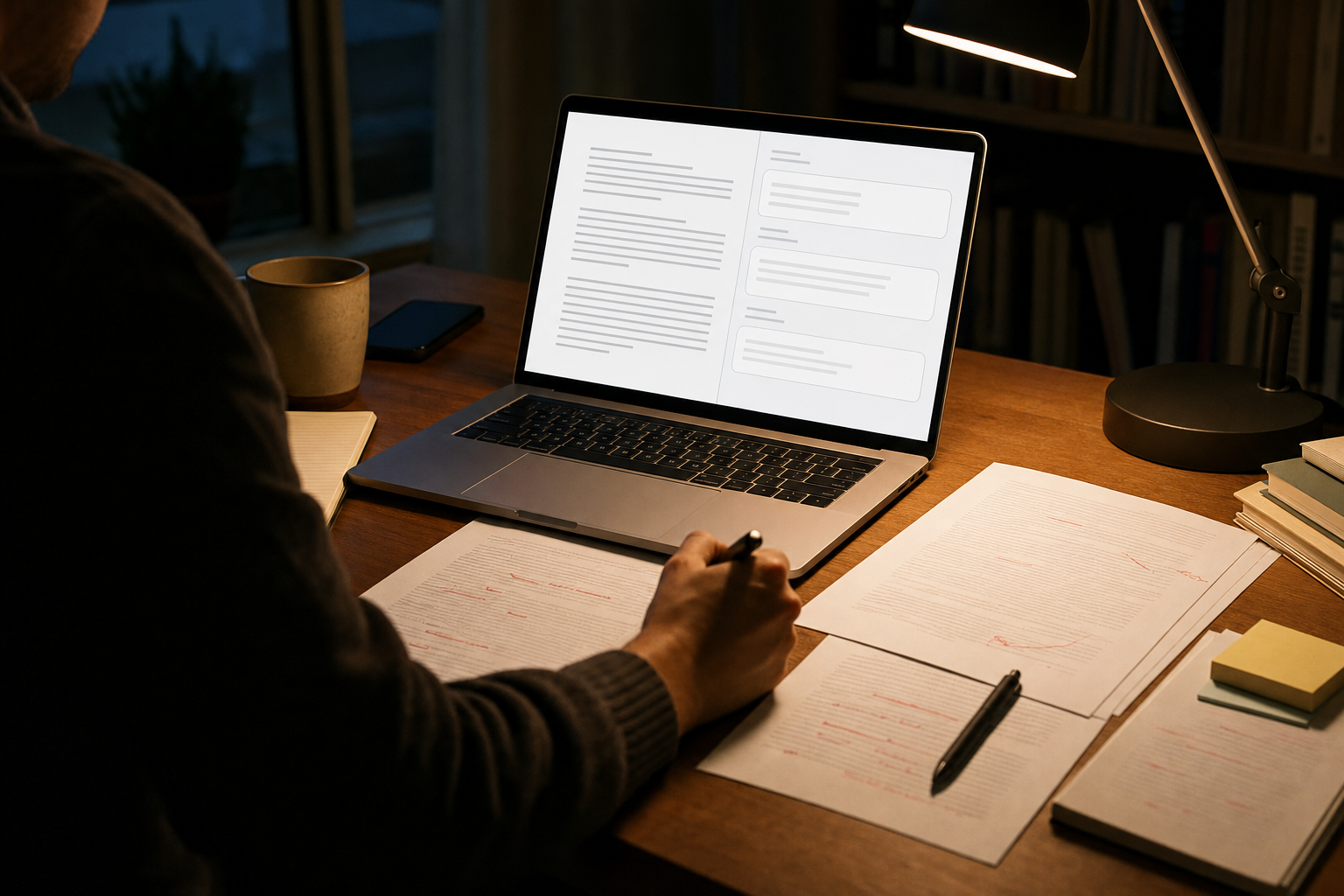
AI writing tools are now built into email, search, word processors, and note apps. They can draft a pitch, rewrite a sentence, summarize a meeting, and translate a paragraph in seconds. That convenience is real. So is the backlash. Many writers say that the more they rely on these tools, the more their work starts to sound smooth, correct, and strangely interchangeable.
That matters because voice is not decoration. It carries credibility, taste, background, and trust. For bilingual writers moving between Arabic and English, it also carries cultural meaning that can disappear when a system chooses the safest possible phrase. The debate is no longer whether writers will use AI. It is whether they can use it for speed without letting it flatten their language.
The promise is real, and measurable
There is a reason so many people keep these tools open. In Microsoft’s 2024 Work Trend Index, 75% of surveyed knowledge workers said they use AI at work. In a widely cited field study of customer support agents, access to generative AI raised productivity by about 14%, with the biggest gains for less experienced workers.
The lesson is not that AI makes everyone a better writer. It is that AI is very good at reducing friction. It helps with first passes, formatting, summaries, grammar cleanup, and versioning. If you need five subject lines, a tighter memo, or a short summary for a busy manager, it can save real time.
But the same strength creates the central risk. These systems are designed to predict likely language. Likely language is usually familiar language. Familiar language is often generic language.
Why generic writing spreads so fast
Generic AI prose has clear symptoms: abstract nouns, empty transitions, and a tone of polished certainty. You see phrases like “in today’s fast-paced world,” “it is important to note,” or “organizations can leverage.” The sentences are not wrong. They are just low-information.
“It sounds fine, but it doesn’t sound like me.”
That common complaint is more serious than it looks. When your wording becomes predictable, readers stop feeling a human choice behind it. In journalism, brand writing, and essays, that weakens authority. In personal writing, it erases personality. In bilingual writing, it can also strip away humor, social cues, and local rhythm.
Voice is not a mystery. It is a pattern.
Writers sometimes talk about voice as if it were a gift you either have or do not have. That is not very useful. Voice is a set of choices you repeat often enough that readers begin to recognize them.
- How quickly you get to the point
- Whether your sentences are tight or expansive
- Whether you prefer concrete verbs or abstract language
- What kind of examples you notice
- How formal or conversational you sound
- How you handle doubt, humor, and emphasis
Once you see voice as a pattern of choices, the practical question becomes clearer: which parts of that pattern can you safely automate, and which parts should stay in your hands?
Use AI for labor, not judgment
A useful rule is simple: let AI handle labor before it handles taste.
- Good uses: outlining notes, trimming repetition, generating headline options, cleaning up grammar, comparing structures, and testing different openings.
- Risky uses: asking for a finished personal essay, a full opinion piece, or a cultural translation with no real source material from you.
If the value of the piece depends on your angle, reporting, humor, or moral precision, outsourcing the first full draft is often where the writing starts to lose shape.
Speed is helpful. Substitution is different. A tool can reduce effort. It should not quietly replace the part of writing that readers come to you for.
Stop giving vague prompts
If you want better output, do not tell a model to “sound human” or “make it punchy.” Those instructions are too vague to be useful. Give it a compact style sheet based on your own work.
- Three words that describe your tone, such as direct, warm, unsentimental
- Three things you avoid, such as hype, corporate jargon, and fake certainty
- Two short paragraphs you actually wrote
- A ban list of phrases you never want to see
- A note on audience, such as educated general readers, including non-native English speakers
This works better than trying to manufacture personality from scratch. The system needs evidence, not adjectives.
Use the notes below to draft three openings. Keep the tone direct and calm. Write in plain English for busy readers. Avoid startup jargon, motivational language, and filler. If an Arabic phrase loses meaning in English, flag it instead of replacing it with a bland equivalent.
That kind of instruction does two important things. It sets boundaries, and it protects meaning.
For Arabic-English writers, translation is where voice often disappears
Bilingual writers face a harder version of the same problem. They are not only choosing words. They are choosing norms.
Arabic and English do not always organize emphasis the same way. A literal translation can sound flat, too formal, or oddly sharp, even when every word is technically correct. Common phrases also carry more than dictionary meaning. Inshallah can signal faith, politeness, uncertainty, or simple habit depending on context. Yalla can mean “let’s go,” “okay,” “come on,” or “hurry up.” A generic system often picks one safe translation and removes the social texture.
The problem is not limited to slang. Formality also shifts. A respectful Arabic line may become stiff in English. A warm English line may become thin in Arabic. And AI systems, especially those strongest in standard web English, often pull distinct local voices toward a more global, corporate middle.
The answer is not to avoid AI. It is to use it as a comparison tool, then make the cultural choice yourself. Ask for two or three translations with notes on tone. Ask what is lost in a literal version. Keep a term untranslated when its cultural weight matters, and explain it only when the reader truly needs help.
A workflow that protects your voice
Writers who use AI well usually do not hand over the whole job. They break the work into parts.
- Write the spine yourself. Draft the central claim, scene, anecdote, or reporting notes without AI first. Even five rough sentences are enough.
- Use AI to widen choices. Ask for alternative structures, shorter versions, sharper transitions, or headline options.
- Feed it raw material. Names, places, timing, facts, and real quotes make output less generic.
- Ask for variations, not verdicts. “Give me one tighter version, one warmer version, and one more skeptical version” is better than “write the best paragraph.”
- Do the last 20% yourself. Final rhythm, emphasis, and word choice are where voice usually lives.
If you skip the first and last steps, the tool starts to control the center of the piece. That is where writers begin to disappear from their own work.
How to spot AI drift before readers do
Most generic writing can be caught in revision if you know what to look for.
- Too many abstract nouns. Replace “innovation,” “impact,” and “solution” with the actual thing that happened.
- No friction. If every sentence agrees with every other sentence, add the real tension, trade-off, or doubt.
- Too much throat-clearing. Cut phrases like “it is worth mentioning” and “in conclusion.”
- Uniform rhythm. Most generic AI prose has one steady pulse. Break it. Mix short sentences with longer ones.
- Borrowed confidence. If the sentence sounds more certain than your evidence allows, lower the temperature.
A simple test helps: read the piece aloud. Another is even simpler. Ask yourself whether the sentence could appear in a hundred LinkedIn posts and still fit. If the answer is yes, it probably needs revision.
Generic: “In today’s rapidly evolving digital landscape, creators must leverage AI strategically to enhance productivity.”
Better: “AI can help writers move faster, but if you let it choose every sentence, your work starts to sound like everyone else’s.”
When not to use AI at all
Some writing tasks should stay mostly human: personal grief pieces, sensitive political writing, reporting that depends on careful sourcing, and any passage where the exact moral tone matters more than speed. The same goes for work with legal, medical, or reputational risk.
Here the problem is not just blandness. It is responsibility. A tool can help surface options, but it cannot carry accountability for nuance, fairness, or consequences. The writer can.
Keep the tool in its place
The healthiest way to think about AI writing tools is not as a rival and not as an author. They are fast assistants with average instincts. That can be useful. Average instincts are good at templates and cleanup. They are bad at singularity.
Your voice is a skill. It grows from attention, revision, memory, reading, and repeated choices. Use AI to save time on the parts that do not define you. Protect the parts that do. If a sentence could have been written by anyone, it is not finished yet.