Why Writing by Hand Still Matters in the Age of AI Tutors
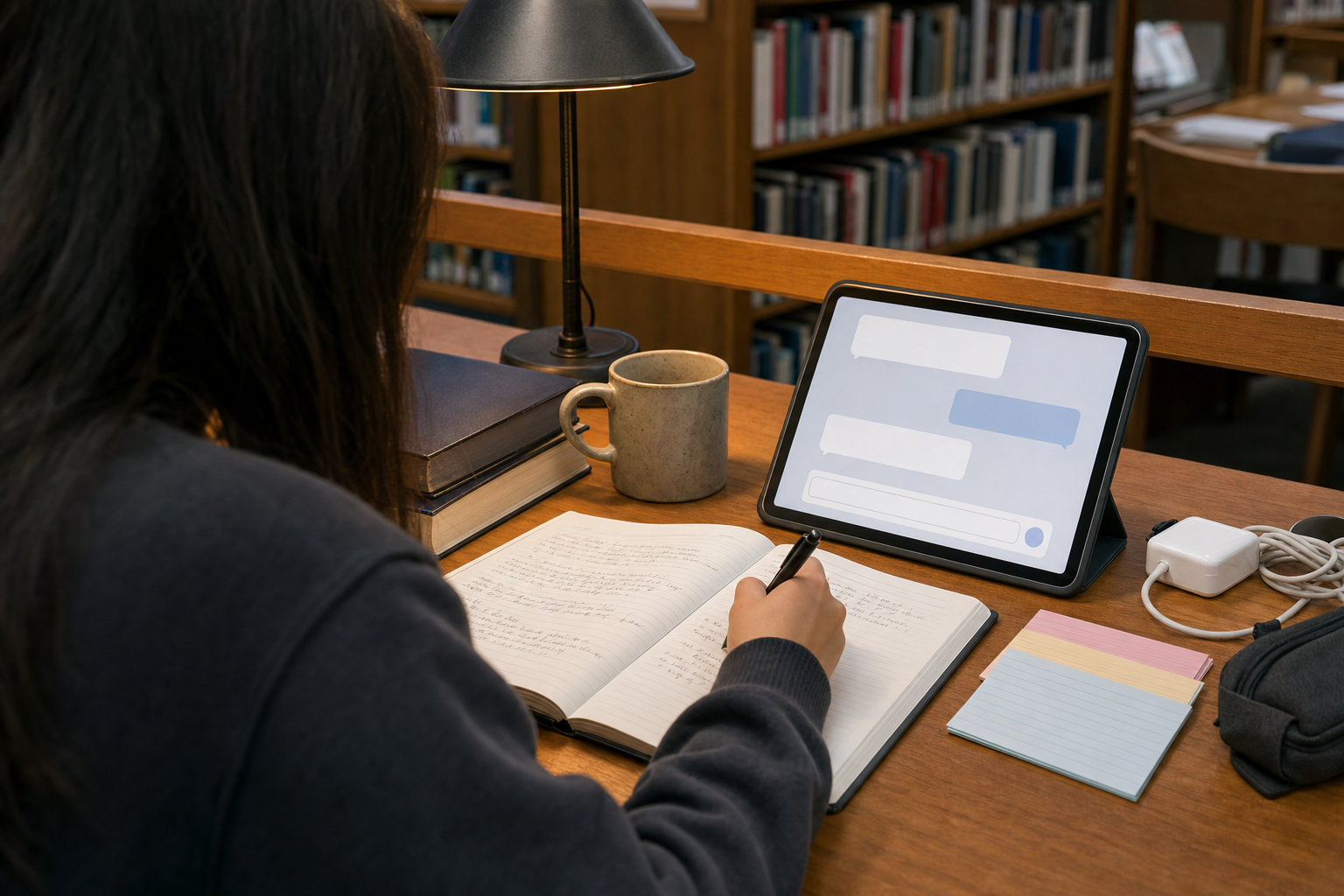
As AI tutors move from novelty to study routine, an older tool is getting new attention: the pen. New discussion around handwriting and cognition, helped by neuroscience studies and classroom research, has reopened a basic question. If a student can ask an AI system for an instant explanation, summary, or model answer, does writing by hand still matter?
It does, for a simple reason. Learning is not only about getting information quickly; it is about doing enough mental work to remember, connect, and use it later. That is the real tension in the age of AI tutors. The promise is obvious: faster feedback, more practice, and help on demand. The risk is just as clear: students may skip the slow first step where understanding is actually built.
The slow part is doing real work
Writing by hand is slower, and that is often the point. Because the hand cannot keep up with every sentence at lecture speed, students have to shorten, sort, and rephrase. Those small decisions are not a side effect of learning. They are part of it.
A typed page can easily become a transcript. A handwritten page is more likely to become a summary, a sketch, or a map of what matters. Students draw arrows between ideas, box a key term, write a question in the margin, or keep every step of a math problem visible from start to finish. None of that is impossible on a keyboard. It is just less automatic.
Paper also changes attention. Notifications do not interrupt it. Search does not tempt the student to jump ahead. And the physical layout of a page can help memory in practical ways. Many students remember not only what they wrote, but roughly where they wrote it.
What the research says, and what it does not
Fact: A widely cited 2014 study by Pam Mueller and Daniel Oppenheimer found that students who took notes longhand did better on conceptual questions than students who used laptops. The laptop group tended to capture more words, often close to verbatim.
Fact: More recent EEG research from scholars in Norway has reported more connected patterns of brain activity during handwriting than during typing. Other studies, especially with children, have linked forming letters by hand with reading and letter recognition.
Interpretation: Taken together, these findings support a modest claim, not a magical one. Handwriting can help encode information because it combines movement, attention, selection, and visual layout. It forces the learner to make choices.
What is uncertain: The size of the benefit is still debated. Not every study finds the same effect. Results depend on the task, the age of the learner, the quality of the notes, and whether typing becomes passive transcription. More brain activity does not automatically mean better learning. It is also not fully clear how much of the effect carries over to tablets and stylus input, though digital ink may preserve some of the same cues.
AI is most useful after the first attempt
None of this means AI tutors are bad for learning. In many cases, they are genuinely helpful. They can explain a confusing step in algebra, generate practice questions, turn rough notes into flashcards, and give language support to students who need simpler English. For students studying alone at night, that kind of immediate feedback can be valuable.
The problem starts when AI arrives before effort. If a student asks for the summary before trying to produce one, the system may remove exactly the struggle that helps memory. If the essay outline appears before the reading has been sorted, the work can look organized without being understood. The result is a familiar academic trap: work that looks polished but is still thin.
AI tools can also create false confidence. Their answers are usually fluent, even when incomplete or wrong. A student may recognize the form of an explanation and mistake that for mastery. Handwriting does not guarantee deep learning, but it does make it harder to skip your own thinking without noticing.
What this looks like in real study sessions
The best use of AI is usually as a second step, not a first one. A few examples make the point clear.
A biology student reads a chapter on cell respiration. Instead of asking AI for a summary right away, she closes the book and writes a half-page explanation by hand. She then uses AI to check what she missed and to generate five quiz questions on the parts she got wrong.
A history student planning an essay writes a paper outline first: thesis, three claims, and two pieces of evidence under each claim. Only then does he ask AI to challenge the argument, suggest counterexamples, or point out where the logic is weak.
A non-native English speaker writes lecture notes by hand in simple language, then asks AI to rephrase them in clearer English and explain two unfamiliar terms. That sequence matters. The student still does the first layer of understanding.
In each case, the student uses AI as a tutor, editor, or reviewer. The system is not doing the first pass of thinking.
A better study loop: write, reflect, then collaborate with AI
For students and teachers, the healthiest workflow is simple.
- Write from memory first. After class or reading, close the source and write a short summary by hand. If you cannot explain it, that gap is useful information.
- Show your steps. In math, science, economics, or logic-heavy subjects, solve at least one problem on paper before asking for help.
- Mark the weak spots. Circle unclear terms, missing steps, or parts you do not trust. Then ask AI focused questions instead of broad ones.
- Use AI for feedback, not first-draft thought. Ask for a quiz, a simpler explanation, counterarguments, error checking, or examples at a different difficulty level.
- Finish with your own version. End by rewriting the idea in your own words. The last pass should belong to the student, not the tool.
Do not turn handwriting into a purity test
There is an important limit to this argument. Handwriting is not automatically best for every person or every task. Students with dysgraphia, motor difficulties, pain, or other disabilities may learn better through typing, speech-to-text, or structured digital tools. Older students writing long papers obviously need keyboards. Searchability, revision, and collaboration are real digital advantages.
So this should not become a nostalgic campaign for paper at any cost. The useful question is narrower: at what point in the learning process does handwriting help this student think more clearly? For many people, the answer is during the first pass: notes, outlines, diagrams, problem steps, and recall practice.
The order of tools matters
The debate is not really pen versus AI. It is about sequence. When students let AI generate the first explanation, the first outline, or the first answer, they often give away the part of study that makes knowledge durable. When they write first and use AI second, they get the best of both: effortful learning and fast feedback.
That is a practical rule worth remembering. Use handwriting to slow thought down just enough to make it yours. Then bring in AI to test it, sharpen it, and extend it.