Can Voice AI Understand Real Life? Siri, Accents, and the Promise of Hands-Free Help
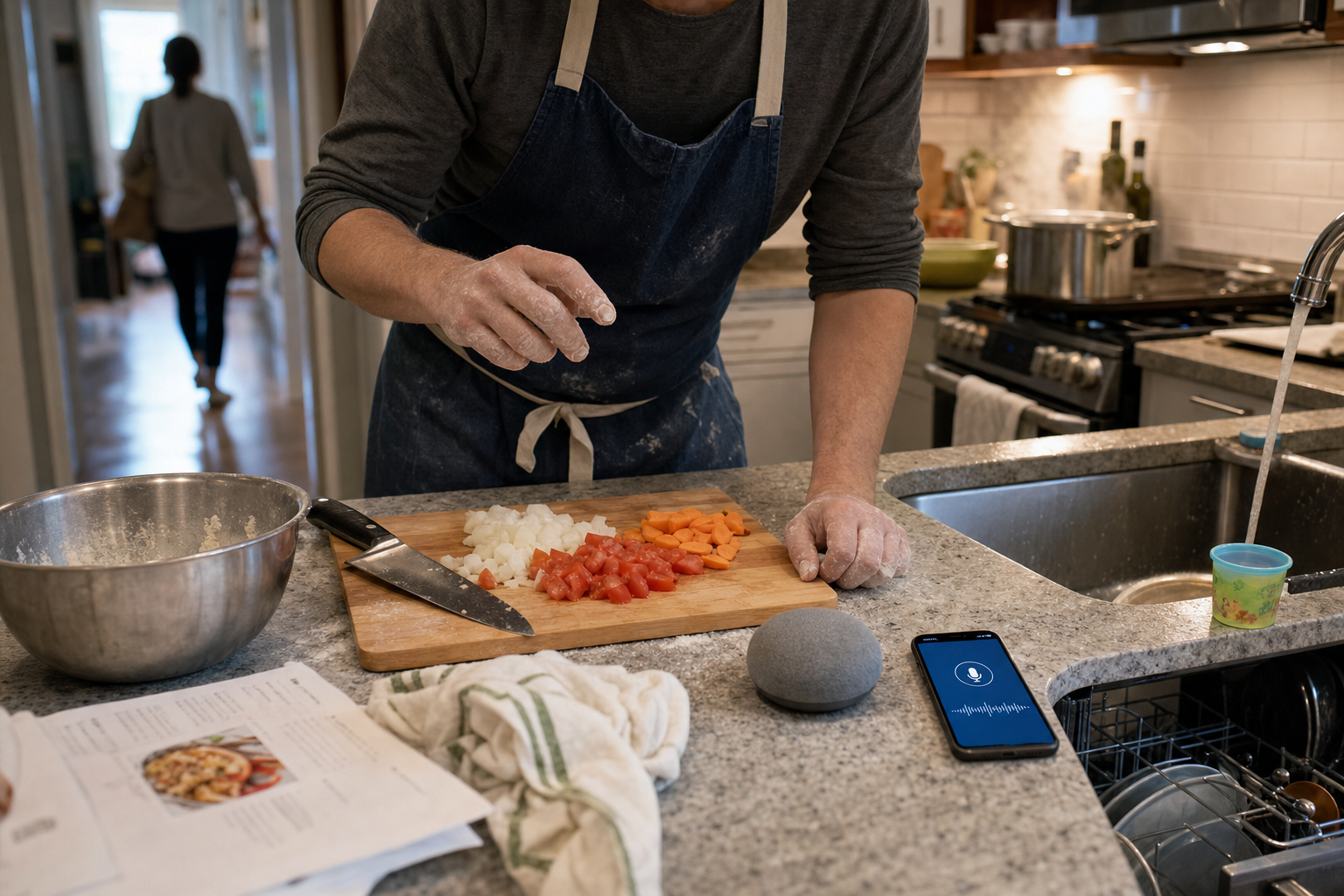
Voice assistants are back in the AI conversation. Apple has previewed a more capable Siri as part of its wider AI push, Amazon has rebuilt Alexa around generative AI, Google keeps folding voice into its AI products, and OpenAI has made natural voice interaction a headline feature. That matters because the next real test for consumer AI is not whether it can answer questions. It is whether it can help when your hands are full, your eyes are busy, or typing is difficult.
The tension is clear. Product demos suggest that voice AI is finally becoming fluid and useful. Daily experience suggests something harder: real speech is messy. People pause, switch languages, interrupt themselves, use local names, speak in noisy rooms, and ask for help in context, not in perfect commands. For multilingual and Arabic-speaking users in particular, the question is not whether assistants sound smarter. It is whether they can handle ordinary life.
Why voice is returning now
Part of the answer is technical. Large language models are better than older assistants at handling flexible wording, follow-up questions, and summaries. A user no longer has to guess the exact command as often as before. In theory, that should make voice feel less brittle.
Part of the answer is commercial. Phones are mature, app stores are crowded, and every major company wants AI to feel useful in the background of daily life. Voice is the most obvious interface for that idea. You can use it while driving, cooking, walking, or carrying a child. For people with low vision or motor impairments, it can be much more than convenient.
But much of the current excitement still rests on claims, previews, and selected demos. In Apple’s case, the promise of a more personal Siri has generated strong interest, but the harder question is what happens after the keynote. Can the system reliably understand names, accents, on-screen context, and corrections? Public evidence is still thinner than the marketing.
Understanding speech is not the same as understanding life
When people say they want a smarter Siri, they usually mean several different things at once.
- They want the system to hear the words correctly.
- They want it to understand what task is being requested.
- They want it to keep track of context across turns.
- They want it to act on the right app, person, or device.
- They want it to recover gracefully when the request changes halfway through.
That is a much harder problem than speech-to-text alone. Consider a simple request: “Message Ahmed that I’m ten minutes late. No, make that twenty. Send it on WhatsApp, not SMS.” A useful assistant has to recognize the speech, identify the right Ahmed, understand the correction, switch channels, and confirm only if needed. If it fails at any step, the hands-free experience collapses.
This is why many users still describe assistants as helpful for timers, alarms, and weather, but unreliable for anything involving people, context, or ambiguity. The new generation may improve that. It has not yet proven that it can solve it consistently.
Accents are not a side issue
Accent handling is often treated as a niche concern. It is not. Everyone has an accent. What people usually mean is whether the system performs well for the accents and dialects that dominate its training data, and worse for others.
There is solid evidence that speech systems do not fail evenly. A widely cited 2020 study in PNAS by Allison Koenecke and colleagues found that several leading speech-recognition systems had much higher word error rates for Black speakers than for white speakers. In that study, the average error rate was about 35 percent for Black speakers and 19 percent for white speakers. The exact numbers depend on the system and dataset, but the message was simple: speech AI can work significantly better for some groups than for others.
That matters far beyond one country or one language. If a system is trained more heavily on standard American or British English, it may still struggle with regional speech, non-native pronunciation, fast speech, or code-switching. A user can feel this immediately. The assistant responds, but not quite correctly. Names become the wrong names. Places become other places. A useful shortcut turns into manual cleanup.
If a voice assistant only works well when the user slows down, speaks standard English, and avoids interruptions, it is not ready for everyday life.
Why Arabic makes the problem more visible
Arabic is a strong test case because “Arabic support” can mean very different things in practice. Modern Standard Arabic is one thing. Daily speech is another. Egyptian, Levantine, Gulf, Iraqi, Sudanese, and Maghrebi varieties differ in pronunciation, vocabulary, and rhythm. Many people also switch between Arabic and English in the same sentence, especially when referring to apps, brands, work terms, or technical tasks.
That is where many assistants start to show their limits. A request like “Remind me tomorrow after Maghrib to send the PDF to Rania on WhatsApp” is normal speech for many users. It mixes a relative time expression, a specific contact, an app name, and possibly a pronunciation that does not match English-centric training. A slightly different version in Gulf Arabic or Egyptian Arabic may confuse the system further.
Names are another weak point. Arabic names are often transliterated in different ways across contacts and apps. “Abdulrahman,” “Abdelrahman,” and “Abd Al Rahman” may refer to the same person or three different people. Place names create similar problems. If the assistant cannot handle this reliably, the user learns not to trust it for anything important.
There is also a data problem behind the product problem. English has far more commercial speech data, benchmark attention, and annotation resources than most Arabic dialects. Companies can say a language is supported, but support may still be shallow for local accents, mixed-language speech, or real household conditions.
Context and interruption are the real test
People do not speak to assistants the way they write instructions. They correct themselves mid-sentence. They refer back to earlier requests. They change their mind because a child is calling, the doorbell rings, or traffic changes.
That means the most important skill may not be eloquence. It may be recovery. Can the system handle “No, not that one”? Can it keep track of what “send it to her” means? Can it tell when it should ask a quick clarifying question instead of making a risky guess?
This is one reason Siri remains such a useful case study. It has been around long enough for users to know both its convenience and its limits. Many people already trust it for narrow tasks. Far fewer trust it for layered tasks. The current AI wave is promising to close that gap. If it succeeds, users will notice not because the assistant sounds more natural, but because they need fewer retries.
Accessibility raises the standard
Voice AI is often marketed as convenience. For many users, it is about access. The World Health Organization estimates that around 1.3 billion people live with significant disability. Not all of them use voice technology, of course, but for blind users, people with motor impairments, some older adults, and people who struggle with typing, better speech interfaces can remove real friction from daily life.
That makes reliability more than a product-quality issue. If a voice assistant misunderstands a grocery list, it is annoying. If it fails during navigation, medication reminders, or communication, the cost is higher. Accessibility users often need the system to work in ordinary speech, not in a special “assistant voice.” They also need clear confirmations, easy correction, and consistent behavior.
This is where the industry’s strongest promise meets its toughest obligation. A hands-free tool that only works for a narrow range of users is not much of an accessibility solution.
What genuinely useful hands-free help would look like
A better assistant does not need to sound human. It needs to be dependable. For voice AI to feel mature, users should be able to expect a few basic things:
- Better accent and dialect coverage: not just formal language support, but solid performance across regional speech and mixed-language use.
- Fast, low-friction correction: the system should handle “no, the other Ahmed” without forcing a full restart.
- Context awareness: it should know what is on screen, what app is open, and what the previous instruction referred to, when permission allows it.
- Care with sensitive actions: messages, payments, and bookings should get confirmation when the risk of error is high.
- Useful fallback behavior: when uncertain, it should ask a short clarifying question rather than fail silently or invent a wrong action.
- Privacy by design: more on-device processing, clearer controls, and less hidden data collection.
These are not glamorous features. They are the features that make voice worth using more than once.
The risk behind the convenience
There is also a privacy trade-off that gets bigger as assistants become more capable. A voice system that can summarize messages, understand personal context, and act across apps needs access to more personal data. In practice, that can include calendars, contacts, location, browsing context, and sometimes ambient speech around the device.
The promise is obvious: less friction, better timing, more useful help. The risk is also obvious: more surveillance potential, more accidental actions, and more uncertainty about where sensitive data is processed. For families, shared households, and children, the issue becomes even more complicated.
This is one reason on-device processing matters so much. It is not just about security. It is also about trust and speed. If a simple reminder or message command requires a slow trip to the cloud and back, users feel the delay. If a private request leaves the device unnecessarily, they may stop using the feature altogether.
What to watch next
In the next wave of announcements, the most useful questions will be simple ones.
- Does the assistant work across accents, or mainly in controlled demos?
- Does it handle interruptions and corrections without falling apart?
- Does it perform well in Arabic dialects and mixed Arabic-English speech?
- Does it actually complete tasks, or mostly produce polished answers?
- Does the company publish meaningful details about privacy, latency, and language coverage?
Those questions matter more than whether the assistant sounds charming. Most users do not want a more talkative device. They want fewer retries, fewer mistakes, and less effort.
That is the real standard for Siri and every rival now chasing the same goal. Voice AI will feel ready when people no longer have to simplify themselves for the machine. Until then, the promise of hands-free help remains exactly that: a promise, impressive in demo form, but still uneven in the messy reality of human speech.