From Prompt to Poem: What AI Teaches Us About Metaphor, Memory, and Cultural Context
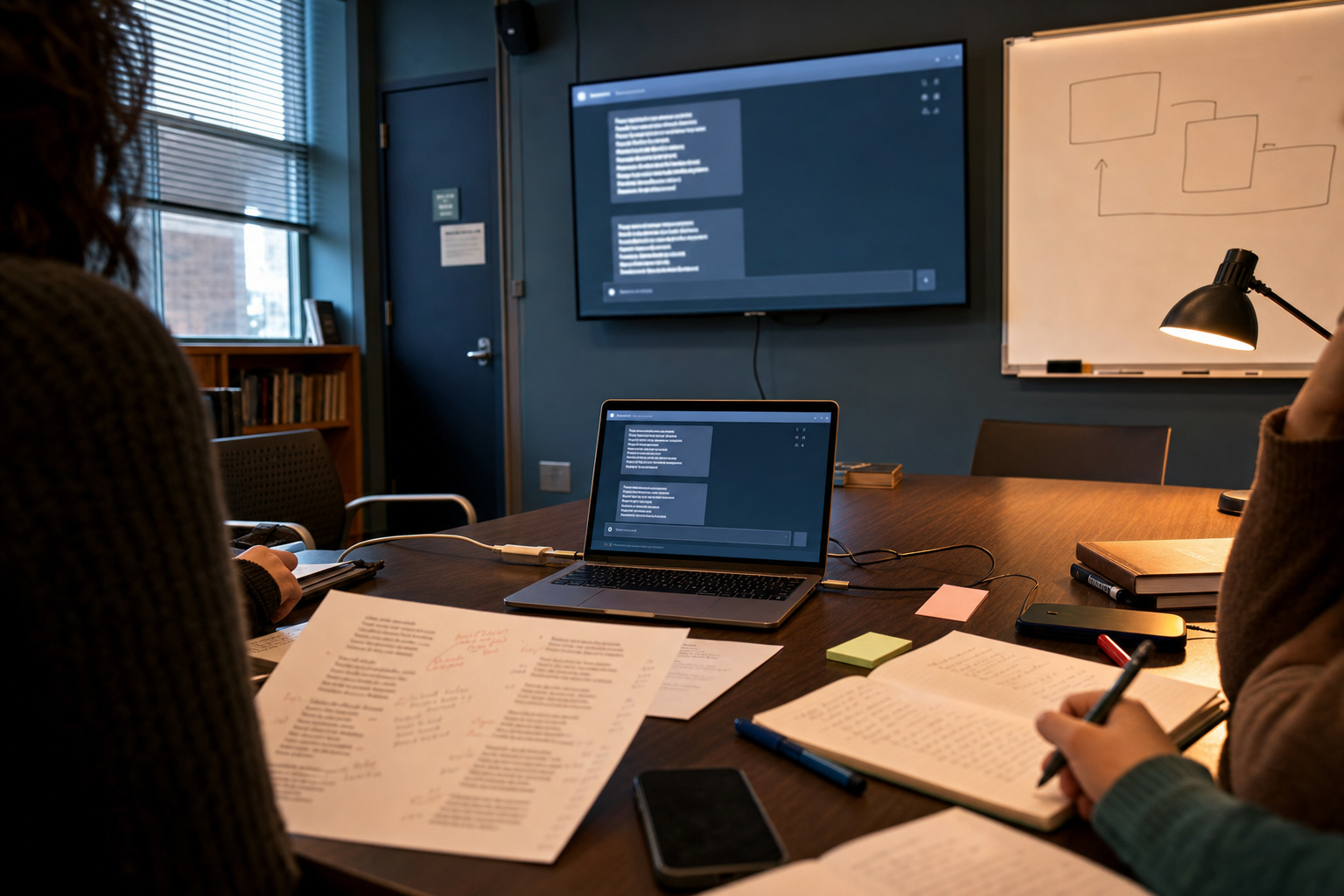
AI poetry is no longer a novelty. Chatbots and writing tools can produce haiku, sonnets, breakup poems, or “poems in the style of” a known writer in seconds. In recent blind-reading experiments, many readers have struggled to reliably distinguish short AI poems from human ones. That matters because the question is no longer whether these systems can sound literary. It is what their fluency reveals about language itself: how much of a poem comes from pattern, and how much comes from memory, culture, and human stakes.
The debate is often framed too simply as a contest over creativity: can a machine be creative or not? That misses the more interesting tension. Large language models are very good at recombining patterns from enormous text archives, often measured in billions or trillions of tokens. Poetry, however, depends on more than pattern. It depends on lived experience, local meaning, and choices shaped by time and place. AI poetry sits right on that fault line, which is why it is worth taking seriously even when the poems themselves are forgettable.
The prompt is already part of the poem
One reason AI poetry can look impressive so quickly is that the prompt often carries much of the real work. Ask for “a villanelle about airport security and homesickness in plain language,” and the human has already chosen the form, setting, mood, and emotional pressure. The system’s job is to generate language that fits.
That does not make the result fake. It does mean authorship gets more layered. The human supplies the frame, the constraints, and usually the taste. The model supplies draft language at speed. In practice, the strongest results rarely come from one magical prompt. They come from a loop: generate, cut, ask for more concrete images, remove clichés, change the rhythm, try again.
This matters because AI poetry is often discussed as if the poem appears fully formed from the model. It does not. The prompt is an editorial instruction, sometimes almost a hidden outline. When people say an AI poem feels coherent or surprisingly moving, they are often responding to the quality of the prompt and the human selection process as much as the raw output.
Metaphor comes easily to a system trained on patterns
Metaphor is where AI often looks strongest at first glance. That makes sense. Large language models are trained to predict likely language based on vast examples. Metaphor depends on association: time as money, grief as weather, love as fire, the city as a body, the mind as a machine. A system that has absorbed huge numbers of these pairings can produce them fluently.
Ask a model for metaphors about burnout, and it may give lines like “a browser with too many tabs” or “a phone that never reaches 100 percent.” These work because they compress a modern feeling into a familiar object. The reader gets the idea immediately. That is not trivial. It is a real form of linguistic competence.
But competence is not the same as pressure. Emily Dickinson wrote, “Tell all the truth but tell it slant—.” Good metaphor does not just decorate feeling. It turns feeling until the reader sees it differently. That usually requires more than association. It requires judgment about what is at stake in the comparison.
This is where AI poetry often starts to thin out. A line such as “silence is a glass forest” may sound fresh, but unless the surrounding poem gives that image a clear job to do, it remains a polished surface. Many generated poems are full of lines like that: novel enough to catch the eye, too weightless to stay in the mind.
Memory without recollection
Human poems are often built from memory, but memory in literature is not just storage. It is selective. It distorts, sharpens, omits, and returns. A poet remembers a room, a smell, a sentence from a parent, and years later that fragment carries more than description. It carries consequence.
AI does not remember in that way. It works through statistical traces from training data and whatever text sits inside the current conversation or context window. It can maintain a motif across several stanzas. It can echo an image from line two in line twelve. It can imitate nostalgia because it has seen a great deal of language about nostalgia. But it does not retrieve a private past.
That difference matters. A human poem about a hospital bracelet, a bus ticket, or a broken bowl may carry a life behind the object. A generated poem can assign symbolic value to the same object, but the force usually comes from convention rather than recollection. Readers often feel this even when they cannot explain it. The poem seems polished, yet oddly uncommitted.
This is also why AI can be useful as a literary mirror. It shows how much emotional writing is built from shared signals. Rain, kitchen light, old photographs, winter coats, train stations, empty chairs, mother tongues: these are not false images. They endure for a reason. AI reveals how quickly they become generic when no deeper memory arranges them.
Culture is not a backdrop
“Language carries culture.”
Ngũgĩ wa Thiong’o’s short line is a useful test for AI poetry. Culture is not decoration added after the poem is made. It shapes what an image means, who is speaking, what remains unsaid, and what kind of rhythm feels natural.
Take something as simple as the moon. In one literary context it may suggest romance. In another it carries exile, distance, or a religious calendar. In another it may be so overused that a serious poet avoids it entirely. A model trained on huge mixed corpora often blends these traditions into one smooth, global lyric voice. The result can be readable and even pretty. It can also flatten difference.
You can see this most clearly when the prompt asks for a poem tied to a specific community or ritual. Ask for a poem about Ramadan, and a model may produce dawn, dates, lamps, patience, and hunger. None of those details are wrong. But they may sit at brochure level. What is missing are the textures that make the moment real: the apartment noise before dawn, the joke at the table, the drag of a workday, the exact sound of a neighborhood just before sunset.
The same issue appears across languages. A prompt written in Arabic, Hindi, Spanish, or Swahili may still trigger an output shaped by dominant English-language patterns, especially if the system has seen far more English literary commentary than living local verse. The grammar may hold. The idiom may not. This is one reason AI poetry can feel culturally adjacent rather than culturally rooted.
There is an ethical edge here too. When users ask for poems “in the style of” a living writer, the system may reduce a hard-won voice to a package of habits: short lines, rural images, clipped endings, a familiar tone of sorrow. That is less like literary influence and more like style extraction.
Why readers sometimes overrate AI poems
If readers prefer AI poems in some blind tests, that does not prove that the systems have matched the best human poetry. It tells us something narrower and, in some ways, more revealing. Many people read poems quickly. On a quick read, polish can beat depth. A clear image, a smooth cadence, and a serious tone can create the impression of insight.
AI systems are good at producing that impression because they generate text one small unit at a time by leaning toward plausible continuation. That makes them especially effective at short lyric forms, where a few vivid images can stand in for a larger structure. The risk is obvious: readers start mistaking fluency for necessity.
Human poems do not always announce their depth on first contact. Sometimes they resist. Sometimes they are awkward because the writer is trying to say something that does not yet have a standard shape. AI tends to smooth those edges away. The result is often more immediately agreeable and less memorable two days later.
What AI poetry is genuinely good for
None of this means AI has no place in literary practice. It has several practical uses, and some are genuinely valuable.
- It lowers the cost of experimentation. A student can ask for the same idea as a sonnet, ghazal, prose poem, or haiku and quickly see how form changes emphasis.
- It helps writers test constraints. If you want ten different openings for a poem about migration, or you want to strip adjectives from a draft, the tool can speed up exploration.
- It can support non-native English writers. Used carefully, it can suggest alternatives for tone, diction, or line breaks without pretending there is only one correct literary English.
- It acts as a cliché detector. Because it reproduces common literary habits so efficiently, it can show writers what sounds generic in their own work.
The risks are just as real. Overuse can flatten a writer’s ear. Style mimicry raises consent questions. Publishers and teachers may face a flood of competent but interchangeable verse. And when a model’s training data underrepresents certain traditions, the system can quietly reinforce the idea that a narrow, globalized literary style is the default.
A better way to judge the poem
Instead of asking only whether an AI poem is good, it helps to ask sharper questions.
- What came from the prompt, and what came from the model?
- Which images feel culturally earned, and which feel imported?
- Is the metaphor doing real work, or just sounding poetic?
- Does the poem risk specificity, or does it stay safely generic?
- What line feels necessary rather than merely plausible?
These questions improve human reading too. That may be the clearest lesson of AI poetry. It forces us to notice parts of literary craft that readers often take for granted: how much a poem leans on shared memory, how much on convention, how much on local knowledge, and how much on a voice shaped by an actual life.
From output back to reading
The most useful conclusion is also the simplest. AI does not need feelings, intention, or a biography for its poems to matter culturally. Its importance lies elsewhere. By turning prompts into plausible poems at scale, it exposes the building blocks of literary language: repeated metaphors, inherited symbols, stock emotions, prestige tones, and cultural defaults.
That is both the promise and the warning. The promise is access, speed, and a new tool for experimenting with form. The warning is that poetry can be reduced too easily to its visible signals. When that happens, language gets smoother, broader, and less rooted in place.
The better question, then, is not whether AI can write a poem. It plainly can produce something that looks and sounds like one. The better question is what kind of reading that output demands from us. Read closely, and AI poetry does not replace the human literary tradition. It reminds us why that tradition was never just about elegant lines. It was always about memory under pressure, metaphor with consequences, and language carrying the weight of a culture.