The AI Co-Creator in Your Pocket: What an On-Device Piano Model Teaches Us About Creativity
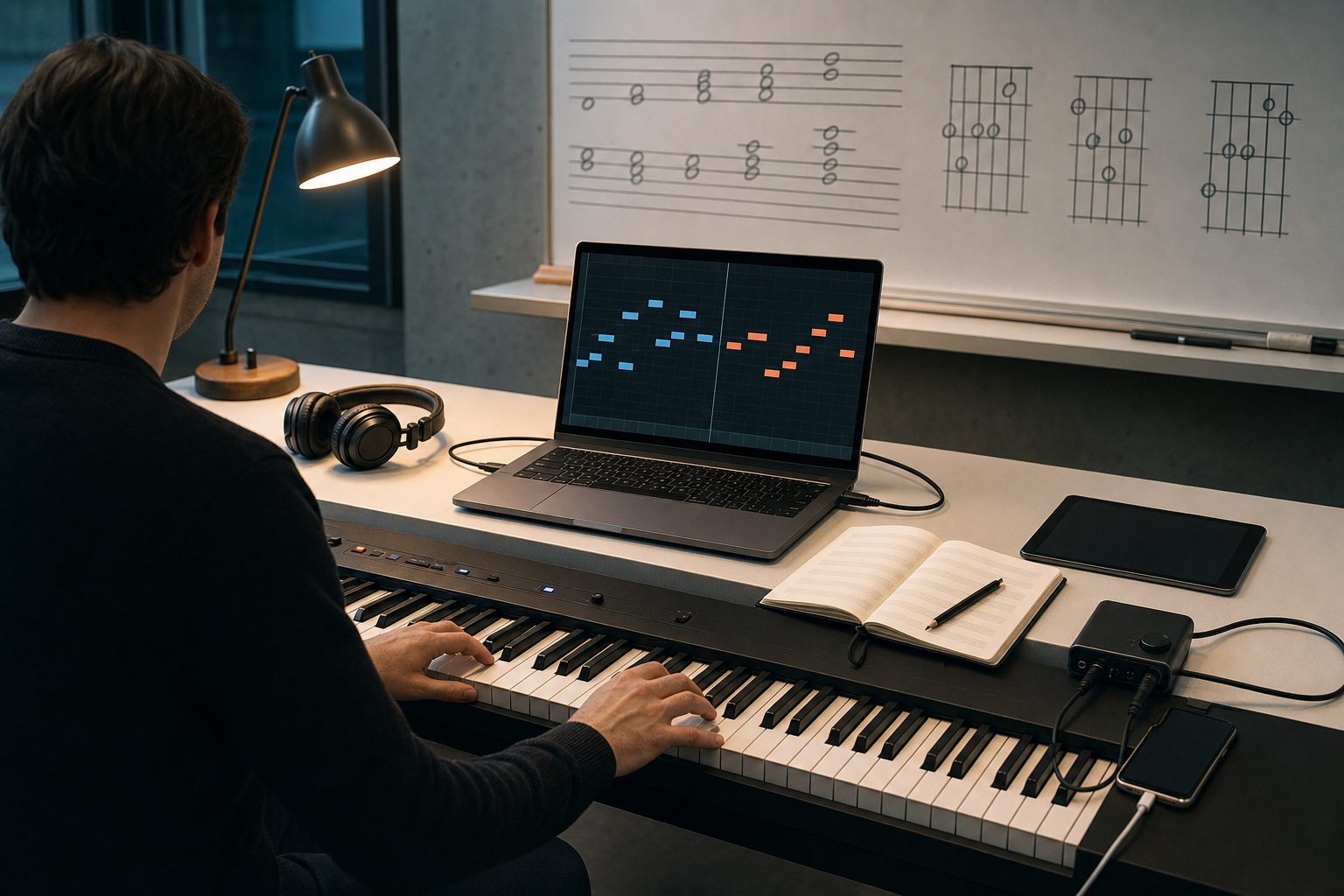
A recent Show HN post on Hacker News drew attention to a 125 million-parameter piano autocomplete model that runs on-device. In plain terms, it is a small music model designed to suggest what might come next while someone is playing, without depending on a cloud server for every response. That matters because it offers a different story about AI and art: less about mass production, more about personal use, privacy, and timing.
The bigger debate is clear. Should creative AI try to produce finished work for us, or should it support the messy human process of making something piece by piece? Most public attention has gone to systems that promise instant songs, instant images, and instant content. This piano project points in another direction. It suggests that the more useful role for AI may be as a quiet tool inside practice, not a factory for output.
A smaller model, a different ambition
The number attached to the project matters. A 125 million-parameter model is tiny by the standards of today’s largest AI systems. That is not a weakness in itself. It reflects a different goal.
Large general-purpose models are built to do many things badly or moderately well for millions of users. A narrow model can do one thing with much more focus. In this case, the job is not to write a symphony from a text prompt. It is to help with a specific musical moment: what note, phrase, or continuation might make sense next?
That distinction is important because it changes the user experience. A pianist does not need an AI system to deliver a complete piece every time they touch the keyboard. More often, they need a nudge when they are stuck, a variation when a phrase feels flat, or a harmonic option they would not have tried alone. Autocomplete is a modest idea, but in creative work, modest ideas are often the useful ones.
Why on-device changes the relationship
The phrase on-device can sound technical, but the practical meaning is simple: the model runs on your own hardware. Depending on the build, that might be a phone, tablet, laptop, or another local device. The key point is that the core interaction happens close to the player, not on a distant server.
That changes several things at once.
- Latency drops. In music, delay matters. A suggestion that arrives too late is not a suggestion. It is an interruption.
- Privacy improves. Draft ideas, rough improvisations, and personal habits do not need to be uploaded by default.
- The tool feels more personal. It becomes part of a musician’s setup, like a metronome, a pedal, or notation software.
- The economics are different. A local tool does not need every creative action to pass through a paid cloud pipeline.
This is one reason the project has resonance beyond piano. It shows that creative AI does not have to mean a giant service sitting between the artist and their work. It can be lightweight, immediate, and local.
That said, on-device is not automatically the same as private. If an app still sends usage logs, recordings, or analytics elsewhere, the privacy advantage shrinks. Public demos do not always answer those questions. Unless a developer clearly explains what stays local and what does not, users should treat privacy claims with some caution.
Creativity is still in the choosing
The most interesting part of a tool like this is not what it generates. It is what it leaves to the human musician.
A piano autocomplete model can predict likely continuations. It cannot decide what the piece should mean, when tension should break, how a performance should breathe, or why one wrong note is sometimes better than the correct one. The player still decides what to accept, what to ignore, what to repeat, and when to stop.
That is why the word co-creator needs care. Used loosely, it can exaggerate what the system is doing. This kind of model does not share authorship in any human sense. It produces options from patterns in data. The musician shapes the result through selection, timing, taste, and context. In practice, that can still feel collaborative, but the creative responsibility remains with the person at the keys.
A useful comparison is predictive text, but with one big difference: musical flow is embodied. A sentence can survive a pause. Improvisation often cannot. If a player can stay in motion while seeing or hearing plausible continuations, the tool supports momentum. That can be valuable even when most of the suggestions are rejected.
What this gets right about creative support
The strongest idea behind the project is restraint. It does not try to replace the instrument, the performer, or the practice. It tries to sit inside the practice.
Imagine a few common cases.
A student is working through chord changes and keeps landing on the same safe endings. An autocomplete tool can offer a few alternatives and make the student test them against their ear. A songwriter has a promising motif but cannot find a convincing continuation. A local model can surface a route forward quickly enough to keep the session alive. A hobbyist practicing at night may prefer a private tool that reacts instantly instead of opening a browser, uploading audio, and waiting for a remote model to reply.
These are not glamorous use cases. They are ordinary. That is exactly the point.
For years, AI creativity products have been marketed through spectacle: make a whole album, generate a soundtrack in seconds, produce infinite variations. But most artistic growth happens in smaller loops. Try. Listen. Adjust. Repeat. A tool that supports those loops may do more for real creativity than one that skips them.
The risks are real, just different
It would be a mistake to treat a small, local music model as automatically harmless. The risks are still there. They just show up in a quieter form.
The first risk is style flattening. Autocomplete systems, by design, are biased toward likely continuations. That can pull users toward familiar patterns, common cadences, and safe musical habits. If a player leans on the tool too often, the result may become smoother but less distinctive.
The second risk is training-data narrowness. Public hobby and research projects do not always provide full detail about what the model was trained on. If the source material is narrow, the suggestions will be narrow too. A model trained mostly on conventional piano material may reward one musical language while being weak, awkward, or misleading in others.
The third risk is dependency. Beginners may start to confuse generated options with good musical judgment. That is not a reason to reject the tool. It is a reason to frame it correctly. Used well, it can widen exploration. Used badly, it can become a shortcut around listening.
There is also a legal and ethical question that hangs over many creative AI projects, large and small: what data went in, and with what permission? A Show HN post is not the same as a full methods paper or a commercial disclosure statement. Unless developers are transparent about training sources, users should assume some uncertainty remains.
Why this matters beyond music
This piano model is really a case study in a broader shift. It suggests that the next useful wave of AI may not look like giant all-purpose systems making polished outputs on command. It may look like domain-specific tools that live inside real workflows: a writing assistant that helps with structure but keeps drafts local, a design tool that suggests variations without exporting every sketch, a language tutor that runs offline and reacts in real time.
That matters for three reasons.
- It returns agency to the user. The person is doing the work, with support.
- It reduces the pressure toward industrial content production. Not every creative tool has to become a content mill.
- It makes privacy and access part of the design conversation. Those issues should not be afterthoughts.
There is also a cultural point here. Much of the anxiety around AI in the arts comes from systems built to imitate finished work at scale. That model encourages replacement thinking: cheaper, faster, more output. A pocket-sized creative assistant encourages a different question: what kind of computational help makes practice better without erasing the person practicing?
What to ask before embracing tools like this
If this kind of project becomes more common, musicians and creators will need simple tests for judging it. The right questions are not complicated.
- Does it help me continue, or does it try to take over?
- Can I reject its suggestions easily?
- Does it keep my drafts local?
- Is the response fast enough to preserve flow?
- Do I understand where its patterns come from?
If the answer to those questions is mostly yes, then a creative AI tool may be serving the artist instead of replacing the process.
A better model for creative AI
The lesson from the on-device piano autocomplete project is not that small models are always better. It is that the shape of the tool matters. A focused system that is private, fast, and easy to ignore may fit human creativity better than a more powerful system that pushes users toward passive consumption.
That is a useful correction to the current mood around AI. The most valuable creative tools may not be the ones that promise to do everything. They may be the ones that help you stay in the work a little longer.
For artists, that is a practical standard worth keeping. If an AI tool helps you hear one new option without taking the keyboard out of your hands, it is doing something real. If it turns creativity into button-clicked output, it is probably solving the wrong problem.