The Invisible Labor Behind One-Click AI
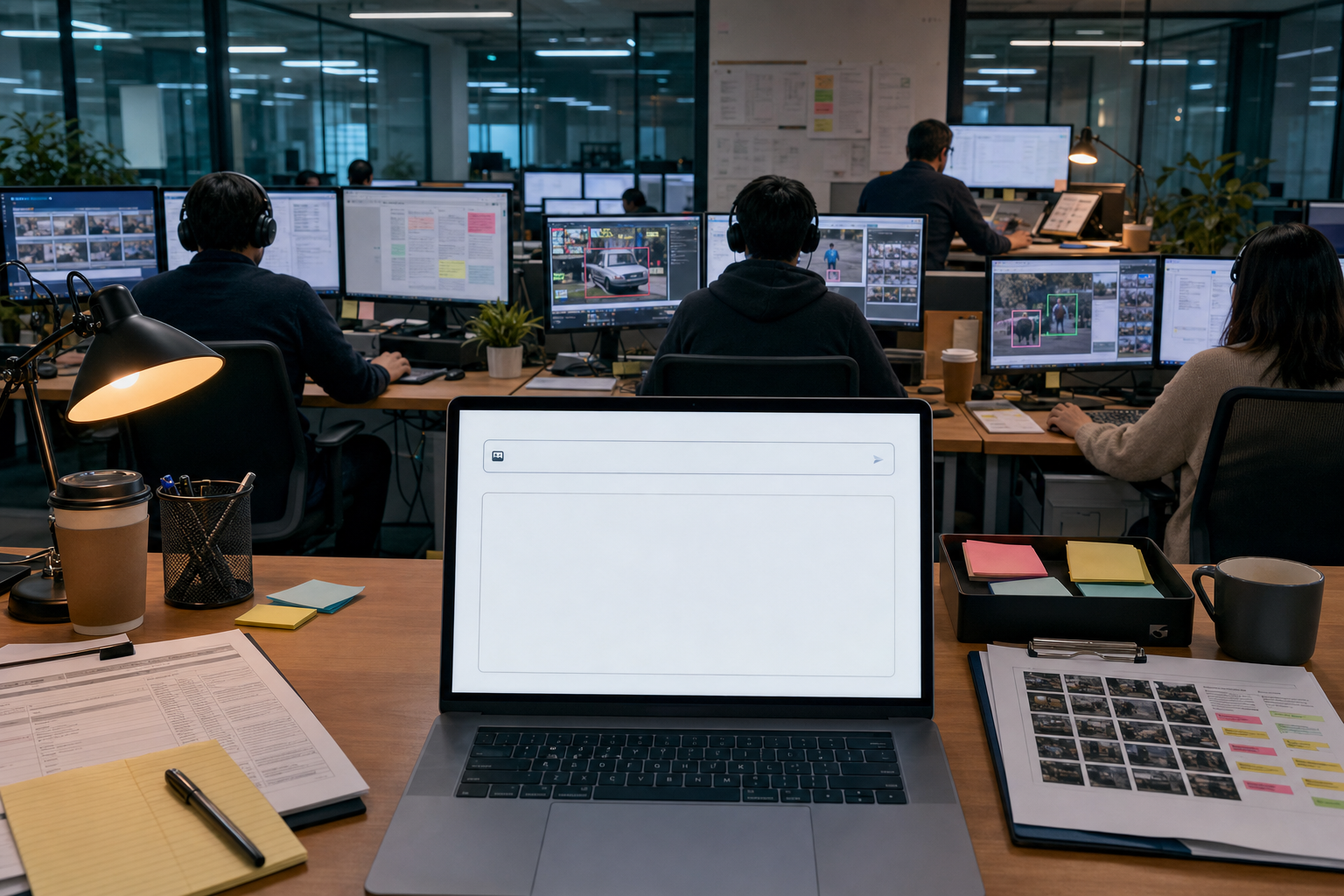
Recent AI headlines have made progress sound almost automatic. A model writes code, summarizes documents, generates a video, or helps explore a hard math problem. The public sees a prompt box and a fast answer. What it usually does not see is the long chain of human work behind that result: annotators labeling data, reviewers ranking outputs, safety teams filtering harmful material, researchers designing tests, experts checking accuracy, and users reporting mistakes. That matters because it changes the story. AI is not just software and chips. It is also a labor system.
The debate is not whether people are involved. They are. The real tension is between the image of AI as frictionless automation and the reality that many useful systems still depend on large amounts of human judgment. Some of that work is done by well-paid specialists. Much of it is done by contractors and crowd workers, far from the companies whose products they improve. The promise is better tools at lower cost. The risk is that the people who make those tools usable remain underpaid, exposed to harm, and easy to ignore.
What the interface hides
The clean design of modern AI products encourages a simple idea: type once, get intelligence. But every reliable output sits on layers of human decisions.
Before a model reaches the public, someone has to gather and clean data. Someone has to remove obvious junk, duplicates, or unsafe material. Someone has to decide what counts as a good answer, then create examples. After that, more people test the system, compare its outputs, and flag failures. Even after release, teams continue to review mistakes and adjust the product.
One common tuning method is straightforward. People are shown two answers from a model and asked which one is better. Those rankings become training signal. That process is often described as reinforcement learning from human feedback, but the plain-English version is simpler: people teach the system what kinds of outputs are more useful, more accurate, or less harmful.
This is not a side note in AI history. It is part of the foundation. ImageNet, the famous dataset that helped drive the deep-learning boom in computer vision, relied heavily on crowd workers on Amazon Mechanical Turk to label huge volumes of images. The current generation of chatbots depends on the same basic fact, even if the tasks have changed: human beings still do a large share of the sorting, judging, and correcting.
Who is doing the work?
The labor behind AI is not one job. It is a stack of different roles.
- Annotators label images, audio, text, and video so models can learn patterns.
- Reviewers compare outputs, correct errors, and flag harmful or low-quality responses.
- Safety teams test prompts designed to trigger abuse, self-harm advice, hate speech, or other dangerous failures.
- Subject experts in fields like law, medicine, education, and programming create high-quality examples and benchmarks.
- Researchers and editors decide what claims are valid, what tests matter, and what evidence is strong enough to publish.
- Users also contribute, often without much notice, through ratings, bug reports, and examples of failure after release.
Researchers Mary L. Gray and Siddharth Suri popularized the term ghost work for labor that keeps digital systems running while staying mostly invisible to the people who use them. AI fits that description unusually well. The system looks seamless because many human tasks have been pushed out of sight.
The hardest part is often judgment, not clicking
It is easy to imagine data work as repetitive and mechanical. Some of it is. But much of the important work is interpretive.
Consider the difference between a correct answer and a safe answer. A medical response might contain accurate facts but still be risky without proper context. A joke may seem harmless in one culture and clearly abusive in another. A political claim may be false, misleading, satirical, or simply incomplete. These are not simple yes-or-no labels. They require guidelines, context, and human judgment.
That is also true at the frontier. When labs discuss models helping with advanced mathematics, including work related to difficult conjectures, the headline often collapses a team effort into one sentence: the AI did the math. The fuller story is usually more complicated. Researchers define the problem, formalize it, check each step, reject weak outputs, and verify whether anything new has actually been shown. If details are limited, the extent of the model’s contribution may be uncertain. “AI-assisted” idea generation is not the same as an independently valid proof.
This distinction matters because AI marketing often rewards compression. A careful claim becomes a sweeping one. A system that helps search possibilities becomes a system that “discovered” something. The faster the headline, the easier it is to erase the people who made the result meaningful.
The labor conditions behind the product
The public face of AI is dominated by famous founders, research leads, and product launches. The hidden workforce looks very different. Much of the routine review and labeling work is outsourced through vendors and platforms, often across borders and under tight deadlines.
In 2023, Time reported that workers in Kenya employed by outsourcing firm Sama to help build an OpenAI content-safety system were paid between about $1.32 and $2 an hour to read and label graphic text involving violence, sexual abuse, and hate speech. The purpose of the work was real: reducing toxic outputs. The human cost was real too. The case became a clear example of how “safer AI” can depend on people doing difficult, sometimes traumatic tasks for low pay.
Not all AI labor looks like that. Some work is done by highly paid specialists. A radiologist evaluating medical outputs, a lawyer building a benchmark, or a teacher writing ideal tutoring responses brings expertise that companies often value more directly. Still, the lower-paid layer remains central. The size of this workforce is hard to measure because it is spread across contractors, temporary projects, and piecework platforms. That uncertainty is part of the problem. What is hard to count is easy to discount.
Why invisibility changes the ethics
When human labor disappears from the story, several things go wrong at once.
First, capability claims become inflated. If a product depends on constant human correction, oversight, or cleanup, it is not pure automation. It may still be useful. But the public deserves a more accurate description of what is doing the work.
Second, accountability becomes blurry. When a system fails, companies can point to “the model” as if it were a natural force. In reality, design choices shaped that outcome: what data was used, what guidelines reviewers received, what corners were cut, and how much labor was available to catch mistakes.
Third, labor conditions affect quality. Thin instructions, unrealistic quotas, and low pay do not just create unfair jobs. They can also produce worse systems. If workers are rushed or unsupported, labels become inconsistent. Edge cases get missed. Safety evaluations weaken.
Fourth, invisibility hides inequality. Models often perform better in English not only because there is more text online, but because there is more human evaluation, more benchmark creation, and more commercial demand. Languages and communities with less paid attention tend to get weaker products.
None of this means AI progress is fake. It means progress has been misdescribed. Better models really can reduce drudgery, speed up research, and make useful tools available to more people. But those gains do not erase the labor underneath. They make it more important to decide what kind of labor system the industry wants to build.
What better practice would look like
If companies want public trust, they should be more direct about the human infrastructure behind their systems.
- Disclose where human labor is used. Product pages and system cards should say whether outputs are reviewed, how feedback is gathered, and whether contractors are involved.
- Pay for difficulty. Toxic-content review, multilingual evaluation, and expert benchmarking should not be treated as cheap piecework.
- Offer real support. Workers exposed to graphic or hateful material need time limits, mental health support, and clear escalation paths.
- Credit contributors. Papers and launch posts should mention data workers, evaluators, and subject experts, not only model size and compute.
- Use precise language. “AI-assisted” is not the same as “AI solved it.”
- Make user feedback count. If people flag errors, companies should explain how corrections are handled and when human review takes place.
Some of this is about fairness. Some of it is about honesty. And some of it is just good product practice. Systems built on hidden labor will keep running into the same problem: the marketing promises independence, while the operations still depend on people.
The full picture of one-click AI
One-click AI is real as an interface. It is not real as a complete description of how these systems work. Behind the smooth answer is a supply chain of attention, judgment, and care. That does not make AI less impressive. It makes the picture more accurate.
The next time an AI result looks instant, it is worth asking a second question after “What can this model do?” Ask who helped make that answer possible, and on what terms. That is where the human side of AI stops being a slogan and becomes the story itself.