The Hidden Human Labor Behind AI Answers
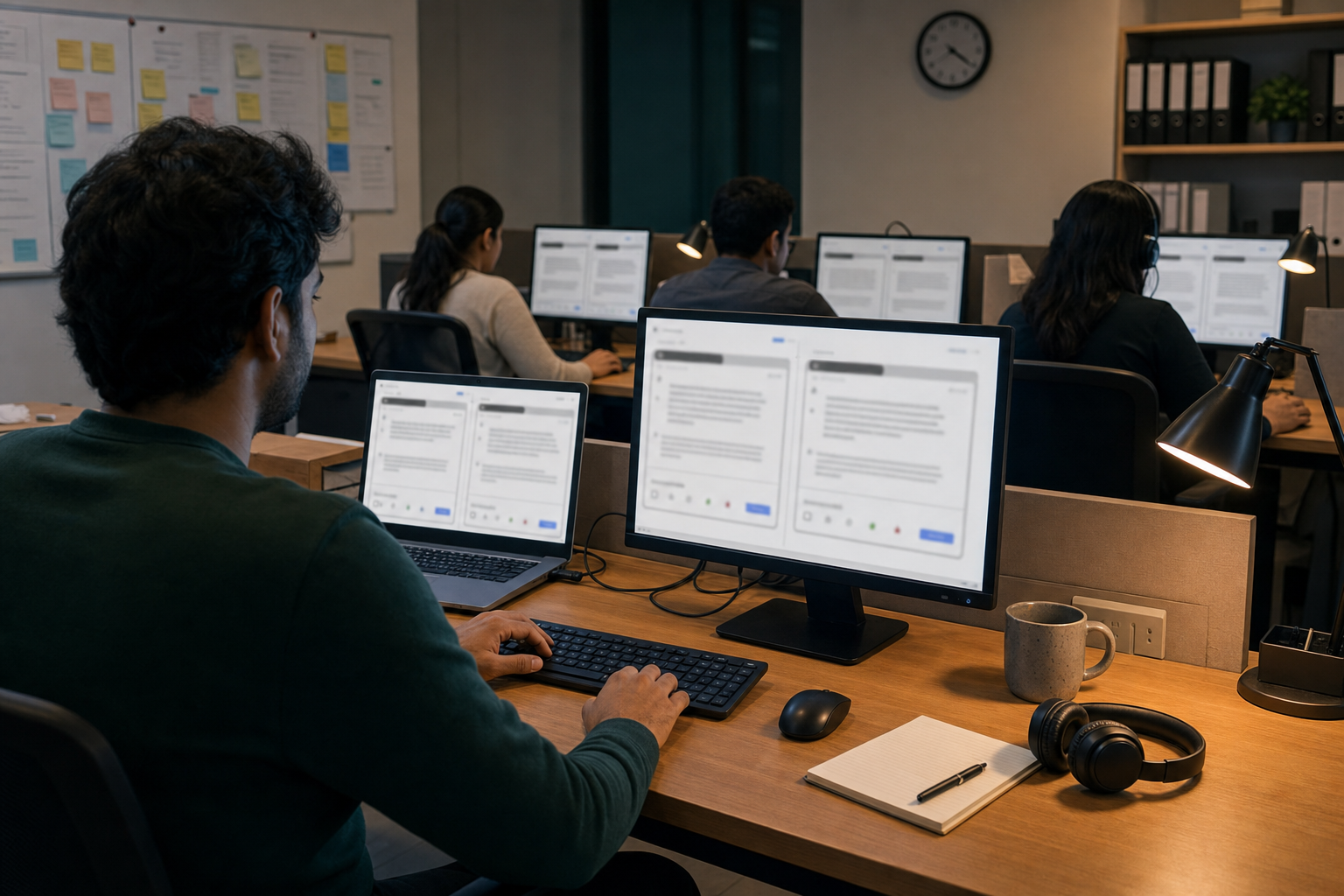
The AI boom has been sold as a story of automation. But the systems now answering emails, writing code, summarizing meetings, and tutoring students are not built by software alone. Behind each polished reply is a chain of human work: people label data, write sample answers, rank better and worse outputs, test for bias and abuse, and review failures after release.
That matters because these workers help decide what an AI system treats as helpful, harmful, accurate, or acceptable. The central debate is not whether human labor exists in AI. It clearly does. The real question is what kind of labor it is, who does it, and whether the people making AI safer and more useful are treated as skilled contributors or as invisible pieceworkers. Exact workforce numbers are hard to verify because most major labs disclose only part of the process.
An AI answer is the end of a workflow
When a chatbot replies in two seconds, it creates the impression that the answer came straight from a model and nowhere else. That is only partly true. A large model does generate the text in that moment. But the behavior that makes the answer readable, polite, and less dangerous usually comes from earlier rounds of human guidance.
The first stage is often called pretraining. Developers feed a model vast amounts of text, images, audio, or code. That material has to be collected, cleaned, filtered, and organized. Some of this work is automated, but a lot of it still depends on human rules and checks.
Then comes post-training, where the human role becomes much more obvious. People write examples of good answers. Reviewers compare two model outputs and choose which one is better. Safety teams create test prompts for fraud, self-harm, hate speech, or dangerous advice. Domain experts check whether a medical, legal, or financial answer crosses a line from useful into misleading.
One early and widely cited example came from OpenAI’s InstructGPT work. The company said it used about 40 contractors to write demonstration answers and rank model outputs. The number is small by the standards of today’s industry, but the point is important: one of the key techniques behind modern chat assistants was built directly on human judgment.
This is why the phrase AI-generated can be misleading if it is taken too literally. The text is generated by a model. The standards that shape that generation are set by people.
The jobs behind the screen
The hidden labor behind AI is not one job. It is a stack of different jobs, with different pay, different status, and very different working conditions.
- Data labelers classify images, text, audio, or user intent so models can learn patterns.
- Preference raters compare outputs and choose which answer is more useful, more accurate, or safer.
- Content moderators review violent, sexual, hateful, or self-harm material so systems can be trained to detect or avoid it.
- Red-teamers actively try to break the system by finding jailbreaks, unsafe responses, or hidden biases.
- Domain experts such as doctors, lawyers, teachers, programmers, and scientists create specialized datasets and evaluations.
- Quality reviewers audit bad responses after launch and feed those failures back into the next model update.
One user question may touch several of these layers. A model that politely refuses to give instructions for making a weapon may reflect content moderation data, policy decisions, red-team testing, and later evaluation work. A model that gives clearer tax guidance may reflect expert-written examples and feedback from reviewers who scored earlier answers as incomplete or wrong.
Some of this labor is highly skilled and well paid. Labs increasingly hire PhDs, clinicians, and senior engineers to build tests and assess quality in specialized areas. But another part of the pipeline looks more like digital piecework: task-by-task contracts, outsourced vendors, non-disclosure agreements, and limited control over pay or pace.
Safety has a human cost
The hardest part of AI labor is often the least visible. Training a system to avoid graphic, abusive, or illegal content requires someone to look at that material first. There is no clean way around that fact.
In 2023, Time reported that OpenAI had outsourced some toxic-content labeling work to workers in Kenya through a contractor. The report said some workers were paid less than $2 an hour to review disturbing material involving violence, sexual abuse, and hate. OpenAI said the work was part of an effort to make its systems safer. Those two facts do not cancel each other out. The safety goal may be real, and the human cost may also be real.
This is not a one-company issue. The broader tech industry has long relied on contractors to moderate harmful content for social platforms, search engines, and recommendation systems. Generative AI extends that pattern. If a model is expected to avoid the worst material on the internet, someone has to help define what “the worst” looks like and how to respond to it.
That creates a moral tension that the marketing around AI often hides. Users see a cleaner product. Workers may see the mess first.
Human judgment improves AI, but it also shapes it
There is a good reason companies use human feedback: it works. Without it, many models are less coherent, less polite, more repetitive, more toxic, and more likely to produce confident nonsense. Human review can make systems more useful for ordinary people very quickly.
But human feedback is not neutral. It brings in the assumptions of whoever writes the instructions and whoever does the scoring.
If raters are told to prefer concise, formal, risk-averse answers, the model will learn those habits. If they are trained mainly on one region’s norms, the system may treat other styles of speaking as lower quality. If safety rules are too broad, the model may refuse harmless questions. If they are too weak, it may give dangerous advice too easily.
This matters even more in areas where values differ. What counts as offensive? When should a model refuse a political question? How cautious should it be with mental health advice? How much uncertainty should it show in medical answers? These are not purely technical choices. They are policy choices translated into datasets, rating rubrics, and evaluation targets.
That is one reason the phrase human-centered AI needs more precision. It can mean AI that serves people better. But it should also mean being honest about which people are shaping the system and under what conditions.
Why the labor stays hidden
The first reason is simple: the product story is cleaner without it. “This model can do everything” is a stronger headline than “this model depends on thousands of judgment calls by engineers, contractors, and subject experts.”
The second reason is structural. Much of the work is outsourced through vendors, subcontractors, or crowd platforms. That makes the labor easy to scale, but also easy to push out of view. Researchers Mary L. Gray and Siddharth Suri called this kind of hidden digital support work “ghost work.” The term fits AI unusually well.
The third reason is that the line between machine work and human work is genuinely blurry. A company may automate one part of labeling while expanding red-team testing. It may reduce direct ranking tasks by using synthetic data, then hire more experts to evaluate the results. So the labor does not always disappear. It moves.
For the public, this invisibility has a cost. If a model gives a harmful answer, it becomes harder to ask basic questions. Was the problem caused by bad training data? A weak safety policy? A rushed evaluation? Low-paid contractors working from unclear instructions? A benchmark that rewarded style over truth? When the pipeline is hidden, accountability is weak.
Will better models need fewer people?
Yes and no. Some repetitive labeling jobs may shrink as models generate more synthetic training data and help review their own outputs. New techniques can reduce the volume of human comparisons needed for certain tasks.
But that does not mean the human role is going away. In many cases, it is becoming more selective and more important.
Take so-called constitutional approaches, where a model is trained to critique and revise outputs using a set of written principles. That can reduce some direct human ranking work. But humans still write the principles, decide which trade-offs matter, and audit the results. The labor shifts from clicking through comparisons to designing the rules and checking whether they hold up in practice.
The same is true in specialized fields. A general chatbot may be able to draft a medical explanation. That does not remove the need for clinicians to test whether the explanation is safe, current, and understandable. In regulated sectors, stronger models may actually increase the need for expert review, because the system will be trusted more and used in higher-stakes settings.
So the likely future is not labor-free AI. It is AI with a changing labor mix: fewer basic tasks in some places, more auditing, evaluation, localization, and expert oversight in others.
What better practice would look like
If companies want public trust, they should stop treating this labor as a backstage detail.
- Disclose more. Model cards and system reports should say who did the training and evaluation work, in what regions, and under what arrangements.
- Set minimum standards for pay and protection. This matters especially for workers exposed to traumatic material.
- Pay for the full task, not just the accepted click. Screening, training, and rejected work all consume time.
- Use diverse raters and experts. A narrow reviewer pool produces narrow systems.
- Give workers a feedback channel. People doing frontline review often spot problems before managers do.
- Treat labor conditions as a quality issue, not just an ethics issue. A rushed, underpaid, poorly supported workforce will not produce reliable safety data.
None of this is anti-technology. It is basic product honesty. If human feedback is central to model quality, then the people providing that feedback are part of the product.
The real story behind the answer
It is easy to look at a chatbot and see only speed. A question goes in, a smooth answer comes out, and the process seems almost weightless. But that answer sits on top of a hidden supply chain of human effort: cleaners, labelers, reviewers, moderators, experts, and testers.
The promise of AI is real. Human guidance has made these systems more useful and, in many cases, safer. The risk is also real. When that guidance is hidden, outsourced, and undervalued, the industry can claim automation while quietly depending on workers it does not want users to think about.
The next time an AI tool gives a polished reply, it is worth asking a simple question: who helped make this answer possible? Better AI will not come only from bigger models. It will also come from seeing the people behind them clearly, and treating them as part of the system rather than as a disposable input.