Creative Constraint, Not Shortcut: A 7-Day AI Poetry Challenge for Arabic Writers
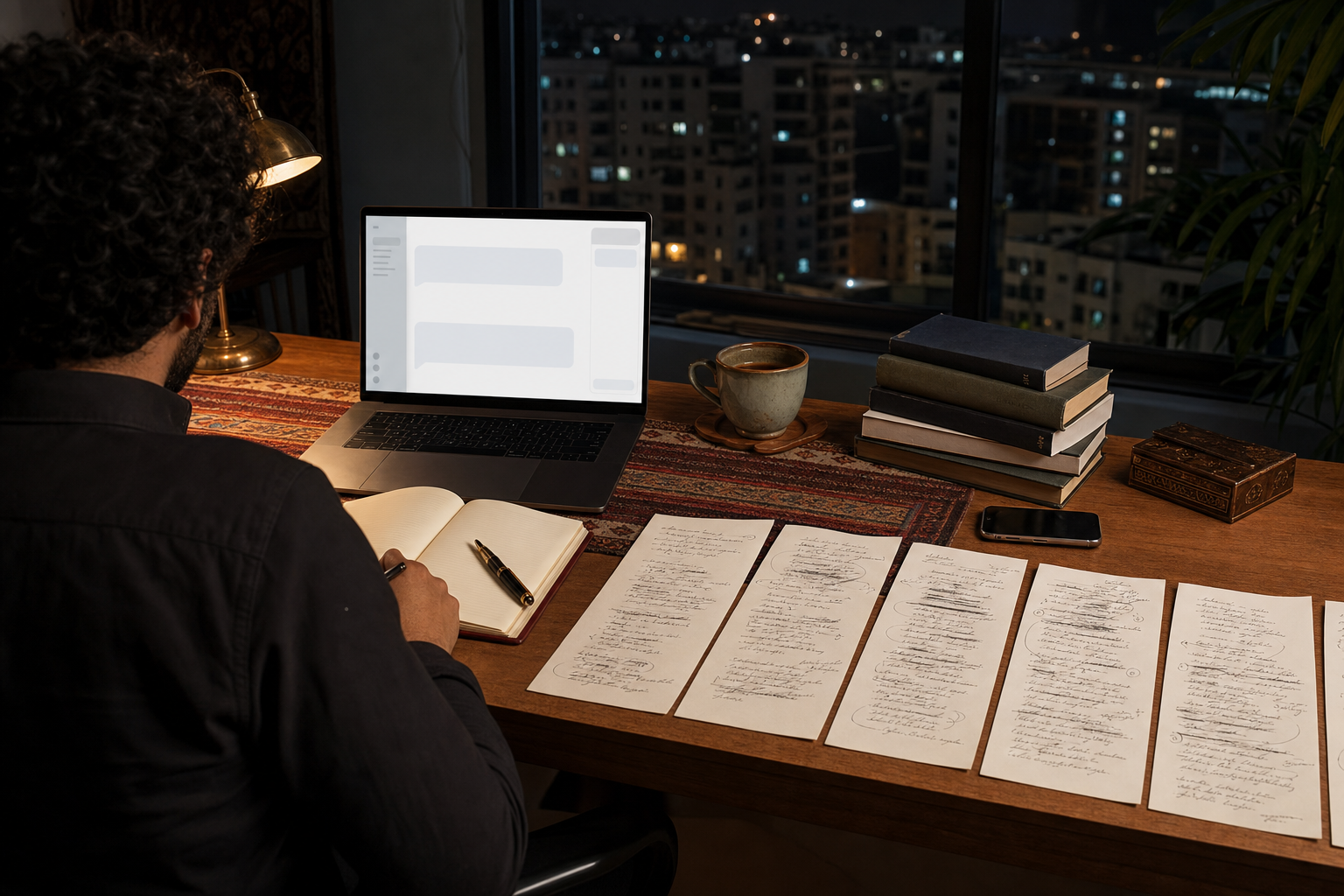
Arabic writers do not need another tired debate about whether AI can “write poetry.” They need better ways to test what these tools are actually useful for. A 7-day poetry challenge is one practical answer. It treats AI as a source of friction, variation, and revision pressure, not as a substitute for a writer’s memory, ear, or taste.
This matters because AI creativity is still less discussed than AI at work or in education, even though writers are already experimenting with it. At Alumniyat Hub, internal signals show that AI Creativity & Expression remains undercovered. For Arabic writers, the tension is especially sharp. AI can quickly suggest images, alternate phrasings, and structural options. It can also produce mixed dialects, vague emotion, false elegance, and lines that sound polished before they say anything worth keeping. That is exactly why the challenge should be built around constraint.
Why poetry is the right place to test human-AI collaboration
Poetry is a good stress test because it is small and exposed. In a poem, weak diction is obvious. So is empty rhythm. So is a borrowed line that does not belong. If you use AI for a business email, average output may be good enough. In a poem, average is the problem.
Arabic makes the test more interesting. A writer may move between Modern Standard Arabic and dialect. A poem may lean on sound, internal rhyme, repetition, or classical echoes. A single word can shift the poem’s social register. These are not decorative choices. They are the poem. AI can offer options, but it is often unreliable on exactly the parts that matter most: tone, context, and the weight of a familiar phrase.
That is the promise and the risk in one sentence. The tool is good at producing many possibilities. The writer still has to know which possibility is alive.
Set the rules before day one
If the goal is to learn, not just generate text, the setup matters. Keep the challenge simple and measurable.
- Use one AI tool for the full week so you can notice its patterns.
- Work for 20 to 30 minutes a day, no more.
- Keep each exercise short: 4 to 12 lines.
- Save every prompt and output in one document.
- Mark clearly what you wrote and what the tool suggested.
- Do not ask the model to imitate a living poet directly.
- Read every draft aloud before you keep any line.
These rules do two things. They keep the experiment honest, and they stop the machine from flooding the page so completely that your own judgment disappears.
Day 1: Start with one image, not a theme
Do not begin with a grand topic like grief, exile, or love. Start with one concrete image from your own life: a cracked cup, a bus stop at noon, a shirt left on a chair, a window that does not close. Write two human lines first. Then ask the AI for image variations around that object, while banning generic poetic language.
“Give me five concrete images related to a cracked cup in Arabic. Avoid hearts, tears, night, longing, and any abstract explanation.”
The point is not to take a full line from the output. The point is to widen the field. If the model gives you something useful, keep one noun, one verb, or one comparison. If it gives you five versions of the same cliché, that is useful too. You have identified a pattern to avoid.
Day 2: Use AI for sound, not meaning
On the second day, work on music. Ask the tool for rhyme families, repeated consonants, or alternate endings built around a sound you choose. In Arabic, sound often carries meaning before the reader fully explains it. This is one area where AI can help as a fast assistant, especially when you want options.
But keep the meaning in your hands. If you let the tool decide both sound and sense, the poem can become smooth very quickly and generic just as fast. A better method is to write your own four lines, then ask the model for possible end words, internal echoes, or tighter verbs. Use the output as a menu, not a verdict.
This is also where many writers will notice a core truth: AI often produces language that is more fluent than precise. Fluency is useful. Precision is the job.
Day 3: Test meter carefully, and distrust false confidence
If you write in formal meter, or even if you only care about cadence, day three is where the challenge gets serious. Ask the model to suggest rhythmic variants of one line. Then test them aloud yourself. If you know prosody, use that knowledge. If you do not, use your ear and compare versions.
Be careful here. Many AI tools sound authoritative on meter and still make mistakes. Arabic prosody is a weak area for many models, especially when the line is complex, modern, or slightly irregular. That does not make the tool useless. It means you should treat it like a rough assistant, not a teacher.
If the model proposes three versions of a line, read all three aloud. One may reveal a cleaner rhythm than your first draft. Just do not confuse a confident explanation with a correct one.
Day 4: Move between standard Arabic and dialect
Arabic writers live with register in a way many other writers do not. A line in Modern Standard Arabic can feel elevated, distant, formal, or timeless. The same thought in dialect can become intimate, comic, cutting, or immediate. Day four should test that shift directly.
Take a short draft and ask for one version in standard Arabic and one in your chosen dialect, or the reverse. Then compare what changes. Does the emotional temperature rise? Does irony become easier? Does the line lose dignity or gain life?
This is one of the most revealing uses of AI for Arabic writers, and also one of the riskiest. Models often blend dialects badly or flatten local texture into a vague spoken Arabic. That failure is instructive. It shows where a writer’s real knowledge begins.
Day 5: Use the tool as a cliché detector
By the fifth day, you should have a small set of drafts. Now turn the AI into an editor with a narrow job: find vague language, repeated images, and overused phrases. Do not ask it to “improve” the poem. Ask it to diagnose where the poem becomes lazy.
“Read this draft and list any clichés, vague nouns, or decorative adjectives. Suggest sharper nouns and verbs only. Do not rewrite the whole poem.”
This is often more useful than asking for a new poem. Many AI-generated Arabic poems lean on safe abstractions such as silence, absence, memory, ash, wound, moon, or shadow. Those words are not banned. But if they appear because the tool defaults to them, they weaken the poem. Day five is about replacing habit with detail.
A good rule is to cut at least three abstract words and replace them with something sensory: temperature, texture, motion, weight, smell, or sound.
Day 6: Borrow structure, not voice
On day six, ask for formal options. Not style imitation. Not “write like” a specific poet. Structure. Ask the model for three possible shapes: a six-line free verse poem with a turn in line four, a couplet-based sequence with one repeated phrase, or a prose poem that moves from object to memory to contradiction.
This is where AI can be genuinely helpful. Many writers do not need more words; they need a frame. A frame can force decisions. A repeated line can create pressure. A short sequence can stop a poem from dissolving into mood.
Keep the ethical boundary clear. Borrowing a structure is part of literary practice. Asking a model to reproduce a living poet’s voice too closely is something else. The challenge should teach craft, not shortcut authorship.
Day 7: Build one final poem and audit the collaboration
The last day is for assembly and honesty. Choose the strongest lines from the week and make one poem of 8 to 12 lines. Then cut 30 percent. Read it aloud. Then answer three questions in plain language:
- Which parts came from my own memory or instinct?
- Where did AI help me see a better option?
- Which line sounds impressive but does not truly belong?
This final audit matters as much as the poem. Without it, the experiment becomes another round of generation. With it, the writer learns something transferable: where the tool sharpens thought, where it muddies it, and where it tempts the writer into keeping language that only sounds poetic.
What Arabic writers are likely to notice after one week
A short challenge is enough to reveal patterns. Most writers will notice at least four.
- AI produces abundance faster than judgment. You will get many lines. Few will deserve to survive unchanged.
- It often defaults to familiar beauty. The language may sound lyrical while staying emotionally generic.
- Register is where the machine slips. Mixed diction, unstable dialect, and awkward formality appear quickly.
- Revision prompts are often better than generation prompts. The tool is more useful when it critiques, compresses, lists, or contrasts than when it tries to deliver the whole poem.
That last point is especially important. The strongest role for AI in poetry may not be authorship at all. It may be pressure-testing. It may be the rough second pair of eyes that helps a writer notice what is weak, obvious, repetitive, or too easy.
The real value is not speed
There is a lot of lazy language around “creative acceleration.” Poetry does not need acceleration. Most bad poems are already too fast. What writers need is a clearer method for generating options without losing standards.
That is why this challenge matters. It gives Arabic writers a way to practice control. The tool can help produce alternatives, expose clichés, compare registers, and offer formal scaffolding. It cannot decide whether a line carries lived pressure. It cannot know which word in Arabic lands with dignity, which lands with irony, and which sounds borrowed from a thousand other drafts.
Used badly, AI makes poems longer, safer, and more forgettable. Used well, it can make the writer more selective.
Constraint is the point
If this 7-day experiment works, the final poem should sound more like you, not less. It may even contain very little raw machine text. That is fine. The value is in what the tool forced you to test: image, register, rhythm, structure, and revision discipline.
For Arabic writers, that is a healthier way to approach AI than either panic or hype. Not as a shortcut. Not as a rival. As a constraint that exposes where human taste still does the real work. In poetry, abundance is easy. Choosing is the art.