The Comment Section as Classroom: What Heated AI Debates Reveal About Public AI Literacy
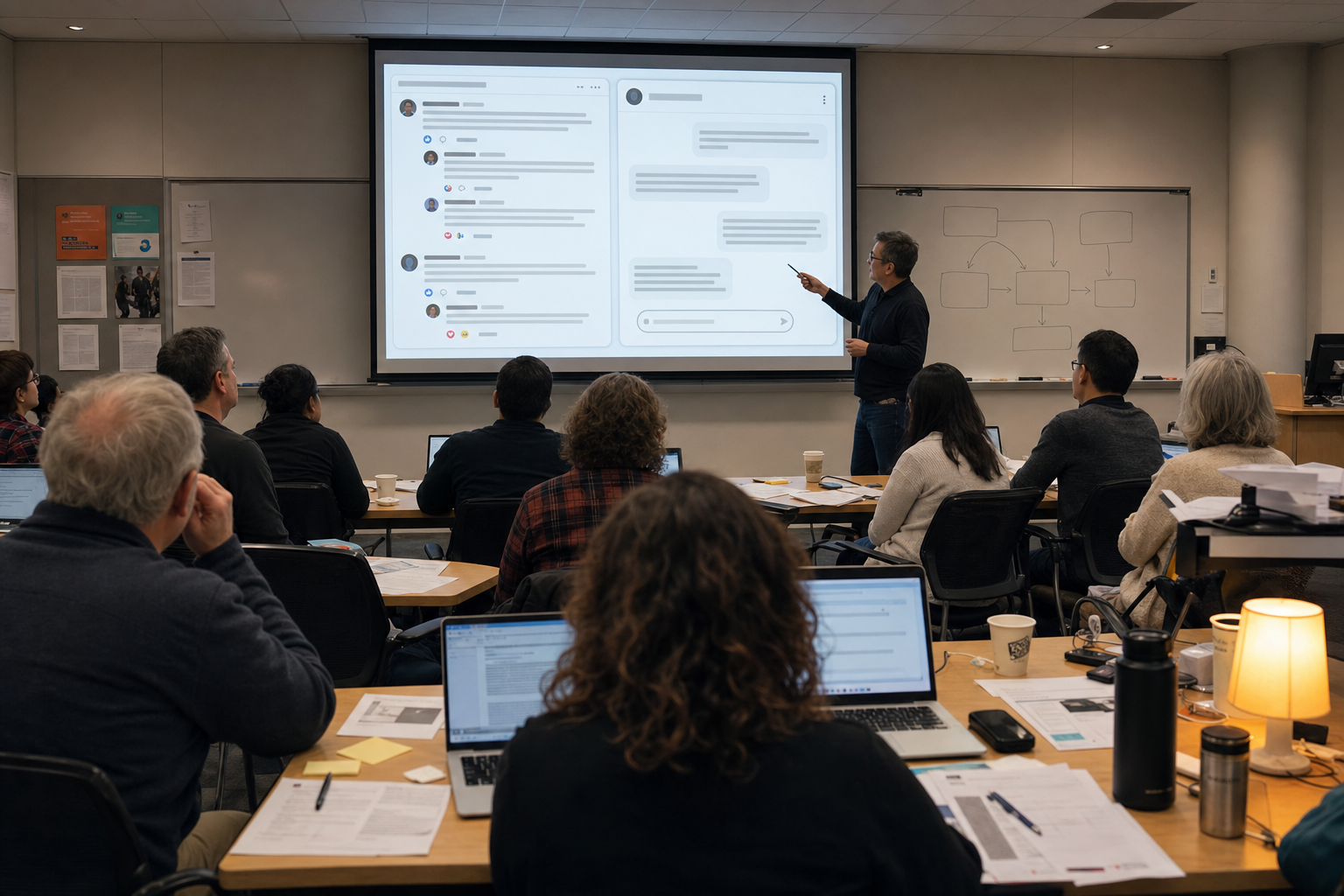
Across recent high-comment AI threads, the pattern is hard to miss. Discussions around Claude Opus 4.8, YouTube’s AI labels, the future of frontend skills, and reports of “AI psychosis” were not just arguments about products or headlines. They became wider fights about evidence, trust, work, authorship, and safety. People were trying to figure out what AI is, what it does, what it changes, and who gets to define those changes.
That matters because public AI literacy is now a social issue, not just a technical one. When people misunderstand AI, they do not only misunderstand a tool. They misread job risk, media authenticity, platform responsibility, and even mental health warnings. The main tension is this: the industry often treats AI literacy as a matter of knowing how models work, while ordinary users experience it as a matter of judgment. They want to know what to trust, what to fear, what to learn, and what rules should apply.
These debates are noisy, but they are not random
Comment sections are messy. They reward speed, certainty, and strong opinions. They are also useful. They show where people get stuck when AI moves from lab demos into everyday life.
That does not make them representative of the whole public. A Hacker News thread is not the same as public opinion, and a YouTube comment section is not a scientific survey. But high-engagement threads do act as early-warning systems. They show which questions keep returning even after years of AI coverage.
Internal audience analytics often reveal the same imbalance. Readers click on product launches, benchmark claims, and workplace disruption. But the biggest unresolved questions sit in the under-covered area of AI in society and ethics. The comments make that gap visible. People are trying to answer human questions with partial technical information.
Four debates, four different literacy gaps
Look closely at the recent arguments, and each one points to a different kind of misunderstanding.
First, capability debates often blur into hype debates. In discussions around Claude Opus 4.8, commenters quickly moved past product details and into bigger claims. Is the model truly better, or does it just sound better? Should users trust benchmark scores, private anecdotes, side-by-side demos, or their own one-hour test? A common mistake here is treating a single impressive output as proof of broad intelligence, or a single failure as proof that the whole system is useless.
The literacy gap is not just about model architecture. It is about evaluation. Most readers have not been given a clear way to ask basic questions such as: Better at what? Compared with what baseline? Under what conditions? With what failure rate? Without those questions, every debate turns into taste, tribal loyalty, or personal anecdote.
Second, authenticity debates often collapse into labeling debates. YouTube’s AI labels triggered a familiar argument: if AI touches a piece of content at any point, should the whole thing be labeled as AI-made? Some users want a bright line. Others see the category as too broad to be useful. Is a video “AI-generated” if the script is human-written but the voice is synthetic? What if AI only cleaned up audio, suggested edits, or generated a thumbnail?
This is a real literacy problem because the public is being handed a binary label for a non-binary process. “Made with AI” can mean anything from light assistance to full synthetic generation. If the label is too vague, it stops informing and starts confusing. If it is too narrow, it misses the point. The debate is really about disclosure, not just technology.
Third, job debates often confuse task automation with occupational replacement. The AI-and-frontend argument shows this clearly. Some commenters argue that if AI can produce interface code, frontend skills are becoming obsolete. Others counter that the hard part of frontend work was never just writing boilerplate. It includes debugging, accessibility, performance, product judgment, design collaboration, browser quirks, security, and maintenance.
Here the gap is economic and practical. Many people still talk about “AI replacing jobs” as if jobs were single tasks. They are not. A role is a bundle of tasks, responsibilities, and coordination work. AI can reduce demand for some parts of a job without eliminating the job itself. It can also change the entry path into a field. Junior work may shrink before senior work does. That is a serious shift, even if the profession survives.
Fourth, safety debates often break down when mental health enters the picture. Reports and discussions about “AI psychosis” show how fragile public understanding still is. The term itself is loose. It is not a formal clinical diagnosis. It usually refers to cases in which intensive interaction with a chatbot appears to reinforce delusional thinking, paranoia, grandiosity, or compulsive attachment. The prevalence is uncertain. The causal pathways are still being studied. But the risk is serious enough that it cannot be dismissed as mere panic.
What the comments often reveal is a split between two bad simplifications. One says the system is harmless and the user alone is responsible. The other says the model itself is uniquely dangerous in some almost mystical way. Both frames miss the point. The real issue is interaction design: how persuasive the system feels, how it responds to unstable thinking, what safeguards exist, and whether vulnerable users are being drawn into unhealthy loops.
In paraphrase, the same comments keep appearing
Across very different threads, the same underlying reactions return. In paraphrase, they often sound like this:
“I used it once, so I know whether it is revolutionary or worthless.”
“If AI touched the workflow, then the whole work is fake.”
“If one task can be automated, the entire profession is finished.”
“If a vulnerable person spiraled while using a chatbot, the product design is irrelevant.”
None of these positions is fully irrational. Each one grows out of a real concern. But each one flattens a more complicated reality. That is why the comment section is such a useful classroom. It exposes the exact sentence where confusion begins.
Public confusion is emotional, ethical, and social
A narrow view of AI literacy says the public simply needs more technical education. That is not enough. Most heated AI arguments are not really about transformer architecture, token prediction, or retrieval pipelines. They are about power, identity, fairness, and control.
Take work. When people argue about frontend skills, they are not only discussing code generation. They are also discussing status, career security, and whether years of training are losing value. That makes the discussion more charged and less patient. Facts matter, but so does fear.
Take content labels. When people argue about YouTube disclosures, they are not only asking for technical precision. They are asking whether human effort still has a visible place, and whether audiences are being manipulated without consent. This is partly a consumer protection issue and partly a cultural one.
Take chatbot-related mental health concerns. These threads are not only about safety features. They are also about loneliness, authority, trust, and how quickly people can assign human-like credibility to a system that generates convincing language. If public AI literacy ignores those conditions, it misses the most important part of the problem.
In other words, people do not need only a better definition of AI. They need better ways to reason about AI in human settings.
What comment threads teach better than many official explainers
Official AI explainers tend to focus on how a model works. Comment threads show where that knowledge fails in practice.
They show that many readers still do not distinguish between a model, a product, and a workflow. A model may have one level of capability, a product may add memory or tools, and a workflow may include heavy human review. Public debate often treats those as the same thing.
They show that many readers do not distinguish between fluency and reliability. A system that produces smooth text can still be wrong. A system that writes passable code can still fail in production. A system that sounds supportive can still reinforce unhealthy beliefs.
They also show that many readers do not distinguish between assistance and authorship. The rise of AI labels has made this confusion more visible, not less visible. If every use of AI becomes morally equivalent in public debate, then meaningful disclosure becomes harder, not easier.
And they show that many readers do not distinguish between individual experience and general evidence. One person’s brilliant result or disastrous failure tells us something, but not everything. Yet comment culture pushes people to argue from vivid examples because vivid examples spread faster than careful comparisons.
What better AI literacy would actually look like
If public AI literacy is the goal, the next step is not another flood of jargon. It is a short set of practical questions that readers can carry from one debate to the next.
- What exactly is being claimed? Is the claim about a model, a product feature, a workflow, a business trend, or a safety risk?
- What kind of evidence supports it? Benchmarks, user anecdotes, company demos, independent tests, or early case reports all have different strengths and limits.
- What is the comparison point? “Better” and “worse” mean little without a baseline.
- Is this about a task or a whole role? Automating a slice of work is not the same as replacing a profession.
- What does the label really mean? “AI-generated,” “AI-assisted,” and “synthetic” should not be treated as interchangeable.
- Who is most at risk? Safety debates are often clearer when you ask which users are vulnerable and how a product interacts with that vulnerability.
- What remains uncertain? In fast-moving AI discussions, uncertainty is not a weakness. It is part of honest reporting and honest judgment.
This kind of literacy is modest but powerful. It does not require readers to become engineers. It requires them to become better question-askers.
The promise and the risk of learning in public
There is a real upside to these comment-driven debates. People surface edge cases faster than institutions do. Workers compare notes before official labor statistics catch up. Creators notice labeling failures before platforms refine their rules. Users flag harmful chatbot behavior before researchers publish a full paper. Public discussion can act as a rough but valuable sensor network.
But the risks are obvious too. Online debate rewards overconfidence. Strong identities form around being early, skeptical, optimistic, or anti-hype. Personal stories beat slow evidence. A sharp one-liner beats a careful distinction. Once that happens, literacy becomes harder because the conversation stops being about understanding and starts being about winning.
That is why publishers, educators, and platform designers should pay close attention to the comment section, but not surrender to it. The useful move is to mine it for recurring questions, then answer those questions clearly and repeatedly.
The real lesson
The most revealing thing about today’s AI arguments is not that people disagree. It is where they disagree. Again and again, the fault lines appear around reliability, authorship, labor, trust, and vulnerability. Those are not side issues. They are the public curriculum.
If we want a more AI-literate society, we should stop treating heated comment threads as pure noise. They are often the first draft of the questions people actually need help with. The task is not to copy the chaos. It is to translate it.
A useful rule for readers is simple: when an AI thread explodes, do not ask only, “Who is right?” Ask, “What are people failing to distinguish?” That is usually where the real lesson starts.