Claude Fable and the Rise of Story-Shaped AI: What Creative Assistants Should Do for Writers
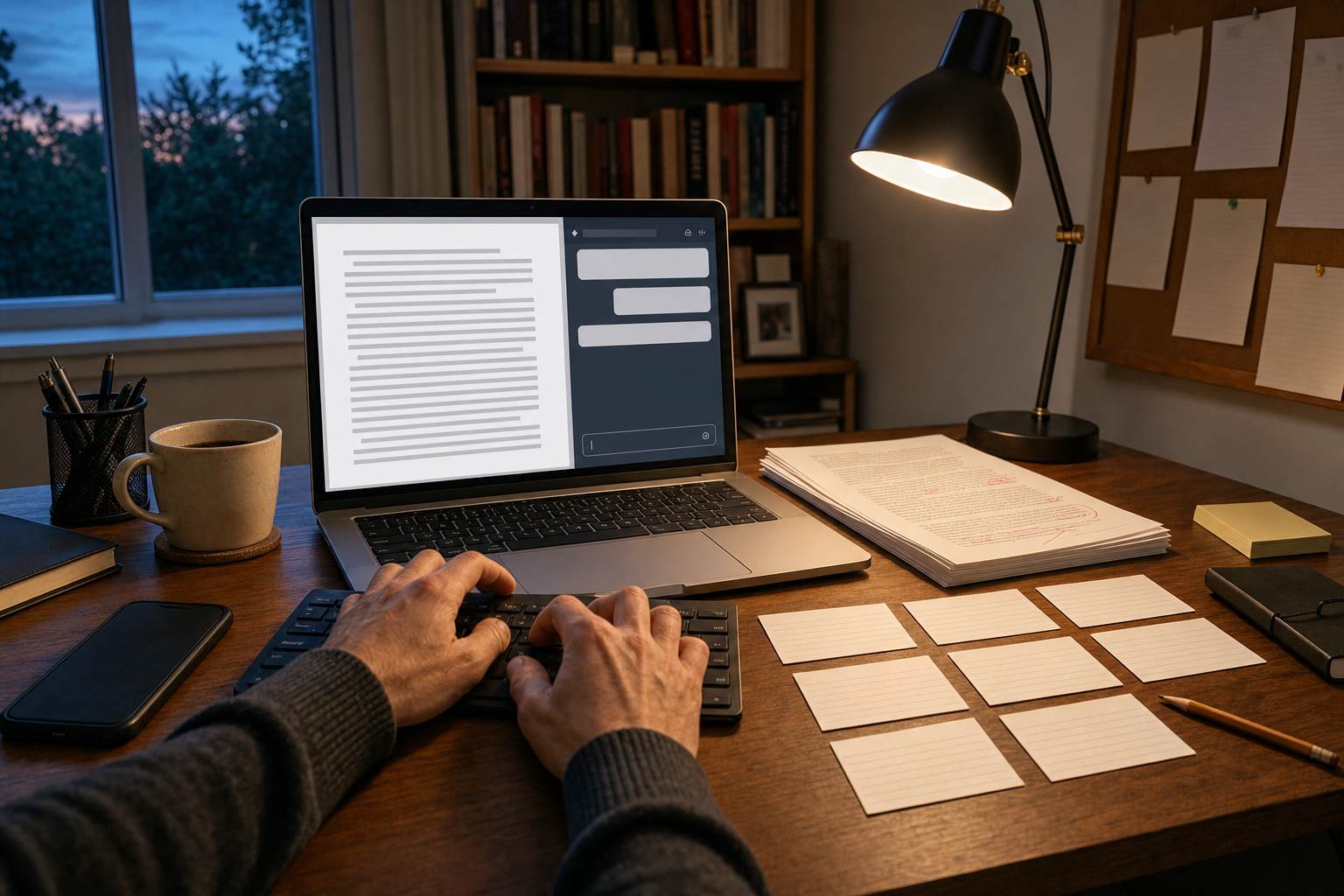
A recent Hacker News discussion put a new phrase into circulation: Claude Fable 5. At the time of writing, that name appears to be part of a public conversation rather than a widely confirmed product announcement. The confirmed fact is narrow. The larger signal is not. Story-oriented AI is becoming important enough to be discussed as its own category, not just as a side use for general chatbots.
That matters because the debate has changed. The question is no longer whether AI can produce readable fiction or mimic narrative structure. It can. The real issue is what these tools should do for writers without displacing the writer’s intention, taste, and cultural judgment. The tension is clear: story-shaped AI can become a serious creative assistant, or it can become a fast machine for generating smooth, generic prose that makes every story sound slightly less chosen.
A rumor that points to a real shift
Even if the Claude Fable label never turns into a formal product line, the attention around it reflects a real market direction. Writers have already been using AI systems for brainstorming, outlining, scene expansion, and revision support through tools such as Sudowrite, NovelAI, and custom setups built on larger foundation models. What is changing now is visibility. Narrative work is moving closer to the center of how AI companies talk about their models.
That shift makes sense. Story work is a good stress test for AI. It asks for long-range memory, tonal control, consistency across chapters, and sensitivity to what should stay unsaid. A model can write one striking paragraph and still fail badly at story. It can lose track of a character’s age, turn subtext into explanation, or flatten a specific setting into borrowed stereotypes.
The useful creative assistant is not the one that writes the most. It is the one that helps the writer choose better.
That is why “story-shaped AI” is a useful term. It suggests a tool designed around the actual problems writers face, not just a chatbot pointed at fiction prompts.
What writers actually need
Most writers do not need another system that can instantly produce 1,500 words of competent fantasy, romance, or thriller prose. The internet already has plenty of that. What they need is support for the parts of writing that are slow, technical, and mentally expensive.
A novelist may need three different ways to stage a reveal while keeping one character’s motives ambiguous. A screenwriter may need help checking whether the emotional turn in scene 42 has been properly set up by scene 18. A journalist writing narrative nonfiction may need a cleaner structure for a chapter without inventing facts. A poet or essayist may want constraints, not expansion.
In practical terms, a good creative assistant should help with tasks like these:
- Planning: testing different scene orders, endings, and points of view.
- Continuity: tracking timelines, objects, character knowledge, and unresolved threads.
- Revision: spotting repeated sentence patterns, tonal drift, weak transitions, or dialogue that sounds too similar across characters.
- Research support: helping gather questions, references, and context while clearly marking what is sourced and what is speculative.
- Constraint management: remembering that the story is in first person, that the father never appears on the page, or that the ending must not explain the central mystery.
These are not glamorous functions, but they are valuable. Many writers do not lack words. They lack distance. They need a second system that can hold the draft steady while they decide what the story is trying to do.
Fiction is not office prose
General-purpose AI assistants are often trained and tuned to be immediately helpful. That is useful for email, summaries, and customer support. It can be bad for fiction.
Good stories often depend on delay, ambiguity, subtext, and silence. A generic assistant tends to resolve those pressures too quickly. If a writer drafts, “He thanked her for the tea and left the ring on the sink,” a weak creative tool may try to explain the emotional stakes, make the gesture more explicit, or add a neat concluding line. In many stories, that would be damage, not help.
This is one reason the benchmark for creative AI should not be simple fluency. Fluency is easy to admire and easy to misuse. A story assistant has to respect the difference between a sentence that is clear and a sentence that is right.
Culture is not a style preset
The hardest part of story work is not syntax. It is meaning. That is where cultural context matters most, and where AI systems often look more capable than they really are.
A model asked for a multigenerational story set in Lagos, Karachi, São Paulo, or Cairo may produce convincing surface detail. It may mention traffic, food, slang, family pressure, or the right kind of school uniform. Some of that may be accurate. But accuracy at the level of props is not the same as cultural understanding.
Stories carry local assumptions about status, humor, class, religion, migration, shame, privacy, gender, language mixing, and what people do not say directly. Those things are hard to reduce to prompts. A tool that fills gaps with statistically likely material can quickly turn a specific world into a familiar export version of itself.
That is a real risk for writers, especially writers working across languages or writing from communities that are often simplified in global media. A creative assistant should not turn culture into decoration. It should help the writer protect specificity.
What a better creative assistant should do
If story-oriented AI is going to mature, writers should expect more from it than impressive sample prose. The design priorities should be practical and visible.
- Ask for the brief before drafting. The tool should clarify the goal of the scene, the desired tension, and what must remain unresolved.
- Keep a living story bible. It should track character facts, timelines, tone rules, and plot constraints across a long draft.
- Offer options, not one polished answer. Writers benefit more from three possible directions with trade-offs than from one confident continuation.
- Mark invention clearly. If a historical detail, legal process, or cultural reference is uncertain, the system should say so.
- Protect voice. It should help analyze rhythm, diction, and repetition without pushing every passage toward the same clean, market-tested sound.
- Show changes transparently. Writers need to see what was cut, softened, intensified, or rearranged.
- Refuse easy imitation. Direct cloning of living authors’ styles is a legal and artistic trap, not a meaningful creative feature.
- Respect private drafts. Unpublished manuscripts, notes, and personal archives need stronger privacy expectations than ordinary chat history.
Notice what is missing from that list: “write the whole novel.” That is not because full drafting is impossible. It is because full drafting is often the least interesting use of the tool. When a model produces entire chapters on demand, it also imports its habits: tidy setups, familiar beats, over-explained motives, and language that feels polished before it feels earned.
The right benchmark is control
For writers, the best test of story-shaped AI is not, Can it write a story by itself? The better test is, Does it improve the writer’s control over the story?
Control means the writer can steer tone without fighting the system. It means the tool remembers that a sister stopped speaking to her brother in chapter three and does not casually erase that tension in chapter nine. It means the model can flag that the missing bracelet disappears for 80 pages and then suddenly matters again. It means the assistant can help generate five endings that preserve the book’s moral ambiguity instead of forcing a tidy resolution.
These are humble abilities, but they matter more than theatrical demos. In creative work, judgment usually beats speed. A writer who can see better options, protect weak points, and preserve deliberate ambiguity will produce stronger work than a writer who simply gets more text faster.
The promise and the risk
The promise of story-shaped AI is real. It can lower the cost of experimentation. It can make revision less lonely. It can help writers hold large, messy projects in view. For students and non-native English writers, it can also reduce friction around structure and phrasing without taking away authorship.
The risks are just as real. These systems can encourage dependence on average solutions. They can produce false confidence, weak research habits, and accidental imitation. They can flatten cultural specificity into pattern-matching. They can make writers mistake movement on the page for progress in the work.
That is why the human question remains central. A story is not just a sequence of plausible sentences. It is a sequence of chosen ones.
What writers should ask for now
Whether Claude Fable 5 becomes a real product, an experiment, or simply a rumor that captured a trend, the larger question will remain. Writers do not need machines that compete for authorship. They need assistants that help them test structure, hold memory, surface blind spots, and protect what is deliberate in a draft.
The future of creative AI should not be measured by how quickly it can finish a story. It should be measured by whether the finished story still feels like the writer meant it.