Can AI Poetry Sound Human in Arabic?
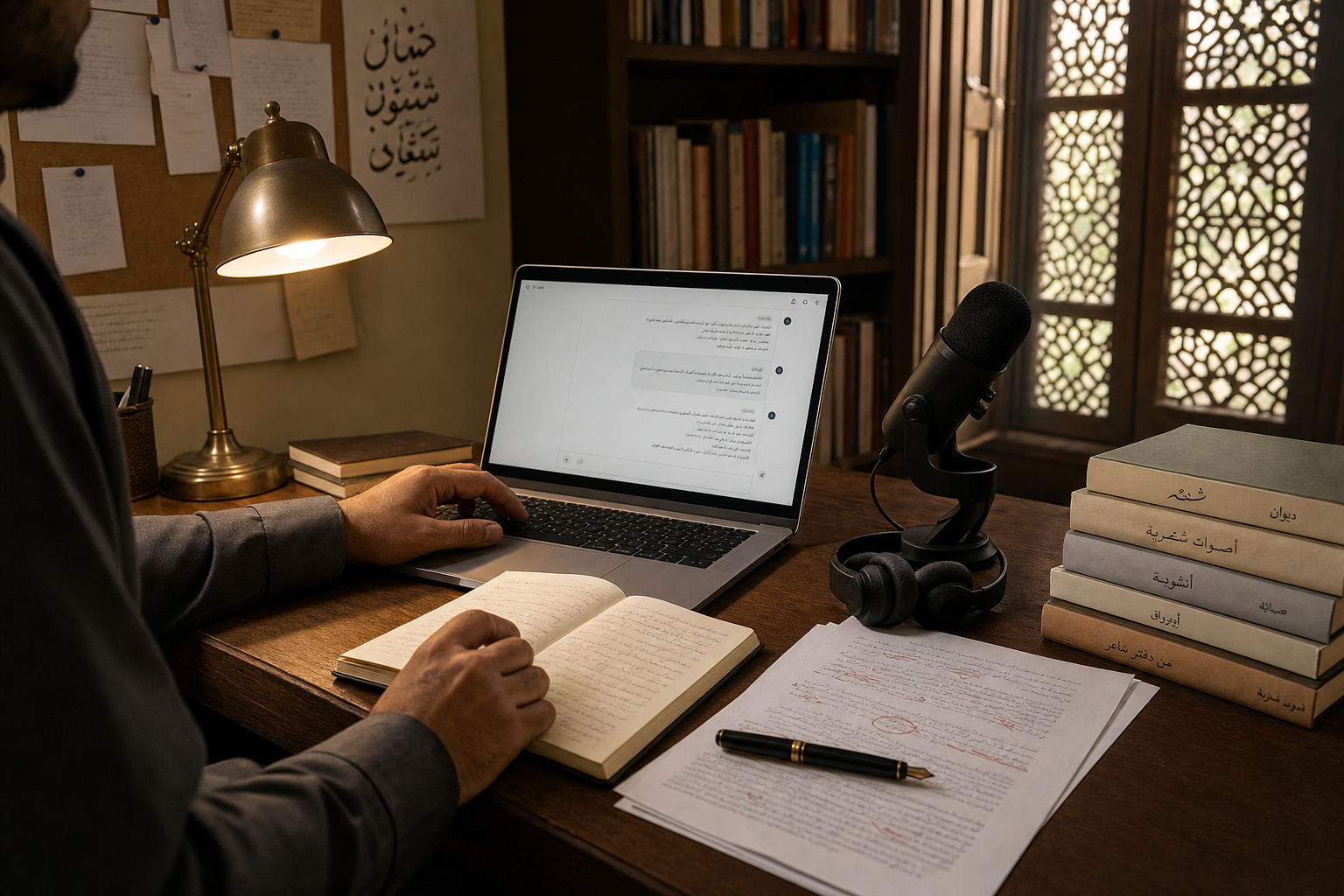
Ask a current AI chatbot for an Arabic poem, and it will usually give you one in seconds. The lines may rhyme. The tone may sound tender or solemn. To a casual reader, the result can look finished. That matters because Arabic is one of the hardest languages in which to fake literary depth. Its poetry depends not only on vocabulary, but on rhythm, recitation, dialect, and shared cultural memory.
The real debate is not whether AI can produce Arabic text. It clearly can. The harder question is whether it can sound human when the task moves from generic sentiment to actual poetry: a stable cadence, a believable voice, fresh imagery, and a sense that the poem comes from somewhere specific. For now, the answer is mixed. AI can imitate the surface surprisingly well. It still struggles when readers listen for pressure, not just polish.
Arabic is an unusually hard test
Arabic creative writing exposes a basic limit of today’s language models. These systems are very good at predicting likely word sequences. Poetry, especially in Arabic, often depends on doing something harder: using familiar language in a way that feels necessary, precise, and alive.
Several features make Arabic a demanding case.
- Meter matters. Classical Arabic poetry is traditionally organized around 16 meters. Keeping that structure across a whole poem is much harder than producing an end rhyme.
- Pronunciation matters. Most Arabic online is written without full diacritics, but poetic rhythm depends on how words are actually pronounced, not just how they appear on the page.
- Register matters. Modern Standard Arabic and spoken dialects live side by side. A line that sounds natural in formal Arabic may sound stiff in daily speech, and a dialect that works in Cairo may feel false in Tunis or Basra.
- Memory matters. A word like watan or ghurba does not arrive empty. It carries echoes of songs, sermons, political speeches, schoolbooks, and famous poems.
This is why Arabic is such a useful stress test for AI creativity. It is not enough for the sentence to be grammatical. The line has to land on the ear.
Where current AI already sounds convincing
AI does best when the task is broad and familiar. Ask for a short poem in Modern Standard Arabic about love, distance, the motherland, rain, memory, or longing, and the output will often be serviceable. Sometimes it will be better than expected. It will likely have balanced phrases, smooth transitions, and the kind of elevated tone many readers already associate with “poetic” Arabic.
That is not trivial. For a greeting card, a school exercise, a social media caption, or a first draft of spoken-word material, this can be useful. The model can also generate several versions quickly, which makes it attractive to busy users.
"Write eight lines in simple Modern Standard Arabic about missing home. Keep one rhyme. Use clear emotional language."
On a prompt like that, many systems now perform reasonably well. The poem may not be memorable, but it can look coherent and emotionally legible. In free verse, the effect can be even stronger, because the form gives the model more room to hide weak rhythm behind short lines and repeated images.
There is another reason the output can feel convincing: much of what circulates online as poetry is already short, direct, and image-heavy. If the comparison set is average internet verse rather than a strong poet, AI has a better chance of passing.
Where the illusion breaks
The cracks show when the request gets stricter. Ask for a poem that maintains a traditional meter, and the lines often wobble after the first few verses. Ask for a specific dialect without stereotype, and the model may mix registers awkwardly. Ask for imagery grounded in daily life rather than abstract sadness, and it often falls back on familiar symbols: moon, night, wound, sea, silence, jasmine, coffee, exile.
This is a key difference between rhyme and music. Rhyme is visible. A model can repeat the same line ending and seem disciplined. Meter is deeper. It runs through the whole line. A poem can look neat on the page and still sound wrong when read aloud.
Arabic readers often notice this quickly. They may not scan the verse formally, but they hear when the cadence collapses. The line feels overstuffed. Or too smooth. Or arranged like prose cut into fragments.
Dialect is another common failure point. A model may produce something that is technically understandable but socially unconvincing. It might sound like television Arabic pretending to be intimate speech. It might mix a Gulf expression with Levantine rhythm, or give Moroccan material a standard-Arabic spine that no real speaker would use in that moment.
Strong human poetry can also break rules, of course. But when a poet bends grammar or mixes registers, it usually feels deliberate. With AI, the break often feels like drift.
What readers mean when they say “human”
“Human” does not mean perfect. In fact, some of the most human lines are rough. They take risks. They include a small detail that seems private, local, or slightly awkward, and that awkwardness is part of the force.
A good poem about exile is rarely just about exile. It may also be about a broken elevator in Beirut, the smell of school notebooks in Casablanca, a missed call to Khartoum, or the strange silence of an apartment stairwell in Amman during a power cut. These details give the poem a speaker, not just a theme.
AI often struggles here. It is good at producing the language of feeling. It is less reliable at producing the friction of lived context. That is why many generated poems read as emotionally available but oddly weightless.
There is an important caveat. Weak human poetry exists in every language, including Arabic. If the test is simply “can AI imitate a generic poem,” the answer is already yes in many cases. If the test is “can AI sustain the force of a strong poet,” the gap is much wider.
That is why the benchmark matters. Against a rushed Instagram poem, AI may compete. Against a skilled poet with a distinct ear, it usually cannot.
Whose Arabic is the model learning?
There is also a data problem hiding inside the artistic one. AI systems learn from whatever text is available in large enough volume. In Arabic, that archive is uneven. Formal prose, news writing, religious commentary, and highly circulated canonical material are easier to find and process than living local poetry from every region and social group.
So when a model produces “Arabic poetry,” it may really be producing a narrow slice of Arabic literary memory. It may lean toward solemn Modern Standard Arabic because that register is abundant and legible in training data. It may underrepresent hybrid urban voices, women’s informal speech, migrant language, or texts that mix Arabic with French or English in the way many real speakers do.
This matters because “human-sounding Arabic” is not one thing. It changes by class, country, generation, and medium. A Palestinian free-verse poem, an Egyptian colloquial lyric, a Nabati line from the Gulf, and a Moroccan text that slides between Darija and French do not sound human in the same way.
So part of the problem is not just model quality. It is archive quality. The machine can only imitate what it has seen, and some Arabic voices are far more visible to it than others.
Can readers still tell?
There is no single public benchmark that settles this question for Arabic poetry. Most tests so far are informal: workshop exercises, social media polls, classroom experiments, or side-by-side comparisons among readers. Those tests point in the same general direction.
Short poems are easier for AI to pass off as human than long ones. Free verse is easier than strict meter. General emotion is easier than local detail. Formal Arabic is easier than a believable dialect. Casual readers are easier to convince than attentive ones.
That should not be dismissed. If a short AI poem can persuade a busy reader for even 20 seconds, that has real consequences. It affects school assignments, literary contests, marketing copy, online publishing, and the simple question of what people come to accept as “good enough.”
The risk is not only fraud. It is taste. A flood of tidy, generic, emotionally legible poems can lower expectations without anyone noticing. Readers may start to confuse recognizably poetic language with actual poetic force.
A useful tool, but a weak substitute
None of this means AI is useless for Arabic writers. Used well, it can help with brainstorming, variation, and revision. A student can ask it to explain why a line misses a rhyme. A writer can use it to test alternative diction. A teacher can use it to show the difference between a competent verse and a memorable one.
It may even become a productive foil. Some writers already use generated text as raw material to cut against, correct, or deliberately resist. In that role, the system is not the poet. It is more like a fast generator of options, including bad options that clarify what the human writer actually wants.
But the limits matter. If editors, schools, or platforms treat AI-generated verse as equivalent to authored poetry, they will reward speed over ear and fluency over experience. That is especially risky in Arabic, where sound, register, and inherited forms carry so much of the meaning.
The practical answer
So, can AI poetry sound human in Arabic? Sometimes, briefly, and mostly at the level of surface impression. It can produce lines that look poetic and, in short doses, even feel persuasive. It is strongest in generic free verse and formal emotional language. It is much weaker when asked for sustained meter, credible dialect, or a voice anchored in real social and cultural texture.
That is not a small achievement, but it is not the same as poetic expression. In Arabic, more than in many easier test cases, readers can still hear the difference between a line that is assembled from patterns and a line that feels earned.
For writers, the practical use of AI is clear: treat it as an assistant, not a ghost poet. For readers and editors, the standard should also be clear: reward specificity, rhythm, and lived detail. A machine can imitate the posture of Arabic poetry. Sustaining its human pressure is another matter.