Can AI Help You Write More Like Yourself? A Practical Arabic-English Experiment
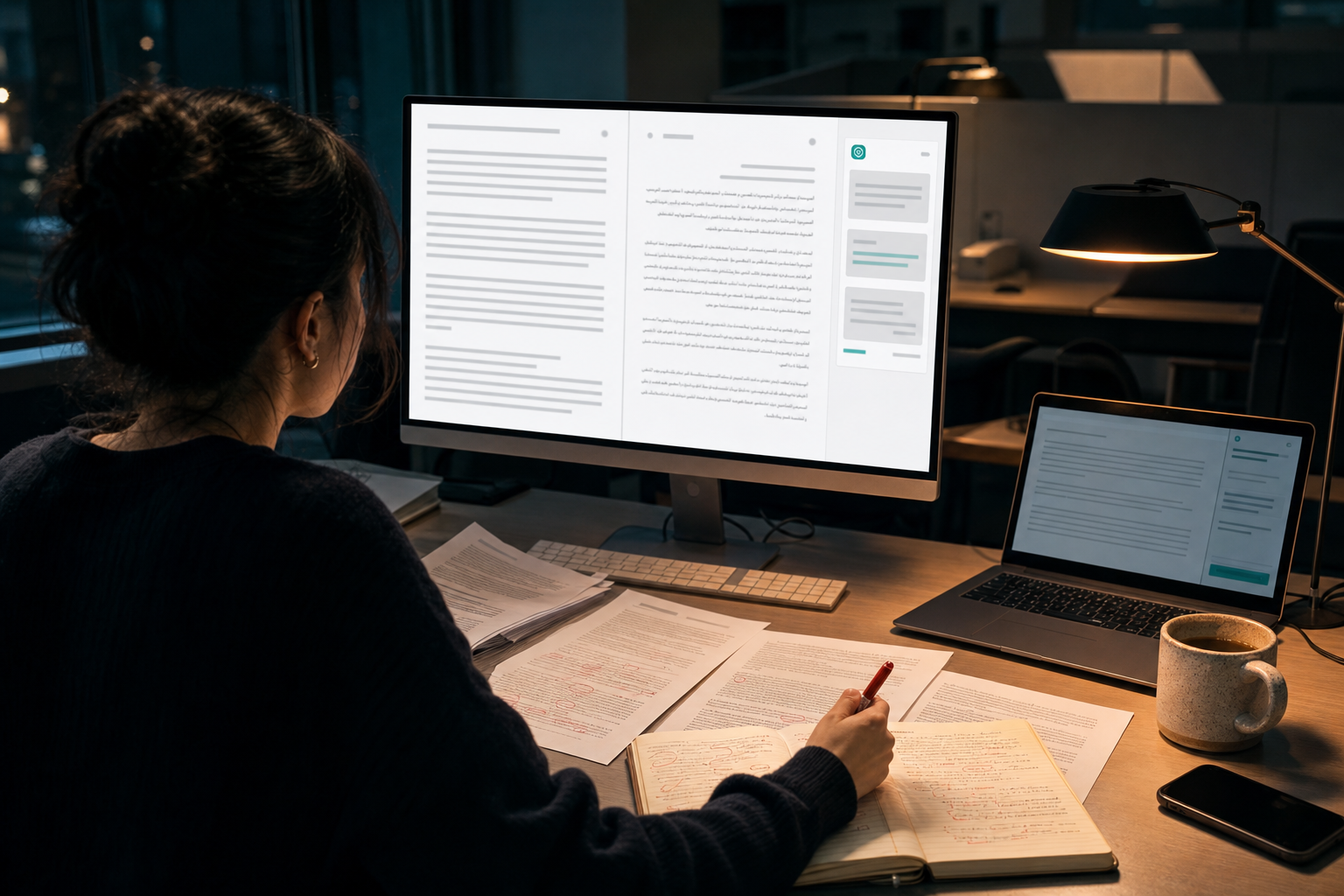
AI writing tools are now part of ordinary work. Students use them to clean up essays. Professionals use them for emails, reports, and presentations. Writers use them for drafts, headlines, and translation. The appeal is obvious. The concern is obvious too: if everyone uses the same systems to polish their prose, will everyone start sounding the same?
That question matters even more for people who write in both Arabic and English. Voice does not travel neatly between the two. Arabic and English differ in rhythm, sentence shape, emphasis, and register. A useful tool can help a bilingual writer become clearer. A careless one can strip out the very features that make the writing personal. To test that tension, I ran a small, informal experiment: not a scientific study, but a practical editorial test.
The experiment was simple
I used three short samples, each between 200 and 250 words.
- An Arabic paragraph written in a reflective, semi-formal voice.
- An English paragraph written directly in English, not translated.
- A translation task: take the Arabic paragraph into English without losing tone.
Then I gave the same system three different jobs.
- Free rewrite: “Rewrite this for clarity and flow.”
- Style diagnosis: “Identify five recurring style traits. Quote short phrases as evidence.”
- Constrained edit: “Edit for clarity, but change no more than 15% of the wording. Keep imagery, keep any deliberate repetition, preserve shifts between formal and informal tone, and explain major changes.”
The goal was not to see whether the system could produce clean text. It could. The real question was narrower and more useful: which kind of instruction helps a writer sound more like themselves, not less?
Why Arabic-English writers face a harder version of this problem
Voice is not just vocabulary. It includes sentence length, pacing, repetition, understatement, directness, and the small signals that tell a reader who is speaking. In bilingual writing, those signals often change across languages.
Arabic, for example, can carry emphasis through repetition and parallel structure in ways that feel natural on the page. English editors often cut repetition quickly because they read it as redundancy. Arabic also moves across registers in a way English software often tries to standardize. A writer may begin in Modern Standard Arabic, slip into a more spoken phrase for warmth, then return to a formal close. That shift can be part of the voice. A generic AI edit may treat it as inconsistency and flatten it.
English brings its own pressures. It rewards explicitness early. It often expects the point to arrive faster. That can help clarity. It can also erase a writer’s preferred build-up, especially if the original style uses delay, contrast, or a quiet ending rather than a blunt topic sentence.
In other words, the risk is not only bad grammar or clumsy translation. The bigger risk is normalization. The system pushes the writing toward a broad, global, polished-middle style.
What happened in the free rewrite
The unconstrained rewrite produced the weakest results. It made the text smoother, but usually less distinctive.
In the Arabic-to-English task, the system often replaced concrete phrasing with general emotion words. One line in Arabic read:
“لم أكن خائفًا بالمعنى المباشر، لكن قلبي كان يسبقني إلى النتيجة.”
A generic rewrite turned that into:
“I was anxious about the result.”
The meaning survived in a basic sense, but the movement of the sentence disappeared. So did the image. The original line does not just state anxiety. It shows it.
The same thing happened in English. A direct sentence such as:
“I do not write fast. I circle the point, then I land.”
was turned into something like:
“I am a careful writer who develops ideas gradually.”
That version is accurate. It is also flatter. A human editor might still choose it in a business memo. But if the aim is to preserve voice, it is a bad trade.
This is the first practical lesson. If you ask a system to “improve” your writing with no guardrails, it will often optimize for generic readability. That is useful for routine copy. It is not the same as preserving authorship.
The most useful result was not the rewrite
The most useful output came from the style diagnosis prompt. Asking the system to describe the writing before editing it produced better editorial value than asking it to rewrite from scratch.
It identified patterns that many writers do not notice in their own work: long opening sentences, a preference for contrast words such as “but” and “yet,” a habit of ending paragraphs with a concrete image, and a tendency to move from abstract statement to personal example. Those observations were not deep literary criticism. They were simple. That was exactly why they were helpful.
In effect, the tool worked better as a mirror than as a ghostwriter.
This matters because many writers do not need a machine to generate a voice. They need help seeing the one they already have. For Arabic-English writers, that can be especially useful in translation. A system can point out where a sentence sounds too literal in English, where a formal Arabic phrase feels stiff, or where a repeated structure is carrying emphasis rather than clutter.
The constrained edit did best
The strongest results came when the system was told what not to do.
With limits in place, it still cut clutter and fixed weak transitions, but it stopped replacing specific phrasing with safe abstractions. The same Arabic line received a better English version under constraint:
“I was not afraid exactly, but my heart kept running ahead to the result.”
That sentence is not perfect. A human writer might still tighten it. But it preserves the movement, the slight hesitation, and the image. It sounds like an edit, not a replacement.
This was the broader pattern across the test. When the instructions included hard limits, the system became more useful. “Preserve the image.” “Keep deliberate repetition.” “Explain why you changed this line.” “Offer two alternatives, not one.” These are not decorative prompt tricks. They are ways of protecting authorship.
Where the system still struggled
Even under better instructions, some problems remained.
Register drift: In Arabic, the tool often moved toward one consistent register even when the original mixed formal and conversational language on purpose. That makes text feel tidier, but sometimes less human.
Idiom pressure: Literal renderings could sound awkward, while naturalized versions could sound too generic. This is a real translation problem, not a bug with a simple fix. Often the best answer is to ask for two versions: one more faithful, one more natural, with a note about the trade-off.
Overconfidence: The system sometimes treated stylistic choices as errors. A short fragment for emphasis, a repeated phrase, or a delayed conclusion could all be “corrected” out of the text.
Cultural flattening: Phrases with local weight can be softened into global business English. The sentence becomes easier to process, but less rooted.
Privacy: If you are pasting personal writing, unpublished work, or client material into a public tool, style is not the only issue. Confidentiality matters too.
How to use AI without surrendering your voice
The practical answer is not to avoid these tools completely. It is to give them a smaller role.
- Write first. Start with your own draft, even if it is messy. Voice is easier to protect than to recreate.
- Ask for diagnosis before revision. “What are the recurring traits of this writing?” is often a better first question than “Make this better.”
- Use constrained prompts. Set limits on wording changes, tone shifts, and sentence order.
- Make the system show its work. Ask it to explain why a line was changed, especially in translation.
- Request options. A minimal edit and a stronger edit are more useful than one “final” version.
- Protect what matters. Tell the system what must stay: a phrase, an image, a bit of repetition, a formal-to-informal turn.
- Keep a style sheet. Save preferred spellings, key terms, punctuation habits, and translated phrases you trust.
- Compare line by line. If a cleaner sentence says less, it is not an improvement.
For bilingual writers, one extra habit is worth adding: keep your own small glossary. This is especially useful for recurring terms, emotional phrases, and expressions that do not map cleanly from Arabic to English. A system can help generate options, but your glossary should be the final authority.
A better prompt is often a better answer
Most disappointment with AI writing tools starts with vague instructions. If you ask for “better writing,” you will usually get safer writing. More useful prompts are narrow and editorial.
“Do not rewrite this from scratch. First, identify the writer’s style traits. Then suggest only the edits needed for clarity. Keep deliberate repetition. Keep the final sentence’s tone. If any phrase sounds translated, explain why before changing it.”
That kind of instruction does not guarantee a strong result. But it changes the job. The system is no longer replacing the writer. It is assisting the writer.
The real value is not imitation
There is a tempting idea behind AI writing tools: that a system can study your past work and then produce more of “you.” Sometimes that can help with consistency. But the more interesting use is simpler. The tool can reveal patterns, spot friction, and test alternatives quickly. It can help you notice where your writing is strong, where it is muddy, and where translation is draining the life out of a sentence.
That is a modest role. It is also the right one.
If you use AI to skip the hard part of writing, your voice will likely thin out. If you use it to inspect your habits, stress-test a translation, or clean a draft under strict limits, it can help you sound more like yourself. For Arabic-English writers, that may be the most practical use of all: not machine-made style, but machine-assisted self-editing.
The simplest rule is also the best one: let the tool suggest, let the writer decide.