Can AI Help You Write Better Arabic Without Erasing Your Voice?
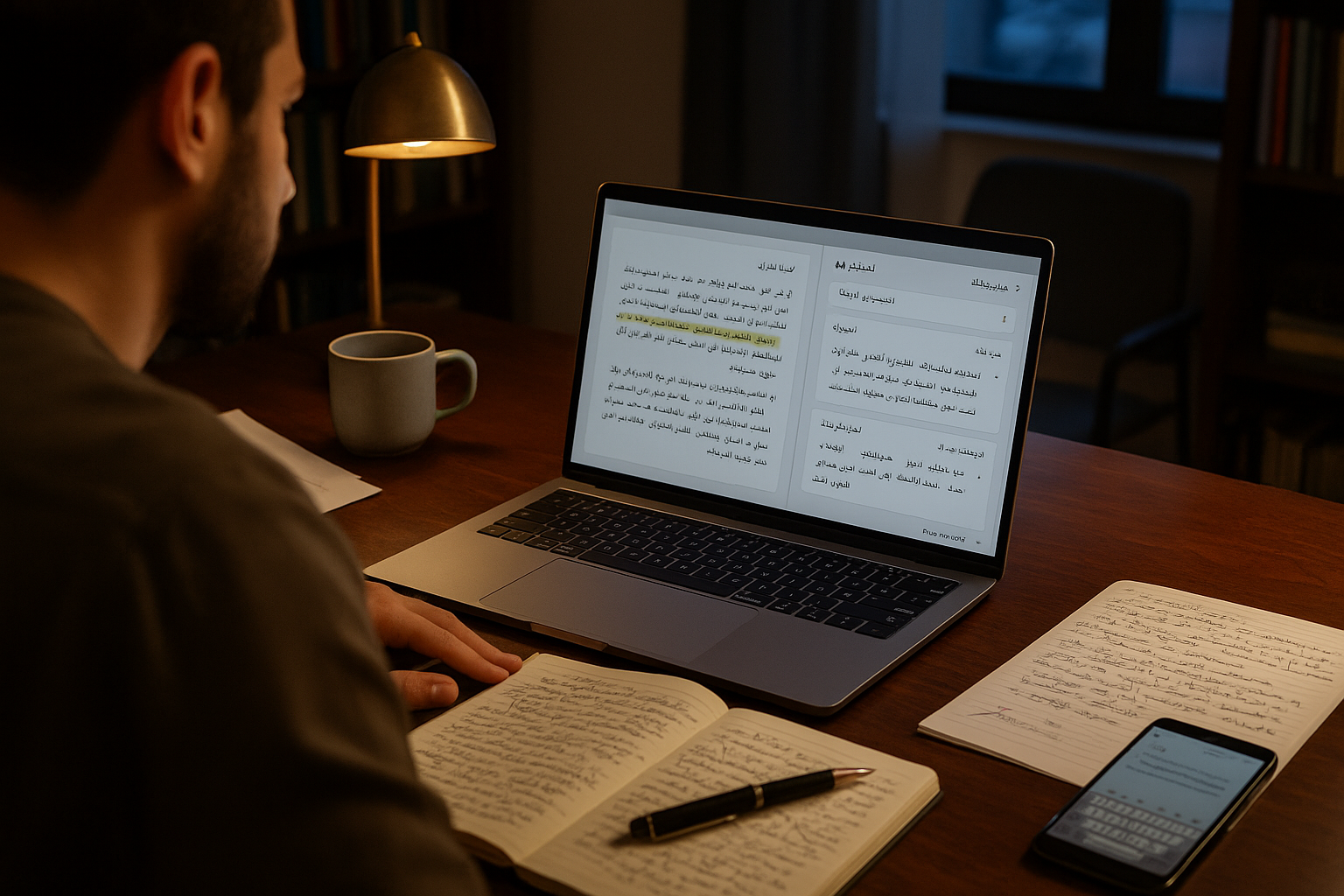
AI writing tools are now part of everyday Arabic writing. People use them to draft emails, fix grammar, shape scholarship essays, polish LinkedIn posts, and turn rough notes into readable text. That matters because Arabic is used by more than 400 million people, yet digital writing support for Arabic has often lagged behind English. The debate has also changed. It is no longer just, “Can AI write Arabic?” The harder question is whether it can help people write better Arabic without pushing everyone toward the same safe, generic tone.
The tension is sharper in Arabic than in many other languages. Formal Modern Standard Arabic can sound clear and authoritative, but much of real expression lives in dialect, mixed registers, and small personal habits of phrasing. Many AI systems handle polished standard Arabic better than they handle regional tone, humor, code-switching, or cultural texture. So the promise is real: faster revision, fewer mistakes, more confidence. But the risk is real too: a tool that improves correctness by sanding off identity.
Where AI is genuinely useful
Used well, AI can be a practical editor for Arabic. It can catch agreement errors, improve punctuation, tighten long sentences, and suggest a clearer structure. That is not a small thing. Arabic writing often requires attention to gender, number, case-related patterns, attached pronouns, and formal phrasing. For many writers, especially bilingual professionals and students, that last 15 percent of cleanup can take the most time.
A bilingual employee, for example, may think through a work memo in English and then write it in Arabic. The result can be accurate but stiff. AI can help turn translated phrases into something more natural. A student may know the point they want to make but struggle to organize it in formal Arabic. AI can suggest an outline, shorten repetition, or offer three ways to state the same idea. A creator writing a caption or script can use it to test alternatives quickly instead of staring at a blank page.
There is another benefit that matters: confidence. Many Arabic speakers move between registers all day. They may text in dialect, read news in formal Arabic, work in a bilingual office, and post online in a mixed style. AI can reduce friction between those modes. For non-native writers of Arabic, or native speakers who feel less secure in formal writing, that support can make expression easier rather than more intimidating.
Why Arabic voice is easy to flatten
The problem is that “better writing” is not the same as “more formal writing.” In Arabic, voice often lives in choices that an AI system is trained to smooth out. That includes dialect words, sentence rhythm, repetition for emphasis, code-switching, and the level of directness or warmth. A sentence can be grammatically improved and still become less you.
Original: "بصراحة، الفكرة حلوة، بس بدها شوية ترتيب."
AI-smoothed: "في الحقيقة، الفكرة جيدة، لكنها تحتاج إلى بعض التنظيم."
Both versions are understandable. The second is more formal and more standard. But it also sounds more distant. It changes the social meaning of the sentence, not just its grammar. The same thing happens when a tool turns a lively Levantine or Egyptian line into textbook Arabic, or when it removes a bit of English that feels natural in a Gulf office or a creative industry setting.
This matters because Arabic is not one writing problem. It is several at once. For most Arabic speakers, the formal written register is learned at school, not acquired at home. Daily speech varies widely across countries and even across cities. In some contexts, that variation is exactly what gives writing its force. A personal essay, ad campaign, podcast script, or social caption may lose its emotional accuracy if it is over-corrected into neutral public Arabic.
What the systems still miss
In practice, most widely used AI systems are stronger in Modern Standard Arabic than in dialect-heavy writing. They are usually better at fixing spelling than preserving tone. They can often produce decent formal prose, but they may mishandle sarcasm, idioms, spoken rhythm, or region-specific references. This is especially noticeable in dialects that have less digital standardization or less representation online.
Take Moroccan Darija. It may appear in Arabic script, Latin script, or a mix, often alongside French. Sudanese Arabic and Yemeni varieties have their own local patterns that are also easy to flatten or misread. Even when a tool “understands” the meaning, it may still rewrite the sentence into a more generic Arab media voice. That can be useful in a cross-border report. It can be damaging in a piece that depends on local texture.
There are other limits. AI systems can over-correct. They may remove intentional repetition that gives a sentence character. They may replace a vivid phrase with a safer synonym. If asked to add sources or quotations, they can also invent them. So while AI can help with language, it should not be trusted as a source checker or a cultural referee.
A better workflow: use AI as an editor, not a ghostwriter
The safest way to preserve voice is simple: start with your own draft. Even if it is messy, give the tool something human to work from. When people ask AI to produce Arabic text from nothing, the system usually falls back on its most statistically common style. That style is often polished, correct, and forgettable.
- Draft first in your own words. A rough paragraph is enough. Your original choices give the tool something to preserve.
- Name the register clearly. Do not just say, “Make this better.” Say whether you want formal Arabic, light colloquial Arabic, Gulf business tone, Levantine warmth, or a close edit that keeps your original rhythm.
- Ask for options, not one rewrite. A single rewrite often pushes the text toward a default voice. Three alternatives make the changes visible.
- Protect key phrases. If a phrase sounds like you, tell the system not to touch it.
- Read the result aloud. Arabic voice is easy to hear. If the sentence looks correct but feels unnatural in your mouth, it is probably wrong for your purpose.
- Check every fact yourself. Language support and factual reliability are not the same thing.
"صحح الأخطاء فقط، وحافظ على لهجتي ونبرة الجمل. لا تحوّل النص إلى فصحى كاملة إلا إذا كان الخطأ واضحًا."
"أعطني ثلاث نسخ: فصحى مهنية، عربية خفيفة قريبة من المحكية، ونسخة تحافظ قدر الإمكان على أسلوبي الأصلي."
These prompts work better because they define the task narrowly. They treat AI as a revision tool, not as a substitute author.
What this looks like for different writers
For students, AI can be helpful when the real problem is structure, not ideas. It can suggest a clearer introduction, point out weak transitions, or explain why a sentence sounds awkward. But if the student outsources the full draft, they may get a cleaner essay and a weaker writing habit. The short-term gain can become a long-term loss.
For bilingual professionals, AI is often most useful as a bridge between registers. It can turn translated corporate language into cleaner Arabic and adapt tone for different audiences. A regional NGO report, a client email, and a public statement may all need different levels of formality. The tool can speed up that adjustment. But it still needs supervision, especially when a message depends on political, religious, or social nuance.
For creatives, the value is in exploration. AI can generate variations, challenge a cliché, or help shape a paragraph that is almost there. But it is weak at the exact things that make writing memorable: controlled ambiguity, local humor, sharp timing, and the right strange phrase. In creative work, AI is better as a second pair of eyes than as a first draft machine.
The bigger risk is cultural, not just stylistic
There is a wider issue behind all this. If schools, workplaces, and platforms start rewarding only polished, standardized, AI-friendly Arabic, then local texture may slowly get treated as error. That would be a loss, not because every text should be dialect-heavy, but because real language range matters. Arabic has always moved across registers. A healthy writing culture should make room for formal clarity, regional identity, and individual style.
The answer is not to reject AI. Clear standard Arabic still matters deeply in education, journalism, law, research, and cross-border communication. The point is control. Writers should be able to choose when they want formal precision and when they want a closer, more personal register. A useful tool expands that choice. A bad habit narrows it.
Keep the final ear human
AI can help you write better Arabic, but only if you stay in charge of what “better” means. If better means cleaner grammar, sharper structure, and fewer awkward translations, the tool can save real time. If better quietly starts to mean flatter, safer, and less personal, then the cost is too high.
A good final test is simple: after the edit, does the text still sound like something you would say? If yes, AI has probably done its job. If not, the writing may be improved on the surface and diminished underneath. In Arabic, as in any language, correctness matters. But voice is what makes a reader stay.