Can AI Help Edit an Arabic Poem Without Flattening Its Voice?
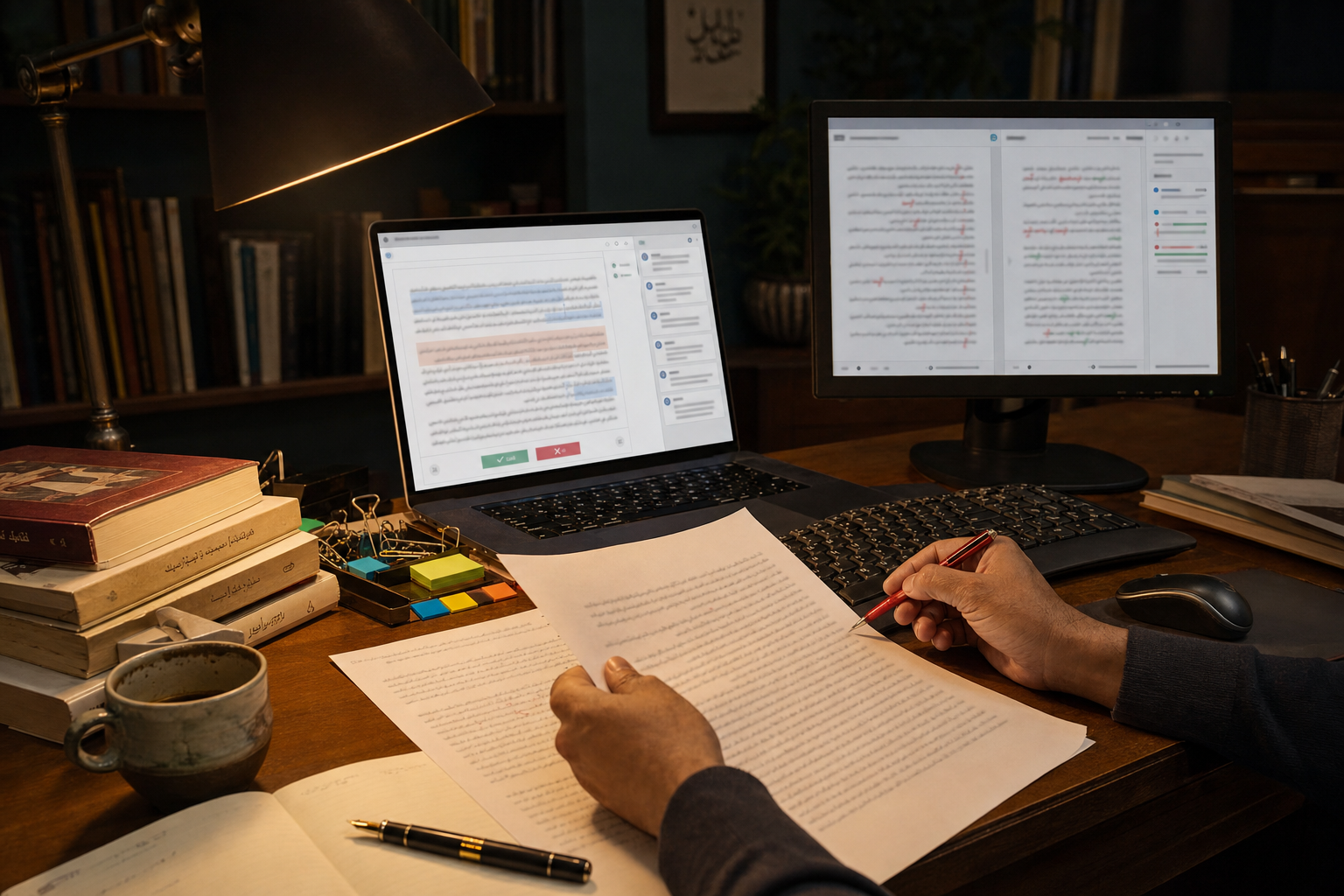
Yes, but only if the poet stays firmly in charge. AI can help with some parts of editing an Arabic poem: spotting accidental grammar slips, flagging repeated words, offering alternate phrasing, or helping organize feedback across drafts. That matters because Arabic poetry is a sharp test of what “creative assistance” really means. The main tension is clear: the same tool that can make a poem cleaner can also make it more generic.
That tension is stronger in Arabic than many AI discussions admit. A short Arabic line may carry rhythm, register, religious or literary echo, dialect, and regional identity at the same time. A minor change can weaken the sound of a line, disturb its meter, or erase the exact shade of intimacy the poet wanted. So the real question is not whether AI can improve an Arabic poem on paper. It is whether it can help revise without smoothing away the poem’s voice.
Arabic poetry is built on more than meaning
Editing a poem is not the same as editing an email, an essay, or even a short story. In poetry, a word is chosen not only for what it means, but for how it lands in the ear, how it sits beside the next word, and what kind of Arabic it belongs to. A poet may move between formal Arabic and dialect on purpose. A line may sound slightly strange on purpose. A repeated word may be a device, not a mistake.
Arabic raises the stakes because it contains many registers, not one neutral standard voice. A poem may lean on classical cadence, modern free verse, prose-poem compression, or colloquial speech. It may borrow from Qur’anic rhythm, everyday conversation, or older poetic traditions. In metered verse, one replaced word can break the meter. In rhyme-heavy verse, a neat synonym can spoil the ending. Even in free verse, a “better” sentence can be a worse line.
A simple example shows the problem.
Original: “أجرُّ ظلّي إلى آخر الليل”
AI-style edit: “أسير بظلي حتى نهاية الليل”
The second line is not wrong. It is easier, more direct, and more standard. But it is also flatter. “أجرُّ” carries drag and fatigue in a way “أسير” does not. “إلى آخر الليل” has more pressure than “حتى نهاية الليل,” which sounds tidier and more explanatory. If your only goal is clarity, the edit may seem helpful. If your goal is poetry, something important has been lost.
The safest jobs for AI
Used carefully, AI can still be useful. The best results usually come when the task is narrow and clearly framed. In that role, the tool acts less like a co-author and more like a fast, imperfect editorial assistant.
- Catch accidental mistakes. It can flag obvious spelling, punctuation, agreement, or typographical errors, especially in later drafts.
- Spot unintentional repetition. It can identify when the same root, image, or phrase appears too often across a poem or a sequence.
- Offer low-risk alternatives. If the poet asks for options with strict limits, the model can suggest small substitutions without rewriting the entire line.
- Check register consistency. It can help show where a poem shifts between formal Arabic and dialect, which is useful if the poet wants control over that shift.
- Summarize workshop feedback. It can turn scattered comments into a revision checklist, saving time between drafts.
These are not trivial benefits. Not every poet has access to a trusted editor, workshop, or literary community. For students, emerging writers, or poets working in the diaspora, basic editorial support can be hard to find. A tool that helps sort comments, identify clutter, or test alternate versions can reduce friction in revision.
Where the flattening starts
The trouble begins when AI moves from diagnosis to authority. Most language models are trained to produce plausible, readable text. That makes them good at average phrasing. Poetry often depends on the opposite: the less expected word, the sharper break, the line that withholds rather than explains.
In Arabic, that tendency can show up in several ways.
- It standardizes toward safe modern prose. A model often prefers smooth, middle-register Arabic over unusual or compressed expression.
- It over-explains. Where a poet uses ambiguity, the model may supply explicit meaning and weaken the line.
- It treats deliberate strangeness as error. Broken syntax, abrupt shifts, or unusual repetition may be part of the poem’s design.
- It struggles with undiacritized ambiguity. Arabic words can carry several readings without diacritics, and a model may simply guess wrong.
- It can erase dialect texture. When a poem uses colloquial phrasing for intimacy or local color, the model may “correct” it into standard Arabic.
Consider a second example.
Original: “وقلبي على مهله يمشي”
Smoothed version: “ويسير قلبي ببطء”
Again, the second version is grammatically clean. It is also less alive. “على مهله” carries an idiomatic softness that “ببطء” does not. The first line feels spoken; the second feels processed. That difference matters in poetry.
There is also a broader technical limit. We still do not have a strong public way to measure whether an AI system preserves literary voice. Standard benchmarks test grammar, translation, summarization, and factual recall. They do not tell us whether a revised Arabic line kept its music, its cultural echo, or its emotional pressure. On that question, human judgment is not optional.
A better way to collaborate
If poets want to use AI without losing control, the workflow matters more than the model name. The safest approach is to ask for analysis first, then suggestions, then very limited rewrites. In other words: diagnosis before intervention.
A useful instruction might look like this:
“Act as a conservative Arabic poetry editor. Do not rewrite the poem unless asked. First identify only possible issues of grammar, accidental repetition, or unclear reference. Preserve dialect, compression, and unusual syntax unless I mark them as unintentional. When suggesting alternatives, give three options: minimal change, rhythmic change, and register-aware change.”
That kind of prompt does two important things. It narrows the task, and it tells the model what not to touch. That may sound obvious, but it is the difference between getting a useful note and getting a flattened poem back.
- Name the form. Say whether the poem is metered, free verse, prose poetry, or dialect-based.
- Mark the non-negotiables. Tell the tool which words, images, or registers must remain.
- Ask for levels of intervention. Minimal, moderate, and high-change options help the poet compare without surrendering the line.
- Keep comments separate from rewrites. Notes are often more useful than replacement lines.
- Read every changed line aloud. If it looks better but sounds worse, it is not an improvement.
Who benefits, and who should worry
The promise here is real. AI can lower the cost of revision. It can help younger poets learn editorial habits. It can support magazines and small literary platforms that do not have large budgets. It can even help bilingual or non-native Arabic writers identify where a line has drifted away from the tone they wanted.
But the risk is also real, especially at the institutional level. If publishers, contests, or magazines begin using AI to “clean up” submissions before serious human reading, the result may be a narrower idea of acceptable Arabic. Dialect-heavy work, experimental syntax, and regionally marked voices could lose out to smoother, more standardized language. That would not be a technical upgrade. It would be a cultural loss.
This matters because Arabic poetry is not one tradition and not one sound. It lives across many countries, schools, generations, and registers. Any tool that quietly pushes all of that toward one polished middle voice is not just editing. It is filtering.
The practical bottom line
AI can help edit an Arabic poem, but only when the poet uses it as a limited tool, not a final judge. It is good at catching surface issues, organizing feedback, and generating controlled alternatives. It is much less reliable when asked to decide what a line should be.
The simplest test is also the best one: if the revised line is cleaner but less distinct, the edit failed. In Arabic poetry, voice is not decoration added after meaning. It is the meaning. So yes, use AI if it saves time or sharpens attention. But give it narrow authority. Let it assist the revision, not define the poem.