Can a Voice AI Really Run Your Front Desk? A Plain Guide to AI Phone Receptionists
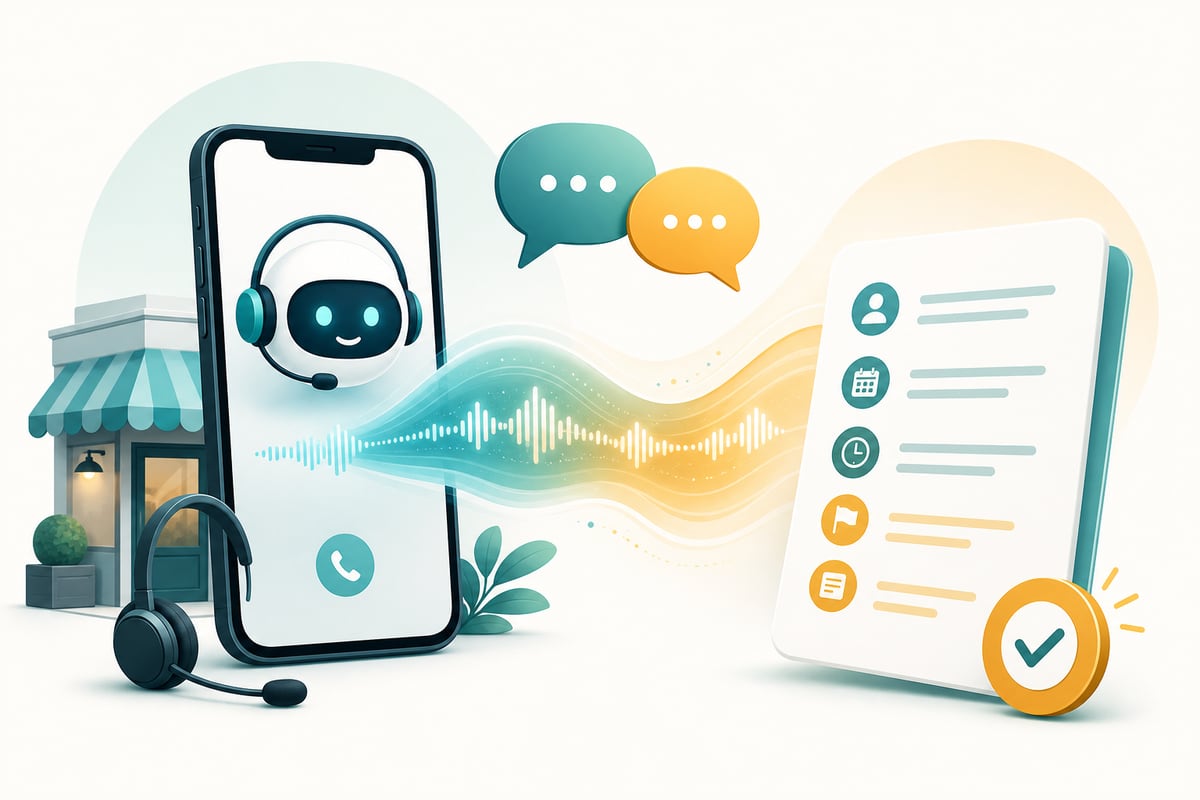
Ask a small business owner what they wish they had more of, and somewhere near the top of the list is a deceptively simple thing: someone to answer the phone. Not a call center. Not another app. Just a reliable voice that picks up when a new customer calls and the office is closed, busy, or short-staffed. This is exactly the gap that a new generation of "AI phone receptionists" promises to fill — and it is worth understanding clearly, because the technology is real, useful, and easy to oversell.
This is a plain-language guide to what voice AI receptionists actually do, where they genuinely help, and where you should be skeptical.
What a voice AI receptionist actually is
Strip away the marketing and the idea is straightforward. A phone number is connected to a conversational AI. When someone calls, the AI greets them, understands what they are saying in real time, asks a few sensible questions, and records the answers. Modern systems are "speech to speech," meaning they listen and talk in something close to natural conversation rather than the rigid "press 1 for billing" menus we all dread.
What the business receives is not a vague voicemail but a structured summary: the caller's name, number, reason for calling, urgency, and which language they prefer for a callback — usually delivered by email or text within seconds of the call ending, along with a full transcript.
Where it genuinely helps
The strongest case is not "replace your staff." It is cover the hours and overflow your staff can't. Most small businesses miss calls in predictable gaps: after 5 p.m., on weekends, during lunch, and whenever the one person at the desk is already on another line. Industry surveys have long suggested that a large share of callers who reach voicemail simply hang up and call a competitor. An AI that answers every one of those calls and captures the lead is, in pure arithmetic, often paying for itself after a single recovered customer.
Three situations where it shines:
- After-hours and overflow intake. The lowest-risk way to start: keep your existing reception, and only route the calls that would otherwise go unanswered.
- Bilingual coverage. Strong systems can switch between English and Spanish mid-conversation. For businesses serving multilingual communities, this is not a luxury feature; it is the difference between capturing a caller and losing them.
- High-value, phone-driven trades. Law firms, clinics, home-services contractors — anywhere a single missed call can mean a lost client worth far more than the monthly cost.
Where to stay skeptical
AI literacy means knowing the limits, too. A few honest cautions:
It should take messages, not give professional advice. A well-built receptionist for a law office or clinic is explicitly designed never to offer legal or medical opinions. If a system happily answers substantive professional questions, that is a liability, not a feature. The right behavior is: collect the details, then hand off to a qualified human.
Recording and consent are not optional. In "two-party consent" states such as California, calls that are recorded or transcribed must disclose that fact to the caller at the start. Any serious provider builds this into the greeting. Ask how they handle it, and how long transcripts are stored.
Generic is not the same as configured. There is a real difference between a self-serve tool you must script yourself and a service that is set up and tuned for your specific business. The first is cheaper on paper; the second is far more likely to sound right to your callers. Plan to review the early transcripts and refine, exactly as you would coach a new hire.
It is a safety net, not a soul. The technology returns a call and captures a lead. It does not build the relationship. Treat it as the reliable first touch that makes sure a human conversation can happen, not as a replacement for that conversation.
What this looks like in practice
To make it concrete: services in this category — for example TelAI, a bilingual AI receptionist aimed at small professional offices — typically connect to your existing line, answer in English and Spanish, take a structured intake, disclose recording where the law requires it, and email you the lead within minutes. The pattern is consistent across the better tools: answer everything, capture cleanly, escalate to a human when it matters, and never pretend to be more than it is.
The bottom line
A voice AI receptionist will not transform your business overnight, and you should distrust anyone who says it will. But as a way to stop quietly losing customers in the gaps of the workday — especially callers who speak another language and would never leave a voicemail — it is one of the most immediately practical applications of conversational AI available to a small business today. Understand what it is, hold it to its limits, and it earns its place: a patient voice that makes sure no one who needed you ever calls into an empty room.