The Arabic Creator's AI Toolkit: Pairing Machine Drafts with Human Taste, Memory, and Voice
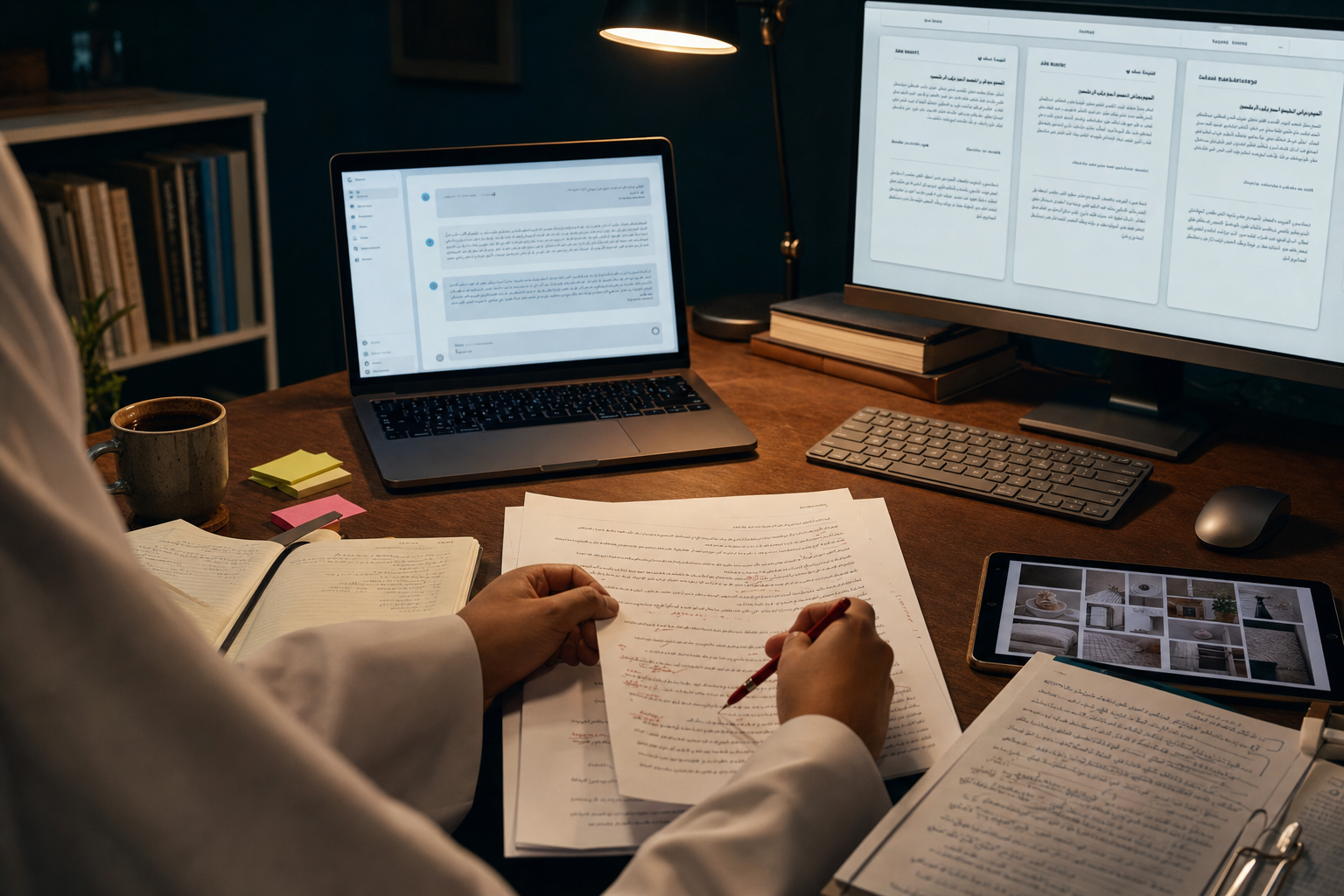
Generative AI has already entered everyday creative work. Arabic writers use it to test headlines. Designers use it to build moodboards. Social media teams use it to turn one long idea into ten short posts. The change matters because it makes production faster and cheaper, especially for small teams and solo creators. But it also creates a real problem: if everyone can generate decent-looking drafts in seconds, what keeps the work distinct, trustworthy, and personal?
For Arabic creators, that problem is sharper than it first appears. Arabic is spoken by more than 400 million people, but it does not move in one voice. Modern Standard Arabic, Gulf Arabic, Egyptian Arabic, Levantine speech, Maghrebi rhythms, religious language, internet slang, and bilingual code-switching all shape how content lands. AI can help with speed, structure, and variation. It can also flatten local voice into generic, over-polished language. The main tension is simple: how do you use machine drafts without handing over taste, memory, and authorship?
What AI is good at, and what it is not
AI is most useful when the job is broad, repetitive, or structural.
- It can turn rough notes into a first outline.
- It can generate several caption openings for the same idea.
- It can summarize interviews or voice notes.
- It can suggest content angles, titles, series formats, and repurposed versions of one piece.
- It can help with translation drafts and tone comparisons.
That is real value. If you are a creator working alone, saving one or two hours on setup can be the difference between publishing and not publishing.
But AI is weak where creative work becomes particular. It does not bring lived memory. It does not know which reference your audience will find precise, and which one will feel fake. It often misses rhythm, timing, subtext, and the social meaning of a phrase. In Arabic work, that gap shows up fast.
A tool can write “celebrate warmth and togetherness this Ramadan.” It is much less reliable at producing the exact detail that makes the line feel lived rather than borrowed: the queue at the bakery before iftar, the family argument over seating, the neighborhood phrase everyone knows, the specific comic tone of a Cairo kitchen or a Jeddah group chat. Those details are not extras. They are often the work.
Where Arabic creative work gets flattened
Many popular AI systems are stronger in English than in Arabic, especially when the task involves dialect, humor, wordplay, or cultural nuance. In practice, Arabic creators tend to hit the same problems again and again.
- Dialect gets washed out. A prompt asking for local, contemporary language often returns safe, formal Arabic.
- The phrasing sounds translated. The sentence is technically correct, but it carries English logic underneath.
- References become generic. Instead of place, class, age, and setting, the output leans on clichés about family, heritage, or spirituality.
- Typography and layout break. Right-to-left text still creates problems in some design, captioning, and image tools.
- Confidence hides errors. Attributions to poems, sayings, historical events, or religious material can be wrong.
That last point deserves special care. In Arabic content, a mistaken quote, a misattributed verse, or a false historical reference is not a small technical issue. It can damage trust quickly. If your work touches religion, politics, literature, or public history, every generated line needs checking.
Use AI for range, not for identity. Let it widen your options. Do not let it define your voice.
Taste is the real advantage
When creators talk about voice, they often mean wording. That is only part of it. Voice also includes pace, humor, restraint, and choice of detail. Taste is what decides which draft feels honest, which image feels cheap, and which sentence sounds like something you would actually say.
This matters because AI produces a lot of usable language. That can be deceptive. A sentence can be smooth and still be empty. A caption can be clear and still sound like everyone else. The creator’s job is no longer just writing from zero. It is selecting, rejecting, sharpening, and grounding.
If the machine gives you ten workable lines, taste is what makes you keep one, rewrite it, and throw away the other nine.
A real toolkit is half machine, half memory
The best Arabic creator toolkit is not one app. It is a workflow. A strong setup usually includes five parts.
- One drafting tool for outlines, variants, summaries, and quick experiments.
- One transcription tool for interviews, meetings, voice notes, and spoken ideas.
- One visual tool for references, moodboards, storyboards, or layout testing.
- One personal archive of notes, photos, saved captions, field observations, old posts, comments, and unfinished fragments.
- One human review layer with rules for tone, fact-checking, dialect, and sensitivity.
The personal archive is the part many people skip. It is also the part that protects originality.
Your archive can be simple. A folder of voice notes. A note titled “phrases I actually use.” A list of images from your city. Screenshots of comments from followers. Snippets from family conversations. Words your audience uses for the same feeling. Details from weddings, commutes, cafés, campuses, offices, and homes. These are not random leftovers. They are raw material that AI does not have unless you provide it.
Memory, in this sense, is not nostalgia. It is creative inventory.
Build a voice sheet before you prompt
Most weak AI content starts with a weak brief. If you want output that sounds like your work, you need to define your voice before the tool begins drafting.
A practical voice sheet can include:
- Who the audience is, in plain language.
- Which register you want: formal, semi-formal, colloquial, or mixed.
- Which dialect to use, and where to avoid it.
- Words, clichés, and marketing phrases you never want.
- References that fit your world: music, sports, food, neighborhoods, social habits, online slang.
- Rules on religious, political, or sensitive topics.
- Formatting preferences for Arabic and bilingual text.
This changes the quality of the draft immediately. “Write a caption about Eid” is vague. “Write five short caption openings for a fashion brand in a warm, contemporary Gulf tone, avoid corporate language, keep it clean, and leave room for a real local detail” is usable.
Notice the difference. You are not asking the tool to be you. You are giving it boundaries so you can edit from a better starting point.
A workflow that keeps authorship with you
The strongest creator workflows usually follow the same pattern.
- Start with a human brief. Write down the goal, audience, platform, emotional tone, and hard facts. If you skip this, the tool will fill the gap with generic assumptions.
- Ask for options, not a final masterpiece. Request hooks, structures, angles, headlines, visual directions, or questions to explore. Early breadth is useful. Early polish is often a trap.
- Add memory before style. Insert your details first: names, places, sensory moments, references, and audience-specific language. Then refine tone.
- Edit aloud. In Arabic especially, reading aloud quickly reveals whether a line is too formal, too translated, or simply not something a real person would say.
- Check facts and context manually. Verify quotes, dates, religious language, poetry, geography, spelling, and attributions.
There is a useful rule here: do not ask AI for your final voice until you have already put your own material into the draft. Otherwise you are polishing emptiness.
How this works in different creative fields
For writers and essayists: Use AI to test structure, not conviction. It can help compare openings, condense long notes, or find missing questions in an argument. It should not decide your central claim or your reporting standards.
For poets and lyric writers: Use it as a pressure tool, not a soul substitute. It can suggest rhyme families, image clusters, or formal constraints. It is much less reliable at surprise, cadence, and emotional timing. If a line could belong to anyone, it probably is not finished.
For designers: AI can speed up moodboards, visual references, naming directions, and campaign concepts. But Arabic lettering, typographic weight, and right-to-left composition still need close human attention. Many generated visuals also drift into lazy “Middle Eastern” symbolism. Specific cultural reference is stronger than decorative shorthand.
For social media creators: AI is excellent at turning one idea into multiple hooks, clip descriptions, or caption versions. It is far less good at knowing which line feels native to your audience and which one feels assembled. Your strongest content still comes from filming, observing, and speaking from a real place.
Protect what should stay human
Efficiency is not the only issue. There are also boundaries worth keeping.
- Do not upload sensitive material casually. Client briefs, unpublished manuscripts, private chats, and identifiable personal data should not be treated as prompt fuel.
- Keep version history. Save your notes and edits so your own process does not disappear inside generated text.
- Be careful with imitation. Studying a genre is normal. Copying a living creator’s recognizable style too closely is not a harmless shortcut.
- Tell collaborators how you are using AI when it affects the work. Transparency matters in editorial, sponsored, and client-based settings.
There is also a practical warning sign: if your output is getting faster but less memorable, the machine is probably doing too much. Another warning sign is when every post becomes polished in the same way. Smoothness is not the same as voice.
The best prompt may be your own notebook
The most useful shift for Arabic creators is not learning one magic prompt. It is building a system where AI handles draft labor and the human creator keeps authorship. That means the machine helps with options, structure, and speed. The person keeps judgment, context, sensitivity, and the final shape of the work.
In a crowded content economy, that division matters more, not less. Generic output is getting easier to produce every month. Distinctive work is still hard. It comes from what you noticed, what you remember, what you choose to keep, and what you refuse to say in a borrowed voice.
The practical conclusion is simple: let AI widen the page, not replace the pen. Build your toolkit around your archive, your ear, and your standards. If the draft saves time but loses your world, it is not a good draft yet.