Arabic Creativity With AI: Dialect, Rhythm, and Cultural Memory in Generated Text
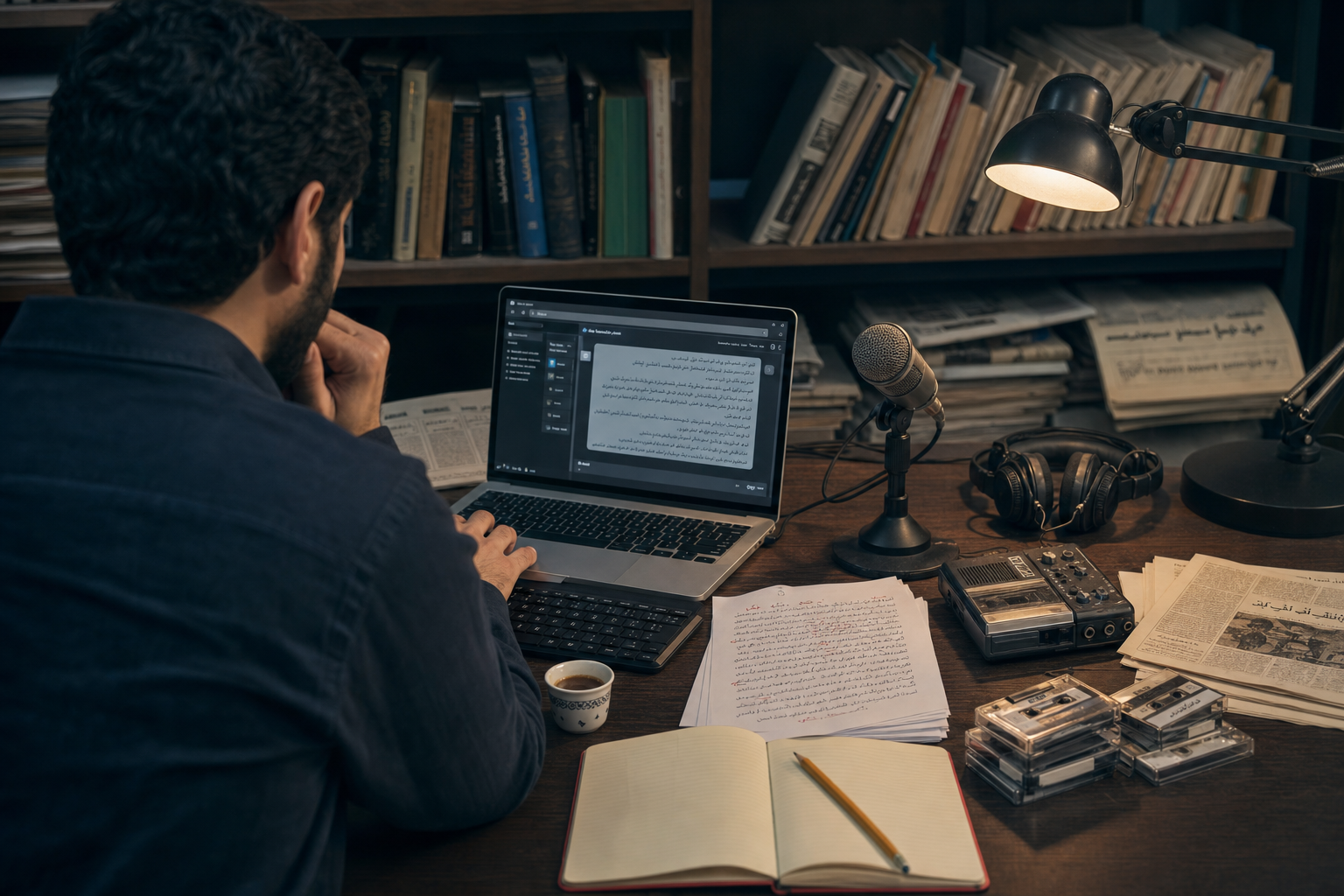
Over the last two years, generative AI has moved from English-language demos into everyday work in classrooms, newsrooms, and marketing teams. It can now produce Arabic emails, captions, lesson plans, ad copy, and even poetry in seconds. But many Arabic users run into the same limit quickly: the text is grammatically acceptable yet socially thin. It often sounds like no one in particular.
That matters because Arabic creativity lives in difference. Meaning shifts when a sentence moves from fusha to ammiya or darija, from a formal cadence to a local joke, from inherited phrase to new slang. The main debate is not whether AI can generate Arabic at all; it clearly can. The real question is whether it can support Arabic expression without flattening dialect, rhythm, and cultural memory into one safe default.
Arabic is not one lane
Arabic is used across more than 20 countries, and no serious creative practice treats it as a single uniform stream. In daily life, many speakers move between formal Arabic and local speech without thinking about it. A teacher may explain an idea in fusha, switch to dialect for a joke, borrow a proverb from an older generation, then return to formal language for emphasis. Writers do the same on purpose.
A simple sentence shows the point:
- Formal written Arabic: “أريد أن أذهب الآن”
- Egyptian colloquial: “عايز أروح دلوقتي”
- Levantine colloquial: “بدي روح هلأ”
All three point to the same basic meaning. But they do not carry the same social signal. They suggest different settings, ages, relationships, and levels of formality. If a model replaces a local line with safe standard Arabic, it does not just change vocabulary. It changes who seems to be speaking.
This is why so much generated Arabic feels “correct” but not rooted. The system has produced language, but not always register.
Why the output gets flattened
The problem is partly technical and partly cultural. These systems predict likely word sequences from huge training datasets. If the available data skews toward formal Arabic, the output will too. And online Arabic still leans heavily toward news articles, government text, educational material, customer service, and institutional writing. Those forms matter, but they are only one slice of Arabic expression.
Everyday language is harder to capture. Dialect spelling is inconsistent. Code-switching is common. On the same platform, Arabic may appear in standard script, mixed with English or French, or written in Arabizi with Latin letters and numbers such as 3 and 7. That is real language use, especially among younger speakers, but it is messy for training pipelines and weakly labeled in many datasets.
Evaluation makes the problem worse. Many benchmarks reward grammar, retrieval, and literal translation. They rarely ask harder questions. Does this line sound Jordanian or just vaguely informal? Would this dialogue feel natural in Khartoum? Is this phrase too old, too stiff, too urban, too online, too formal for the scene? What gets measured shapes what gets improved, and Arabic creativity is still undermeasured on those terms.
Rhythm is part of meaning
In Arabic creative work, rhythm is not decoration. It matters in poetry, but also in sermons, slogans, rap, spoken word, TV dialogue, political chants, and everyday banter. Repetition, internal rhyme, parallel structure, pause placement, and the length of a clause can make a line persuasive, funny, intimate, or sharp.
Models often handle this only at the surface. They can generate rhyme. They can imitate elevated diction. They can produce a sentence that looks literary on the page. But pace is harder. Much generated Arabic arrives with the same even pressure, as if every line were written for a brochure. That is one reason AI-written verse and dialogue often feel generic even when no single word is wrong.
A useful Arabic writing tool must capture more than vocabulary. It must handle timing, register, and the pressure of a spoken line.
Consider the difference between a polished phrase like “لم يعد في القلب متسع” and a tighter spoken line such as “القلب ما عاد شايل.” Both point to emotional exhaustion. The second lands differently because it carries everyday rhythm and a clearer social place. Human writers make these choices instinctively. AI tools can assist, but they still need strong prompting, better data, and careful human editing to get close.
Cultural memory is harder than style
Arabic writing also carries deep layers of shared memory. A short line may echo a proverb, a classical verse, a sermon cadence, a Fairuz refrain, a neighborhood saying, or a phrase heard from a grandparent. These references are not decorative extras. They locate the text inside history, class, humor, faith, region, and family life.
Generated text can reproduce the surface of those references while missing their weight. A wedding speech and a condolence message may draw from overlapping cultural archives, but the rules are not the same. The same is true for religious language. A phrase that sounds powerful in one context can sound careless, heavy-handed, or inappropriate in another.
This is where flattening becomes more than a style issue. It becomes a memory issue. If AI systems reduce Arabic culture to a few easy signals, such as old vocabulary, generalized nostalgia, or stock phrases like “عبق الماضي,” they do not preserve richness. They replace it with cliché.
There is also a rights question. If models are trained on living poets, lyricists, forum writers, or social media posts without clear permission, then cultural memory is not only being simplified. It is also being extracted.
Where AI can actually help
None of this means Arabic creators should reject AI tools. Used well, they can save time and widen access. The strongest uses today are practical, collaborative, and clearly supervised by humans.
- Drafting across registers: A writer can ask for the same idea in formal Arabic, neutral colloquial, and a region-specific tone, then compare what feels true and what feels false.
- Teaching language awareness: Students can see how meaning changes between fusha and everyday speech, or how a paragraph becomes too stiff when every sentence is standardized.
- Editing interviews and oral history: Journalists and researchers can turn rough transcripts into readable drafts while preserving direct quotes in the original voice.
- Subtitling and adaptation: Creators working between Arabic and English, or across Arabic dialects, can use AI for first-pass subtitles, transliteration, and tone experiments.
- Creative exploration: Poets, scriptwriters, and lyricists can test openings, scene variations, or character voices faster than before, then do the serious work of selection and rewriting themselves.
In all these cases, the value is not that the model becomes the author. The value is that it becomes a fast drafting instrument under human judgment.
What better Arabic AI would require
If companies and institutions want better Arabic creative tools, the next step is not just “more Arabic data.” It is better Arabic data, better evaluation, and more local control over what counts as quality.
- Dialect-rich, ethically sourced datasets: Not only formal text, but spoken-language material, code-switching, and underrepresented dialects, collected with consent where possible.
- Regional review: Outputs should be tested by speakers from different countries and social backgrounds, not only by general Arabic language evaluators.
- Register-aware interfaces: Users should be able to specify audience, age, setting, city, and level of formality, instead of choosing only between “formal” and “informal.”
- Clear uncertainty signals: When a system may be mixing dialects or producing a phrase with weak local grounding, the tool should say so.
- Respect for creators: Writers, translators, musicians, and publishers need clear rules on training, attribution, and compensation.
These are not niche requests. They are basic quality requirements for a language ecosystem as large and varied as Arabic.
The standard that matters
The useful test is not whether a model can generate Arabic quickly. It is whether the result keeps the speaker located in a real place, with a real rhythm, among real memories. A student in Rabat, a teacher in Riyadh, a copywriter in Cairo, and a poet in Beirut do not need one default Arabic voice. They need tools that respect difference.
AI can support Arabic creativity, but only if it stays in the role of assistant and not cultural authority. The best systems will help people draft, compare, and refine. The final voice should still belong to the writer. If that principle holds, AI may widen expression. If it fails, the cost will be easy to notice: Arabic that is smooth, useful, and strangely empty.