Arabic Creativity with AI: Why Translation Is Not the Same as Voice
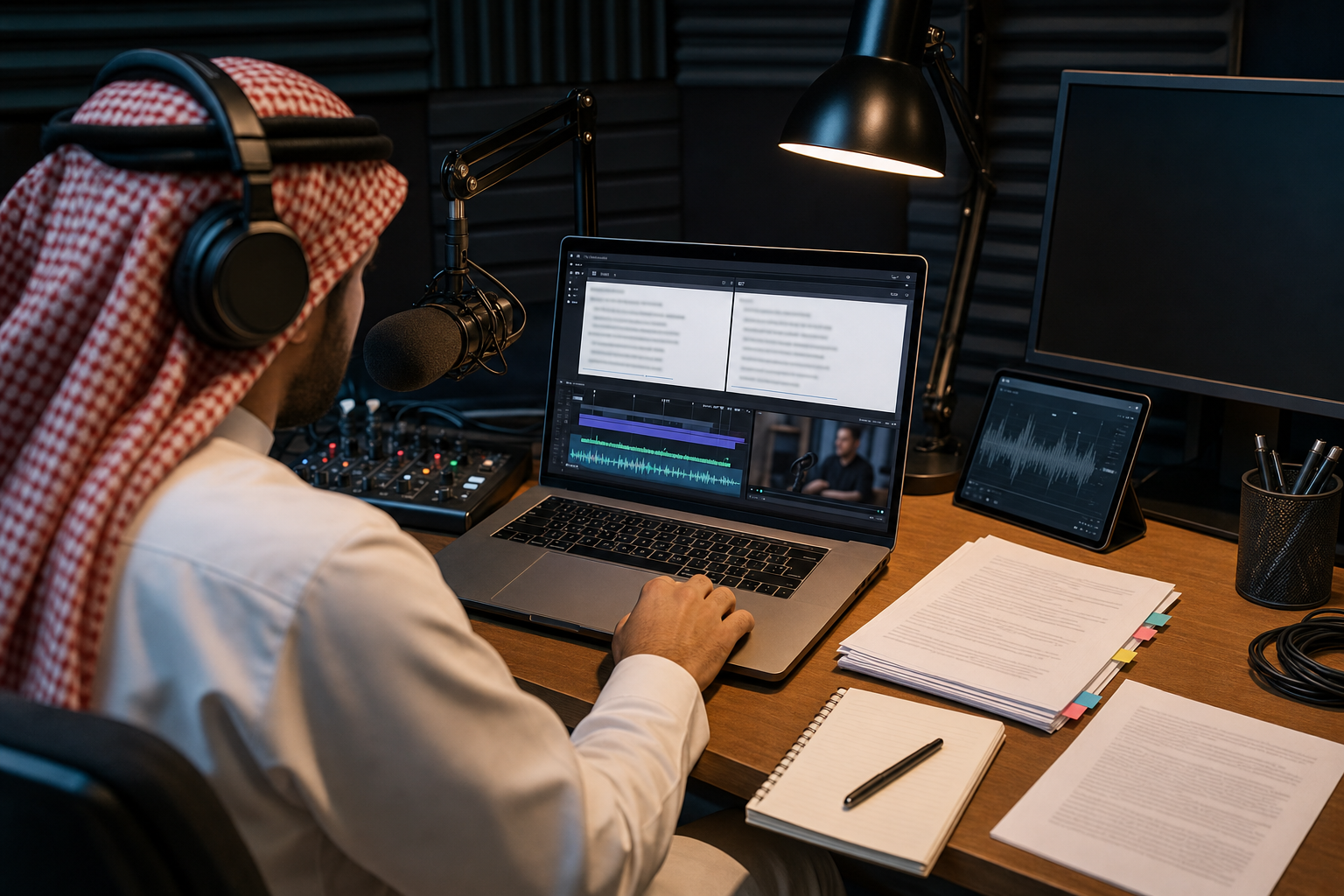
AI tools are now widely used to write, translate, subtitle, and edit Arabic content. For Arabic-speaking creators, that is both a practical gain and a creative test. The gain is speed. The test is voice. A system can produce correct Arabic much more easily than it can produce Arabic that sounds like a person from Jeddah, Tunis, Amman, or Cairo speaking to a specific audience.
That matters because Arabic creativity depends on more than meaning. It depends on dialect, rhythm, formality, code-switching, and cultural reference. The debate is not whether AI should be used at all. It already is. The real question is how to use it without letting it smooth Arabic into clean, generic prose that carries the message but loses the speaker.
Arabic is one language, but not one voice
Arabic is spoken by more than 300 million people across more than 20 countries. That single fact explains part of the challenge. There is Modern Standard Arabic, or fusha, which dominates news, formal education, official statements, and much professional writing. Then there are regional and local dialects, each with its own tone, vocabulary, and social signals.
Real creators move between these layers all the time. A podcast host may open in formal Arabic to sound credible, shift into dialect to sound human, then drop an English word because that is how the audience actually speaks online. A marketing writer may choose one phrase for Saudi business readers and another for students in Egypt. A poet or comedian may build an entire line around a local rhythm that disappears the moment it is standardized.
AI systems are usually strongest where Arabic is most standardized. That is not surprising. Formal Arabic appears in books, articles, policy documents, and school materials. Dialect writing is more fragmented. It lives in chats, subtitles, comments, memes, lyrics, and voice notes turned into rough text. Spelling is less consistent. Regional phrases shift fast. Some users also write Arabic in Latin letters and numbers, known as Arabizi. A tool trained mostly on clean formal text will not treat all of that equally well.
Arabic script adds another layer. Most everyday writing leaves out short vowels. A form like علم can point to science, flag, or he knew, depending on context. Human readers usually resolve that quickly. Systems do it unevenly, especially when the sentence is short, colloquial, or ambiguous on purpose.
Translation can carry information. Voice carries social meaning.
Translation is not the enemy. It is useful, and often necessary. If a university sends a deadline update, if a newsroom needs a quick summary, or if a business wants a first-pass Arabic version of an English memo, AI translation can save real time. For many factual tasks, that is enough.
Creative work asks more of language. It is not only about what a sentence says. It is about who seems to be saying it, to whom, and in what setting. That is why a line can be accurate and still feel wrong.
Example: “This is not just technology” can become هذا ليس مجرد تقنية in formal Arabic, الموضوع مو بس تقنية in a casual Levantine or Gulf register, or دي مش بس تقنية in Egyptian speech. The information is similar. The speaker you imagine is not.
The same gap appears in emotional language. A formal translation may choose a polished verb where ordinary speakers would use a more intimate phrase. In love, grief, humor, frustration, and friendship, that difference matters. So does rhythm. Arabic often carries emphasis through repetition, sound, and pacing. A tool that is too eager to “clean up” a sentence can remove exactly the texture that made it memorable.
One common mistake is to treat translated Arabic as neutral Arabic. It is not. When creators draft in English first, then ask AI to convert the result, the Arabic often keeps English sentence logic. You start seeing stacked nouns, weak verbs, and imported corporate phrases everywhere. The text may be grammatically correct. Readers can still feel that it arrived through translation rather than growing naturally in Arabic.
Where AI genuinely helps Arabic creators
The promise is real, and it should not be dismissed. For many Arabic-speaking students, educators, journalists, marketers, and independent creators, AI can lower the cost of producing good work.
- It can transcribe interviews and lectures, then produce rough summaries.
- It can generate bilingual drafts for newsletters, presentations, or social posts.
- It can clean up grammar in formal Arabic without changing the core message.
- It can suggest headline options, caption variations, and shorter versions for mobile screens.
- It can help creators compare registers by asking for a formal, casual, or youth-oriented version of the same idea.
- It can speed up subtitles and accessibility work, which matters for education and video content.
These are not small gains. An independent creator with no editor, no copy desk, and no translation budget can suddenly work faster across Arabic and English. A teacher can turn notes into readable handouts. A small business can produce clearer customer messages. Used well, AI can widen participation.
The hidden cost of generic Arabic
The main risk is not always bad Arabic. Often, it is generic Arabic. The output is smooth, safe, and grammatically sound, but it sounds as if it could have been written for anyone and from anywhere. That is a problem for creators because distinctiveness is part of the value. If every brand, newsletter, speech, and video caption starts sounding like neutral corporate fusha, audiences lose the sense that a real person or community is speaking.
There is also a question of power. Which Arabic gets treated as the default? If AI performs best in Modern Standard Arabic and in a few heavily represented dialects, other voices are pushed to the edges. A creator from the Maghreb, Sudan, or Yemen may end up rewriting their own language into something more machine-friendly before the tool becomes useful. Convenience then turns into pressure to self-standardize.
Code-switching creates another fault line. Many Arabic-speaking professionals naturally move between Arabic and English. Many North African creators move between Arabic and French. In some contexts, that is not sloppy writing. It is the authentic register of the audience. AI tools often “correct” this mixture away, even when the mixture is the voice.
And then there is trust. In sensitive fields such as health, education, religion, or public service, readers can quickly detect language that feels imported or over-processed. They may understand it. They may still feel that it does not speak to them. That gap affects engagement, credibility, and reach.
How to use AI without losing your voice
Many of the strongest Arabic workflows do not use AI as a replacement for style. They use it as a fast assistant, then make deliberate choices that the system cannot reliably make on its own.
- Name the audience. Say whether the text is for school parents in Jordan, startup founders in Dubai, or students in Casablanca. Do not just ask for “Arabic.”
- Name the register. Ask for Modern Standard Arabic, a light dialect touch, or a spoken tone. If you want code-switching, say so.
- Request more than one version. A formal version and a conversational version can quickly reveal what the tool is flattening.
- Keep a style sheet. Save the phrases, spellings, and expressions that make your voice yours, and reuse them deliberately.
- Read the text aloud. In Arabic, rhythm exposes weak writing fast. If it sounds translated, the audience will hear it too.
- Use human review for public-facing work. This matters even more when content is regional, sensitive, or brand-defining.
A simple rule helps