When AI Writes in Dialect: Can Machines Capture Egyptian, Levantine, Gulf, and Maghrebi Nuance?
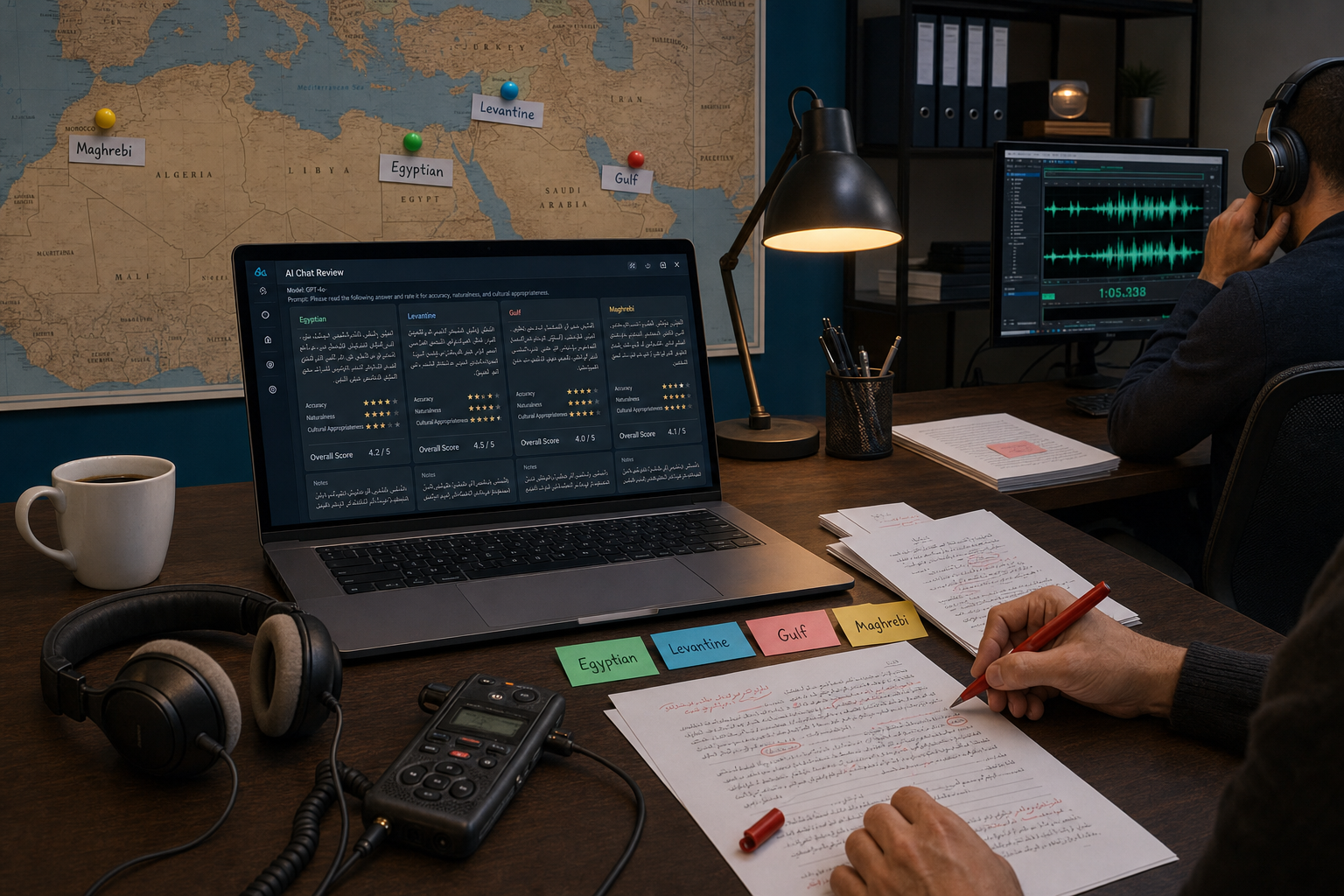
AI systems can now generate Arabic that looks local at first glance. Ask for Egyptian dialogue, Levantine ad copy, Gulf customer support, or Moroccan social captions, and many tools will return something readable in seconds. But the quality changes sharply by region. Egyptian often sounds the most natural. Levantine and Gulf output is frequently blended into a generic “regional Arabic.” Maghrebi varieties still expose the biggest weaknesses, with awkward word choices, unstable spelling, and strange jumps back into formal Arabic.
This matters because dialect is not decoration. In Arabic, it carries intimacy, class, geography, age, humor, and respect. A sentence can be grammatically correct and still sound fake, stiff, rude, or accidentally funny. That is the core debate now: if AI can produce something mostly understandable, is that enough for education, media, and business? Or does near-correct dialect create a bigger problem than obvious error, because it looks authentic until a native speaker notices the social mismatch?
Arabic is not one spoken language
One reason this problem is so easy to underestimate is that many discussions about “Arabic support” still treat Arabic as a single everyday language. It is not. Modern Standard Arabic, or MSA, is the shared formal register used in news, official writing, and much of education. Daily speech is another matter.
For one simple greeting, MSA gives you كيف حالك؟. In daily life, a speaker might say إزيك؟ in Egypt, كيفك؟ in parts of the Levant, شلونك؟ or شخبارك؟ in parts of the Gulf, and لاباس؟ or كيداير؟ in parts of the Maghreb. Those examples are not exhaustive. They vary by country, city, age group, and situation. But they show the basic point: spoken Arabic is plural.
Most large language models are still strongest in MSA because that is where formal text is abundant: news archives, books, government pages, school material, and translated content. Dialect data exists in huge amounts too, especially online, but it is messy. It appears in different spellings, mixed with English or French, written in Arabic script or Latin letters, and rarely labeled in a clean way by region and register.
Fluency is not the same as authenticity
The fact is simple: model fluency in Arabic has improved. Many systems can now produce smooth sentences, basic dialogue, and usable summaries. The harder question is what that fluency actually means.
A chatbot can generate a sentence that sounds “Arabic enough” to a non-specialist reviewer. That does not mean it sounds native to a Cairene student, a Beirut copywriter, a Kuwaiti customer, or a Casablanca comedian. In dialect writing, the last 10 percent often matters most. That is where rhythm, sarcasm, warmth, hierarchy, and local identity live.
The real test is not whether a sentence is grammatical. It is whether a speaker from Cairo, Amman, Riyadh, or Casablanca would ever say it that way.
Why Egyptian usually comes first
If one dialect tends to perform better, it is often Egyptian Arabic. That is not magic. It is exposure. Decades of film, television, music, subtitles, memes, and social media have made Egyptian far more visible in public text and media than many other spoken varieties.
As a result, AI can often imitate the surface of Egyptian fairly well. It can produce familiar words, common turns of phrase, and conversational pacing that feel close to real speech. For quick drafts, that can be useful.
But even here, the cracks show fast. A model may overuse the most obvious markers and turn every line into a stereotype. It may throw in أوي, بجد, or يا باشا as if these alone create a believable voice. It may produce dialogue that sounds like internet parody rather than real speech between friends, coworkers, or family members.
That matters in practical settings. A tutoring app might teach learners phrases that are understandable but socially off. A brand might sound as if it is trying too hard to be “local.” A film draft may read like a flat imitation of speech rather than speech itself.
Levantine and Gulf: easy to flatten, hard to get right
Levantine and Gulf Arabic reveal a different problem. Both labels are useful, but both hide major internal differences. Lebanese, Syrian, Jordanian, and Palestinian speech overlap, yet they are not interchangeable. The same is true across the Gulf. Saudi, Emirati, Kuwaiti, Qatari, Bahraini, Omani, and other varieties share features, but they are not one uniform register.
AI output often smooths those boundaries away. It may produce “Levantine” by choosing a few familiar words, then mix vocabulary, particles, and phrasing from different countries in the same paragraph. To a learner or outsider, that may seem fine. To a native speaker, it can feel immediately wrong.
The same happens in Gulf output. A system may get the polite tone roughly right, then drift between country-specific expressions, or suddenly retreat into MSA when the prompt requires precise social nuance. This is especially visible in customer service, marketing, and scripted dialogue, where tone is part of the message, not just a wrapper around it.
The challenge is not only lexical. It is also about social calibration. A phrase that sounds warm in a family context may sound too casual in a business context. A formal line may sound respectful in one setting and stiff in another. Models can predict common text patterns. They do not automatically know who is speaking to whom unless the prompt makes that explicit.
Maghrebi Arabic is where many systems lose the thread
If Egyptian is usually the easiest case, Maghrebi Arabic is often the hardest. Here again, the category is broad. Moroccan, Algerian, Tunisian, and Libyan varieties differ from one another, and many speakers move naturally between dialect, MSA, French, and sometimes Amazigh languages or other local influences.
This creates several problems for AI. Public text is less standardized. Spellings vary widely. Code-switching is common. The distance between local speech and textbook Arabic is often larger than many non-Arabic developers assume. A system may understand a Moroccan or Tunisian prompt, then answer in simplified MSA with a few token words added on top.
That is where output starts to look performative rather than real. A model may use Moroccan واخا with Tunisian برشة, or insert بزاف into otherwise formal Arabic as if one local word solves the problem. For a native reader, that is an immediate signal that the system is stitching together patterns without a reliable grasp of region and register.
Maghrebi varieties also highlight a wider design problem: developers often think of dialect support as a matter of adding vocabulary. But dialect writing is not a glossary exercise. It depends on syntax, sound patterns reflected in spelling, shared references, and accepted ways of switching between codes.
Humor, rhythm, and social meaning are the hardest part
Even when AI gets the words roughly right, humor is another level. Jokes in dialect depend on timing, understatement, exaggeration, and cultural reference. A literal rewrite usually fails. So does a too-clean rewrite.
Arabic humor online often relies on small shifts in tone: a repeated word, a sarcastic honorific, a deliberately stiff phrase dropped into casual speech, or a sudden switch into English, French, or MSA for comic effect. These are hard enough for human translators. For statistical text generation, they are harder still.
Social meaning is just as important. Terms of friendliness or respect can signal closeness, distance, class position, or age. A model may produce a phrase that is polite in the abstract but wrong for the relationship. That is why a sentence can look excellent on a screen and still fail in the real world.
There is also the issue of rhythm. Native speakers often feel a line is wrong before they can explain why. The words are acceptable. The sequence is not. The emphasis lands in the wrong place. The sentence is too complete, too formal, or too tidy for the situation. This is where many systems still sound written rather than lived.
Where dialect AI is genuinely useful
None of this means dialect generation is pointless. It is already useful in several settings if expectations are realistic.
- Drafting: Writers can use it to generate first-pass dialogue, alternate phrasings, or regional variants before human revision.
- Education: Students can compare dialect and MSA forms, as long as the material is reviewed by native speakers and not treated as an authority by itself.
- Customer support: Narrow-domain replies can be localized to sound less robotic, especially when tone and terminology are tested with real users.
- Creative work: Content teams can brainstorm captions, voice-over options, or character voices faster than starting from zero.
- Accessibility: Speech tools and summaries can help people engage with more local audio and video content, though accuracy remains uneven.
In all of these cases, the value is speed and range. The risk comes when draft quality is mistaken for final quality.
Where the risk becomes serious
The most obvious risk is embarrassment. A brand launches a campaign in “local Arabic” and native speakers mock it within minutes. But the bigger problems are quieter.
Students may learn forms that are understandable but unnatural. Public information may sound patronizing or confusing. Content moderation systems may miss abuse because dialect insults are highly local, or over-flag harmless slang because the model has poor regional grounding. Hiring, health, legal, and government communication can be especially sensitive, because tone affects trust.
There is also an inclusion problem. Well-represented dialects get better support first. Less represented communities are told, in effect, that their speech is an edge case. That is not only a technical gap. It is a cultural signal.
A final risk is false confidence. Once a system becomes good enough to fool people who are not native speakers of that dialect, low-quality output can travel further. Bad English is easy to spot. Almost-right dialect can be harder to catch until it is already published.
What better Arabic dialect AI would need
If companies want real progress here, the next step is not simply training on more text. It is building for language as people actually use it.
- Better dialect-labeled data: not just “Arabic,” but region, context, audience, and level of formality.
- Native-speaker review: especially for education, media, health, finance, and public communication.
- Support for code-switching: many speakers move naturally between dialect, MSA, English, French, and Arabizi.
- Register controls: “friendly,” “professional,” “peer-to-peer,” and “elder-to-younger” matter as much as country labels.
- Benchmarks beyond grammar: systems should be tested for naturalness, politeness, social fit, and consistency, not just spelling or translation accuracy.
- Honest fallback behavior: when the system is unsure, neutral MSA is often better than fake dialect confidence.
That last point is underrated. In many cases, it is better for a system to produce clean, neutral Arabic than to imitate a dialect badly. Users can forgive formality. They rarely forgive a voice that sounds invented.
The practical bottom line
Can machines capture Egyptian, Levantine, Gulf, and Maghrebi nuance? Partly, and very unevenly. They can imitate visible features of dialect. Sometimes they can be impressively useful. But surface fluency is not the same as social accuracy, and in Arabic the gap between those two things is where trust is won or lost.
The practical rule is simple: use dialect AI as a draft tool, not a final authority. If the text is meant to teach, persuade, comfort, entertain, or represent a community, a human speaker from that community should have the last word.