AI in Arabic Classrooms: Dialects, Translation, and the Student Confidence Gap
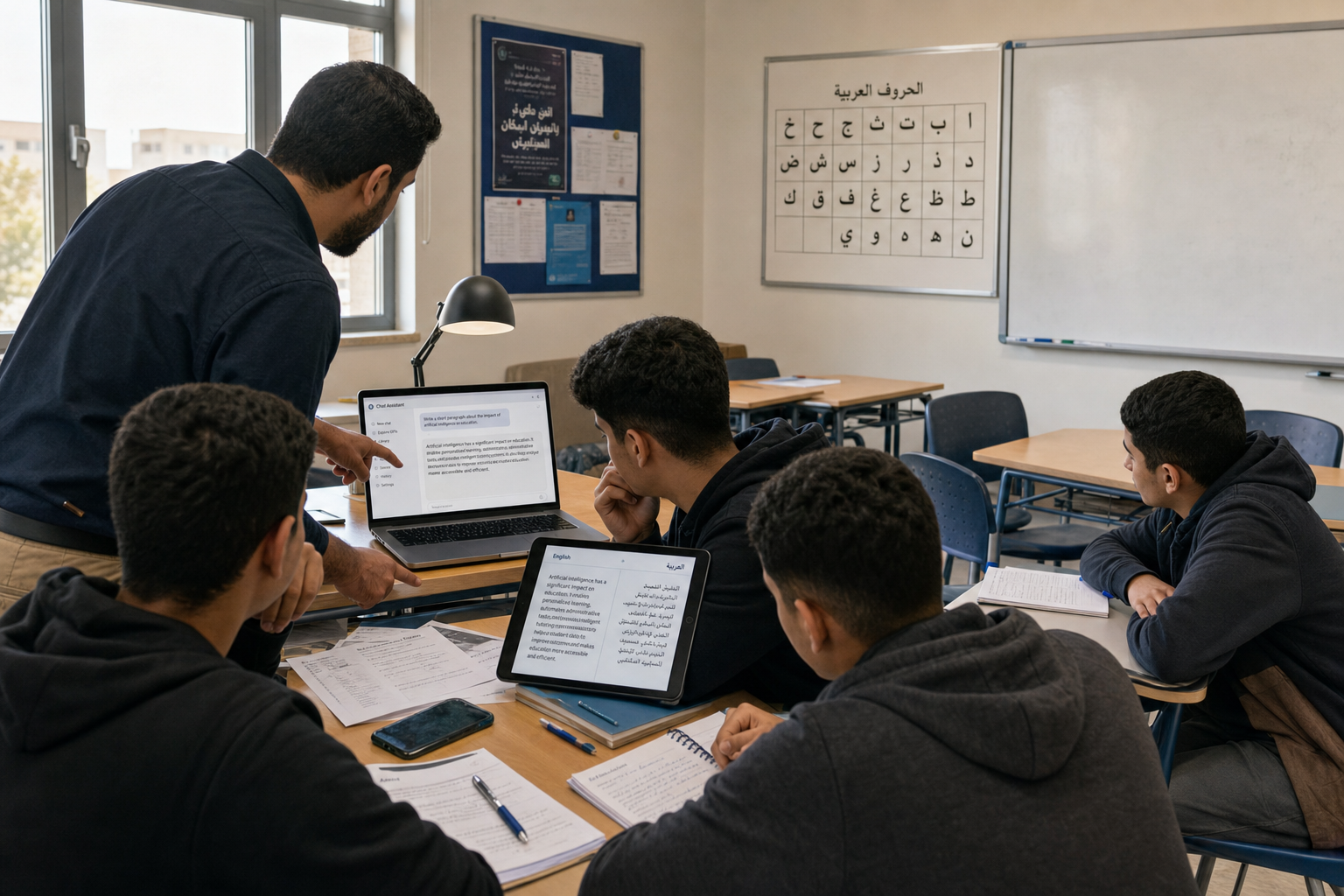
AI chatbots, writing assistants, and translation tools are becoming part of school life in Arabic-speaking classrooms. Their appeal is easy to understand: they can explain a lesson, simplify a text, suggest vocabulary, and give instant feedback. But there is a catch. Many of these systems were built around English habits, and when they work in Arabic, they often handle formal written Arabic better than the language students actually speak.
That matters because language affects much more than grammar. It affects who asks questions, who joins discussion, and who feels capable in class. The real debate is not whether AI is good or bad for education. It is whether schools will use it in a way that expands access, or in a way that quietly tells students that their dialect, their phrasing, or their bilingual habits are somehow less academic.
Arabic is not one classroom language
Arabic is spoken by more than 300 million people and is an official language in 22 countries. But in education, it does not appear in one simple form. Students may read and write in Modern Standard Arabic, or MSA, while speaking Egyptian, Levantine, Gulf, Sudanese, or Maghrebi varieties in daily life. In some schools, English or French is mixed in as well, especially in science, technology, or private education.
Teachers understand this reality. Students move between registers all the time. A formal answer on an exam may need MSA. A question to a friend may come in dialect. A research prompt may include English technical terms. Human teachers usually recognize this as normal classroom language. AI tools often do not.
An Egyptian student might type "عايز شرح بسيط" and simply mean, "I want a simple explanation." A tool may rewrite that into more formal Arabic such as "أريد شرحًا مبسطًا" and then answer in textbook language. The information may still be useful. But the system has already signaled that everyday Arabic is not the preferred form for serious learning.
Why translation is not a side issue
In many classrooms, translation is the first way AI enters the lesson. Students use it to translate articles, rewrite instructions, or get key terms in two languages. That can be genuinely helpful. In a large class, or in a school with limited support, a quick second explanation can save time and reduce stress.
But translation is not neutral. It chooses vocabulary, tone, and level of difficulty. A tool may produce Arabic that is technically correct but much harder than the original text. It may ignore local usage. It may return a version that sounds polished but slightly unnatural. The student then faces a double task: understand the subject and decode the register.
This becomes even more important in writing. Many AI tools are tuned to English essay norms. They often reward direct thesis statements, very clear signposting, and short, efficient paragraphs. Those can be good habits. They are not the only way good writing works. When Arabic writing is judged through English-centered patterns, students can get the impression that their writing is weak when it is simply following a different structure or rhythm.
A common example is the opening paragraph. An AI tool may tell a student to state the main claim in the first sentence and cut what it sees as repetition. Sometimes that is useful advice. Sometimes it removes the framing that makes the Arabic argument coherent. The problem is not correction itself. The problem is that the standard being used is often hidden.
Where the tools genuinely help
None of this means AI has no place in Arabic education. Used carefully, it can solve real problems.
- Quick explanations: A student can ask for a simpler version of a difficult paragraph before class discussion begins.
- Vocabulary support: A chatbot can list key terms in Arabic and English, which is especially useful in science, computing, and business courses.
- Private practice: Shy students can test a question or draft a paragraph before speaking in front of classmates.
- Extra scaffolding: In classes of 30 or 40 students, an instant second explanation can help students who might otherwise wait too long for help.
- Better access: Students with weaker writing skills can use step-by-step prompts to organize ideas they already understand.
These benefits are real. For some students, especially those without access to tutoring, AI can act as a useful study aid. The mistake is not using the tool. The mistake is assuming that the help arrives equally for everyone.
The confidence gap is quieter than the accuracy gap
Schools usually notice factual errors first. A chatbot invents a source. A translation misses a key term. A grammar suggestion is wrong. These problems are visible. The confidence gap is harder to measure, but it may matter just as much.
It appears when students stop asking follow-up questions because the language of the answer feels distant. It appears when they copy polished AI phrasing they do not fully understand. It appears when students who are already comfortable in English or formal Arabic get more benefit from the tool than those who are not.
This is especially important for younger students and first-generation university learners. If a system repeatedly "improves" their language by stripping out local phrasing, the lesson is not only grammatical. It is social. Serious knowledge starts to look as if it belongs to English or to very formal Arabic, while everyday speech belongs outside the learning process.
That can change classroom behavior. A student who worries that their phrasing sounds provincial, incorrect, or unsophisticated is less likely to volunteer an idea, test an argument, or write freely in a first draft. Over time, a language difference can become a confidence difference.
The product problem behind the classroom problem
It is important to place responsibility in the right place. If an AI tool struggles with dialects, code-switching, or local vocabulary, that is not evidence that students are using language badly. It is evidence that the product was trained and tested in a limited way.
Large AI systems are generally built on far more English material than Arabic material. Even within Arabic, formal written text is easier to collect at scale than casual dialect writing or spoken classroom language. So a system may look fluent in Arabic in a demo, yet perform unevenly when real students ask real questions in the forms of Arabic they actually use.
This is why broad claims about multilingual AI should be treated carefully. A tool can support Arabic in a marketing sense and still handle dialects poorly, flatten nuance, or give better results to students who know how to reframe the question in English first.
AI literacy must include language equity
Most school conversations about AI literacy focus on prompts, plagiarism, and productivity. Those topics matter. But in Arabic classrooms, AI literacy also needs a language equity layer.
- Teach register awareness: Students should understand when they are using dialect, MSA, or a bilingual mix, and how the tool may respond to each form.
- Compare outputs: Ask the same question in dialect and in MSA. Compare the answers. This turns a hidden bias into a visible lesson.
- Check terms against the textbook: In science, history, and law especially, students should verify that the AI’s Arabic terminology matches the course language.
- Protect the first draft: Students should be allowed to brainstorm in the language form that helps them think clearly, then revise for the assignment.
- Separate ideas from polish: Teachers should assess understanding and reasoning, not only how closely a final paragraph matches formal AI-generated style.
These steps do not require perfect software. They require better classroom habits.
What schools and developers should change
Schools should not choose AI tools based only on English performance or glossy multilingual claims. They should test them with real classroom prompts from different Arabic-speaking regions. A simple question works well: can students ask for help in the Arabic they naturally use and still get a clear, accurate, respectful answer?
Developers also need better evaluation. Standard Arabic benchmarks are not enough. Educational products should be tested on dialect variation, code-switching, subject terminology, and age-appropriate phrasing. They should make it easy for users to choose a target register, such as simplified MSA, local dialect, bilingual explanation, or formal academic Arabic.
Even small design choices can help. A system can say which variety it is using. It can offer a simpler Arabic explanation without switching to English. It can show alternative wording instead of silently rewriting a student into a more prestigious register. In education, those are not cosmetic features. They affect who feels included.
A practical standard for the classroom
AI will remain part of Arabic education. The real question is whether it will act as a bridge or a filter. If schools teach students to compare registers, question translations, and protect their own voice, these tools can support learning. If they do not, AI may mostly reward the students who already sound closest to its training data.
A good rule for schools is simple: a student should not have to translate themselves before they can learn.