Can AI Be a Creative Partner in Arabic Poetry? A Guided Experiment
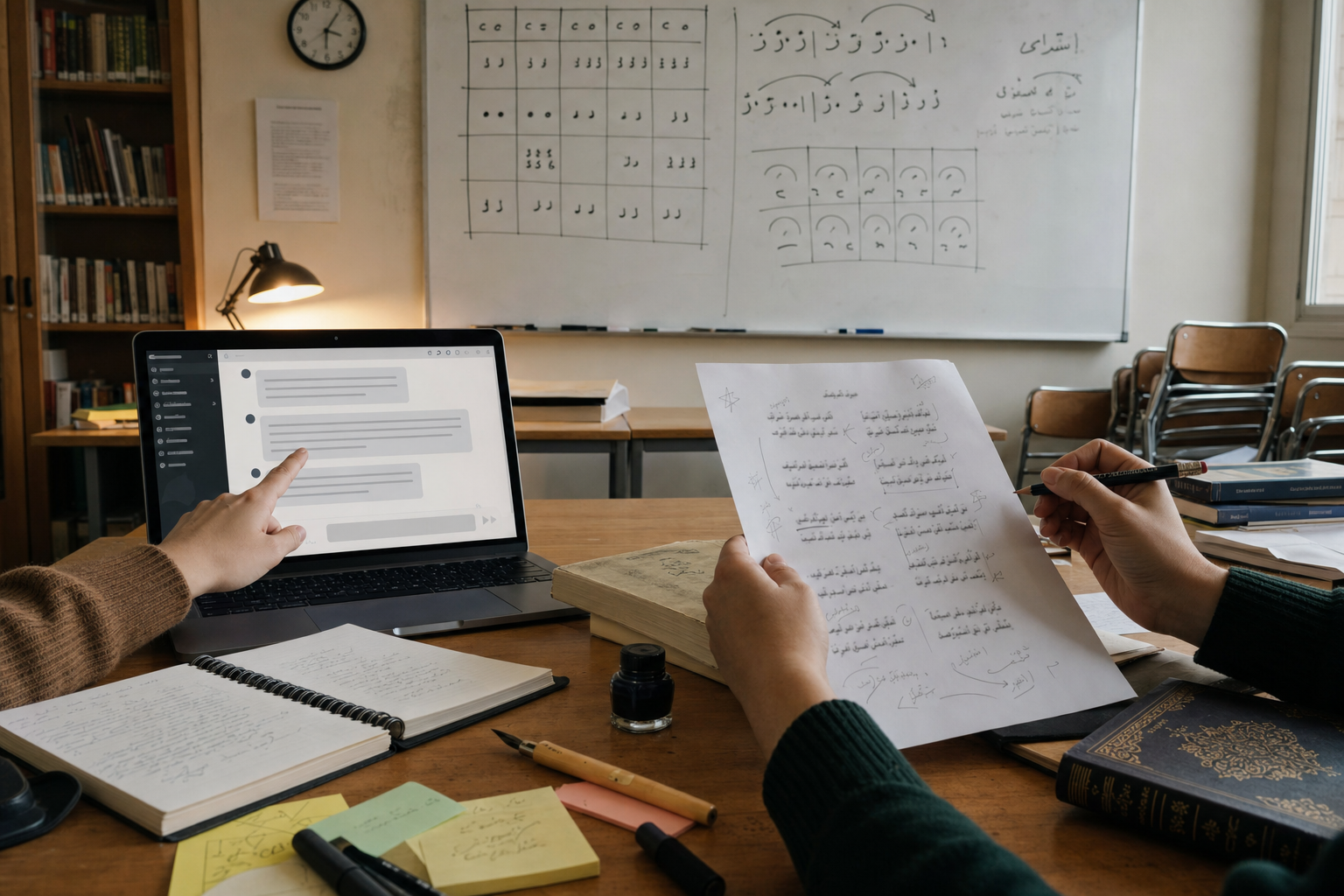
Put a current text model through a simple Arabic-poetry exercise, and the pattern appears quickly. The system can help generate images, tighten lines, and offer alternatives at high speed. But when the task requires control of form, register, and cultural weight, the limits show just as fast.
That matters because Arabic poetry is a serious test of what people mean when they call AI “creative.” The issue is not whether a model can produce elegant-looking lines. It can. The real tension is whether it can support real poetic work without reducing a living tradition to smooth imitation and familiar cliché.
Why Arabic poetry is a hard test
Arabic poetry asks for more than pretty language. Classical verse depends on meter and end rhyme. Modern free verse asks for musical control without the full frame of classical form. Prose poetry often depends on voice, tension, and surprise. Dialect poetry adds another layer: local rhythm, social texture, and implied place.
The classical system alone is demanding. The tradition formalized by al-Khalil ibn Ahmad identifies 16 main meters. Many readers will not check every line by hand, but they can still hear when the rhythm slips. Add the divide between fusha and spoken dialects, and a model that looks fluent on the surface can still miss the real task.
There is also a practical problem. Most commercial systems do not explain their Arabic training data in much detail. That makes it hard to know how much carefully edited poetry they have seen compared with ordinary web Arabic. The outputs often suggest a familiar imbalance: good fluency, weak judgment, and too much reliance on stock phrases.
The brief: one scene, strict limits
A good test is small and specific. Instead of asking for “a beautiful Arabic poem,” give the system a scene and a few constraints.
Prompt: “Write four lines of free verse in Modern Standard Arabic about hearing a voice note from home at dawn in a foreign city. Do not use the words أم، حنين، قلب، غربة. Keep the tone restrained. Include one concrete sound and one physical object.”
The constraints matter. They block easy sentiment. They force the model to find an image instead of naming an emotion. Readers can try this with any general-purpose text model. The exact results will differ, but the pattern is often similar.
Round 1: Generating openings
This is where AI is often at its best. Give it one clear brief, and it can produce several openings in seconds. Some will be weak. A few may be genuinely useful.
One promising line: أضاء الهاتف فوق الطاولة كأنّه كوب ماء
Roughly: “The phone lit up on the table like a glass of water.”
One weak line: وغسلتني الذكريات بمطر الشوق
Roughly: “Memories washed me in the rain of longing.”
The difference is instructive. The first line is concrete. It gives the poem an hour, an object, and a room. The second sounds poetic in the thinnest way. It is fluent, emotional, and almost empty.
That is the first clear lesson. AI is useful for options, not judgment. It can give the writer ten openings. It cannot reliably tell which one belongs to this poem rather than any poem.
Round 2: Revision is often stronger than invention
The second round usually works better than the first. Once a human writer has chosen a direction, the model can test alternatives with some real value. Ask it to make the line less sentimental. Ask it to replace an abstract word with a household detail. Ask it for three endings that keep the scene but lower the emotional temperature.
Sometimes the results are surprisingly good. A request for a more physical image may produce something like كان الصوت يوقظ الملاعق في المطبخ البعيد, or “the voice was waking the spoons in the distant kitchen.” That is not automatically a finished line. But it is a better problem to work with than vague sadness.
This is where the tool starts to look useful. A revision request might replace “the room felt less cold” with a kettle starting to sound, a chair pulled closer to the phone, or dawn catching on the window latch. Not every suggestion is strong. But the exercise helps the writer see what kind of concreteness the poem still needs.
For beginners, this can be especially valuable. A student who knows what they want to say but not how to shape the line can learn a lot by comparing five versions of the same image. The machine becomes a fast workshop assistant, not an authority.
Round 3: Form is where the trouble starts
Ask the same system to recast the poem into a stricter form, and the weak spots become obvious. A request for classical meter and a single repeated end rhyme often produces lines that look traditional but do not fully hold together. The model may label a line al-kamil or al-basit with great confidence even when the rhythm breaks.
This is more than a technical slip. In Arabic poetry, form is part of meaning. Meter is not decoration added after the idea. It shapes pace, emphasis, and memory. A line that merely sounds elevated is not the same as a line that is built correctly.
The same problem appears with register. A model may drift from fusha into casual colloquial without warning, or smooth a local dialect into standard Arabic. That matters if the poem depends on the social texture of a specific place. A voice from Alexandria, Basra, Fez, or Sana’a should not come back as one generic “Arabic voice.”
What the experiment shows
The result is not that AI fails at Arabic poetry. That would be too simple. It succeeds at some parts of the job. It can propose imagery, compress a sentence, supply alternate phrasings, and help a writer escape the first obvious draft.
But it also reveals a hard limit. Poetry is not only generation. It is selection, restraint, and refusal. The writer decides that one image is borrowed, another is true, and a third is too loud for the poem. That kind of decision depends on taste, memory, and context. A general model can imitate the surface of those choices, but it does not carry their stakes.
Promise and risk
The promise is real. AI can widen access to poetic practice. It can help students experiment with rhyme. It can help a writer working in a second language test whether an image is clear. It can help editors spot flat phrasing by contrast. In places where access to workshops, mentors, or