AI Art: A Gallery of Human-AI Creative Collaboration
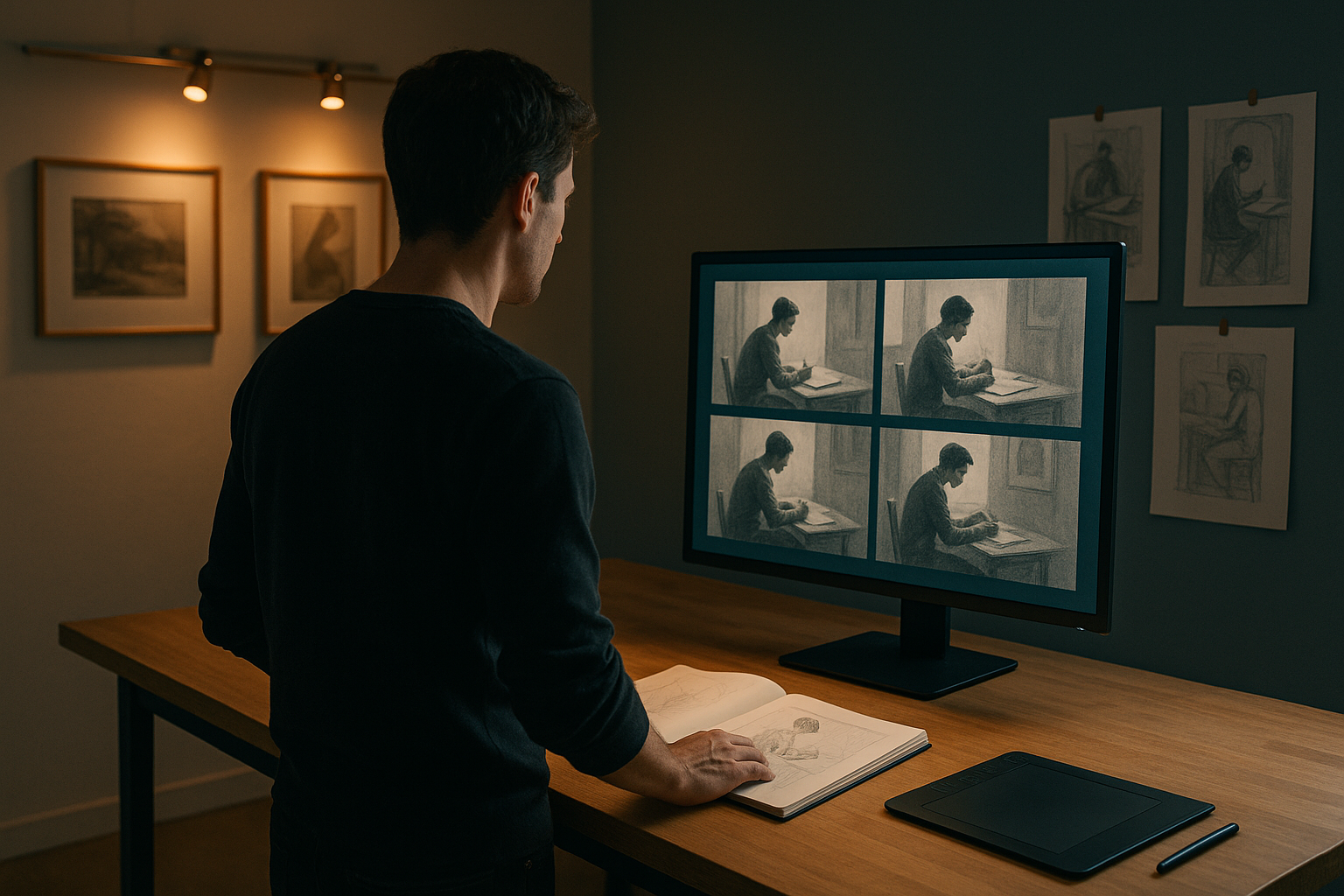
AI art has moved very quickly from novelty to normal tool. In the past few years, systems such as Midjourney, DALL-E, Stable Diffusion, and Adobe Firefly have gone from research demos and online experiments to everyday use in design studios, marketing teams, classrooms, and personal projects. A person can now type a prompt, upload a sketch, or extend a photograph and get polished visual options in minutes.
That matters because image-making is no longer limited by traditional technical barriers in the same way. More people can make more visuals, faster. The tension is obvious: is this a genuine new form of creative collaboration, or a shortcut that borrows too much from artists, photographers, and illustrators without clear consent or credit? The answer, at the moment, is both more promising and more complicated than the loudest arguments suggest.
From curiosity to workflow
AI content generation is now part of ordinary creative work, not just internet culture. Image tools are the clearest example because the results are immediate. A small business can mock up packaging. A filmmaker can test twenty poster ideas before hiring a designer. An architect can explore lighting, materials, and mood long before a formal render. Adobe pushed this shift further when Photoshop added Generative Fill in 2023, placing AI image editing inside software many professionals already used.
That speed changes creative habits. Early stages of work become wider and cheaper. People try more directions because the cost of being wrong is lower. For beginners, that can be liberating. For professionals, it can be useful, but also destabilizing. When rough concepts become easy to generate, clients may start to undervalue the trained eye needed to make images coherent, original, and usable.
The first lesson of AI art, then, is simple: the tool matters less than the workflow around it. A strong piece usually comes from selection, revision, editing, and context. A weak piece often comes from treating the first output as the finished work.
What the human actually does
There is still a common misunderstanding here. Many people imagine AI art as a one-step process: type words, get picture, done. Sometimes that happens. But the more serious examples usually involve many human choices before and after generation.
- Choosing references, mood boards, or source images
- Writing and rewriting prompts
- Adjusting composition, lighting, camera angle, and style
- Rejecting large numbers of weak outputs
- Combining several results into one image
- Painting over errors and fixing anatomy, typography, or texture
- Placing the final image inside a larger project, such as a book cover, campaign, installation, or series
A model does not understand a face, a city, or a historical period in the human sense. It predicts visual patterns based on training data. The human contribution is often the part that gives the image direction, purpose, and standards.
The most convincing AI art is rarely fully automatic. It carries a visible human point of view.
A small gallery of collaboration
It helps to stop talking about “AI art” as if it were one thing. In practice, it is a cluster of very different methods.
Concept worlds and fast ideation. This is the most common use. Game designers, filmmakers, advertisers, and fashion teams use text-to-image systems to test moods, palettes, costumes, and environments. The value here is not the final output alone. It is the ability to explore many directions quickly. A human art director still has to decide what belongs, what is cliché, and what can actually be built.
Photo editing and impossible composites. Some of the most practical collaboration happens inside existing images. A photographer may expand a background, remove a distracting object, or generate several lighting variations before a shoot. This is less about replacing photography than about bending it. The risk, of course, is that the line between photograph and synthetic image becomes harder to read, especially in editorial, documentary, or political contexts where truth matters.
Training on personal archives. A more careful model of collaboration is emerging among artists who train systems on their own work or tightly controlled datasets. Instead of asking a general model for “a portrait in my style,” they build a system from their drawings, photographs, notes, or textures. The result can feel less like imitation and more like self-sampling. It is also easier to defend ethically because the source material is clearer.
Data-driven installations. At the large public end of the spectrum, artists such as Refik Anadol have used machine learning systems to turn archives, environmental data, and image collections into immersive installations. These works often succeed as scale, atmosphere, and spectacle. Their weakness is different: the visual drama can hide thin ideas, and viewers may not always know where the source data came from or what exactly the system is doing.
Human-machine drawing systems. Not all collaboration looks like prompt-based image generation. Artists such as Sougwen Chung have worked with robotic drawing systems shaped by Chung’s own mark-making. This is a useful reminder that the strongest human-machine art often grows from a long practice, not a one-click trick. The machine process is folded into an existing artistic language.
Why these images spread so fast
Part of the answer is obvious: they are cheap, quick, and often impressive at first glance. But AI art also spreads because it fits the visual habits of the internet. It produces striking thumbnails. It leans toward dramatic lighting, hyper-detailed surfaces, and cinematic moods. Those images perform well on social platforms, pitch decks, and mood boards.
That is also why so much AI art starts to look the same. The default aesthetic is now easy to recognize: polished faces, exaggerated atmosphere, perfect symmetry, fantasy architecture, glossy realism. The problem is not that these images are synthetic. The problem is that they are generic. When every prompt can produce “epic” beauty, taste becomes more important, not less.
In that sense, AI has not removed the old creative question. It has sharpened it. If anyone can make something pretty, who can make something specific?
The authorship question is now unavoidable
The art world saw this debate early. In 2018, Christie’s sold the AI-generated portrait Edmond de Belamy for $432,500. The price was a signal. AI images were no longer just a technical curiosity. They had entered the market as cultural objects. But the sale also raised a hard question: what, exactly, was being valued? The code, the concept, the curation, the media attention, or the image itself?
That question became mainstream in 2022, when Jason Allen won a blue ribbon at the Colorado State Fair with a Midjourney-assisted image. The backlash was immediate. Some saw it as a legitimate digital workflow. Others saw it as an unfair shortcut. The real significance of the episode was not the prize. It was the public realization that creative competitions, classrooms, client work, and online platforms would all have to define what counts as authorship.
The legal system is still catching up. In 2023, the U.S. Copyright Office said that material generated solely by AI, without sufficient human authorship, cannot be registered for copyright protection. At the same time, it left room for protection when a human meaningfully selects, arranges, edits, or transforms AI-generated material. That is a practical position, but not a simple one. It means the details of process matter.
The hidden issue: whose work trained the system?
This is where the argument gets sharper. Many leading image models were trained on vast image-text datasets gathered from the public web. That made the tools powerful very quickly, but it also created legal and moral conflict. Getty Images sued Stability AI, alleging unlawful copying of its images in training. Those claims remain contested and unresolved in court, but the case captures the central dispute: can companies build creative systems from enormous stores of online art and photography without direct permission from every creator involved?
Different companies have taken different routes. Adobe has said Firefly was trained on licensed Adobe Stock content, openly licensed material, and public-domain content. That approach is not perfect, but it shows where the market may be heading: toward cleaner datasets, clearer licenses, and tools that can be used commercially with less legal uncertainty.
The gap between those models matters. If the training pipeline is opaque, every beautiful output carries a question mark. If the training pipeline is documented and licensed, the collaboration becomes easier to defend. Viewers may not ask about datasets when they first see an image. Professionals increasingly do.
The labor issue is not abstract
AI art is often discussed as a culture-war topic, but it is also a work topic. For some creative jobs, especially quick-turn illustration, stock imagery, and early concept development, AI lowers costs in ways that will reduce paid assignments. Entry-level freelancers are likely to feel that pressure first. A client who once commissioned three rough sketches may now generate thirty internally and hire a human only for final polish.
At the same time, small teams and independent creators genuinely gain new power. A student can build a visual world for a thesis film without a large budget. A novelist can prototype cover directions before meeting a designer. A museum team can produce interpretive mockups for an exhibition faster than before. The promise is real. So is the displacement.
That is why easy slogans do not help much here. “AI art is theft” misses the variety of workflows and the emergence of licensed alternatives. “AI art democratizes creativity” ignores the workers whose markets are being reshaped underneath them. The honest position is less neat: these tools expand access while also redistributing economic value, often upward and unevenly.
What makes AI art worth looking at
Most AI-generated images are forgettable for the same reason most images of any kind are forgettable: they do not have much to say. The better work tends to have three things.
First, a clear constraint. The artist is not asking for “anything beautiful.” They are setting limits: a family archive, a local neighborhood, a historical style, a narrow color system, a visual argument.
Second, strong editing. Good AI art is often built through refusal. The maker rejects the easy option, fixes mistakes, and resists the software’s default taste.
Third, context. The image belongs to something larger: a series, a performance, a political point, a design brief, a personal history. Without that frame, many AI visuals feel like technical demonstrations rather than artworks.
This may be the simplest way to judge the field. Do not ask only, “Was AI used?” Ask, “Did the use of AI help produce a more interesting idea than other tools would have?” Sometimes the answer is yes. Often it is no.
How to look at an AI image now
For viewers, critics, clients, and students, a few practical questions go a long way.
- What did the human contribute beyond the initial prompt?
- Where did the training material come from, if that information is available?
- Is the image specific, or does it rely on familiar visual shortcuts?
- Would this work still be interesting if the AI angle were removed?
- Who benefits from the speed and reduced cost, and who loses work?
That checklist does not solve every dispute, but it cuts through hype very quickly.
AI art is not a separate universe from human creativity. It is part of the long history of new tools entering art, design, and media and forcing people to renegotiate skill, originality, and labor. Some of the results are shallow. Some are genuinely fresh. The difference usually comes down to something old-fashioned: judgment. In this gallery, the machine can generate possibilities. The human still has to make them matter.