AI Art With an Arabic Memory: Why Local Symbols, Dialects, and Histories Still Need Human Direction
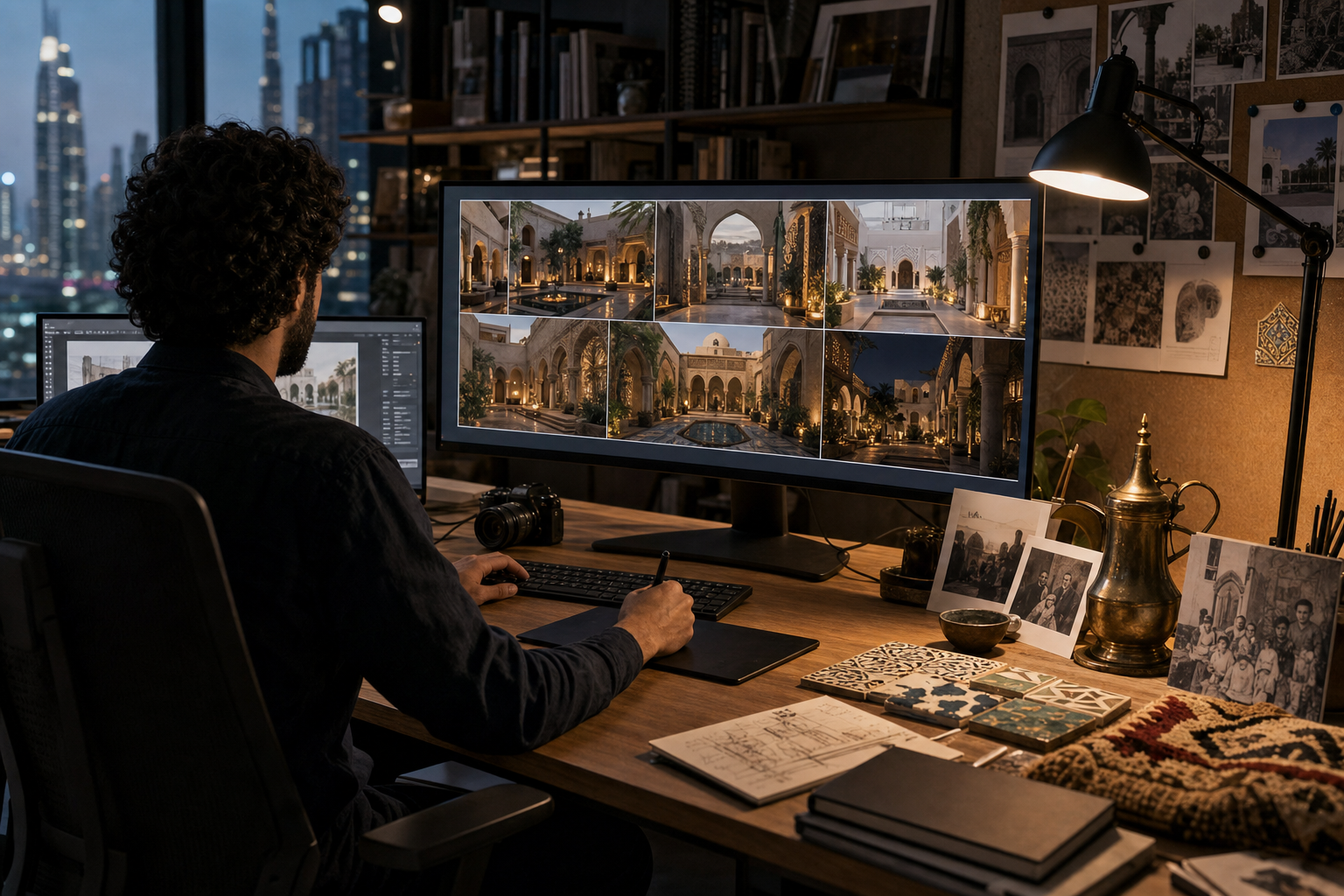
AI image and video tools have improved fast. A single creator can now generate mood boards, campaign visuals, storyboards, and short cinematic clips in minutes. For Arabic-speaking artists, designers, filmmakers, and small studios, that is a real change. It lowers costs, speeds up experimentation, and makes high-end visual production feel less locked behind big budgets.
But speed is not the same as cultural accuracy. A model can produce a scene that looks vaguely “Middle Eastern” very quickly, yet meaningful creative work depends on memory, context, and judgment. That is the main tension now. The question is not whether these tools are useful. They are. The question is whether systems trained on broad, uneven datasets can handle Arab symbols, dialects, and histories without flattening them into cliché. In most cases, they still need strong human direction.
The tools are getting stronger, and that matters
Over the past two years, text-to-image and text-to-video systems have become much better at lighting, composition, texture, and camera movement. What once looked obviously synthetic can now pass as polished concept art or a workable first draft for commercial use. Creators use these tools for album covers, pitch decks, ad concepts, fashion mock-ups, animation tests, and social media campaigns.
That matters in the Arab creative market because access has always been uneven. Not every designer has a large team. Not every filmmaker can hire a full art department. If AI can help a young director visualize a scene in Casablanca, Baghdad, Jeddah, or Beirut before spending real money, that is a practical gain.
It also matters because Arabic is spoken by more than 400 million people across more than 20 countries. That is not a niche audience. It is a huge creative field with distinct visual cultures, music scenes, fashion languages, and local histories. Better tools could support more local storytelling, not less.
Still, one fact shapes the whole discussion: most major generative systems were built first around English-language prompts and datasets. Arabic-language material makes up only a small share of the public web compared with English. That imbalance affects what the system treats as normal, what it recognizes confidently, and what it guesses poorly.
“Arab” is not a single visual category
This is where many outputs start to slip. Ask a popular model for an “Arab street,” an “Arab wedding,” or an “Arab market,” and the results often lean toward the same familiar package: warm sand tones, ornate arches, lanterns, calligraphy-like shapes, and a general tourism-poster mood. The image may be attractive. It may even feel recognizable. But it is often culturally thin.
The Arab world is not one look. A courtyard in Fez does not look like a home in Riyadh. A street in old Damascus does not read like a Corniche scene in Alexandria. The textures of a Gulf majlis, a Beirut apartment, a Tunis medina, and a Baghdad bookstore are not interchangeable. Even within one city, class, generation, and neighborhood change the image.
Local symbols make this even sharper. Mashrabiya is not the same as zellige. Palestinian tatreez is not generic “Arab embroidery.” A bisht, an abaya, a galabeya, a kaftan, and a djellaba do different cultural work. When a model blends them into one decorative mix, the output may still look “regional” to an outsider, but it has already lost the specificity that gives the work its value.
That is not a minor design issue. In many cases, the symbol is the meaning. A tatreez motif can carry village identity. A certain doorway, tile pattern, or coffee set can place a scene socially as well as geographically. Remove that meaning, and the work becomes a mood instead of a memory.
When the reference is thin, the cliché arrives quickly.
Dialect changes the picture
Language is part of visual culture. That is especially true in Arabic, where Modern Standard Arabic lives alongside many everyday dialects, and where the same object can be named differently across the region. This matters for prompting, for captions, for voice, and for the credibility of a scene.
Take something simple like tea or coffee. A creator in Morocco may think in terms of atay. A creator in the Gulf may picture Arabic coffee with cardamom when writing qahwa. In Egypt, Iraq, the Levant, and elsewhere, shay or local variations may carry different domestic or social cues. These are not just vocabulary choices. They signal setting, ritual, class, and region.
Many image models also still struggle with Arabic text itself. Short words and simple signs have improved, but longer connected script, newspaper headlines, storefront typography, and handwritten notes often break down. The result is familiar to many designers: the scene comes from the model, but the Arabic text must be rebuilt manually. For a campaign that depends on authentic signage or a believable book cover, that is not a small correction. It is the difference between atmosphere and accuracy.
Video tools expose the same gap in another way. A short AI-generated clip may capture clothing and lighting well, yet miss the rhythm of speech, the timing of gesture, or the social feel of a room. A family scene can look polished and still feel imported. A wedding clip can look expensive and still be culturally wrong in ten tiny ways.
History is where the shortcuts become obvious
Contemporary style is one challenge. Historical memory is another. AI systems are very good at blending visual patterns from many sources. That is useful for moodboards. It is risky for history.
If a creator asks for “1970s Baghdad,” “1960s Cairo cinema,” or “1980s Beirut apartment,” the model may return something persuasive at first glance. But look closer and the cracks often show. Furniture from the wrong decade. Signage in the wrong font. Clothing mixed across generations. Cars, radios, school desks, or political posters that do not belong together. The model has matched a vibe, not verified a world.
That matters because historical details are rarely neutral in Arab contexts. A flag design, a uniform cut, a headscarf style, a newspaper masthead, or a wall portrait can shift the meaning of an image completely. In places shaped by war, migration, colonial rule, censorship, or displacement, small visual decisions carry heavy context. Treating them as decoration is not just sloppy. It can become offensive or misleading very quickly.
The same problem appears in heritage work. A model can imitate old family-photo aesthetics, faded film stock, or handwritten captions. But it does not know which details a family remembers, which object belonged to a grandmother, or why a certain room in a house matters. Those details live in oral history, not in pattern matching.
The promise is real, but so is the risk of cultural flattening
It would be easy to turn this into a simple anti-AI argument, but that would miss the real opportunity. These tools can help Arabic-speaking creators prototype faster, test multiple visual directions, and build stronger pitches. They can support independent musicians, fashion labels, documentary teams, teachers, and small agencies that would otherwise struggle to visualize ambitious ideas.
They can also help revive overlooked archives. A creator can use old magazines, family photographs, street typography, textile references, and regional cinema as inputs for new work. Used carefully, AI can become a bridge between archive and contemporary design.
The risk is that convenience pushes creators toward the generic. Once a model offers a fast “Arab aesthetic,” the temptation is to stop there. That is how rich local cultures get compressed into stock imagery. It is also how living traditions are detached from the people who made them. Embroidery becomes pattern. Calligraphy becomes texture. History becomes color grading.
There is a commercial risk as well. Brands and platforms often reward what reads instantly on a small screen. Generic signals are fast. Specificity takes work. But the work is exactly what protects creative integrity. If every campaign for the region starts to use the same algorithmic arches, the same fake script, and the same gold-and-sand palette, audiences will notice. The work will look polished, but empty.
What human direction actually means
Human direction does not mean rejecting the tool. It means refusing to outsource judgment. In practice, that usually involves a few concrete steps.
- Start with references from the right place and time. Family photos, city archives, old magazines, regional films, textile scans, packaging, schoolbooks, and street signs are better guides than generic online moodboards.
- Prompt with specifics, not broad labels. “Arab living room” invites cliché. “1990s apartment in Amman, patterned sofa, lace TV cover, metal tea tray, winter afternoon light, Arabic sports newspaper on the table” gives the model a real world to work with.
- Separate image generation from typography. If Arabic script matters, many creators still get better results by designing or correcting the text by hand.
- Use local review. A historian, stylist, translator, family elder, or community member may catch what the model and the art director both missed.
- Treat output as a draft, not evidence. AI can suggest. It should not be trusted as a source on history, costume, politics, or religion.
This is where human taste becomes more important, not less. The job is no longer only to make an image. It is to decide what is true enough, respectful enough, and specific enough to deserve publication.
The best work will come from local memory, not just better prompts
There is a deeper point here. Creative work that feels local usually comes from more than technical skill. It comes from memory: the way a grandmother arranged a salon, the color of old taxi seats, the shape of a balcony railing, the exact plastic cover on a television, the sound of a phrase in one neighborhood and not another. These details do not appear because a model is advanced. They appear because someone cared enough to notice them.
That is why local creators still have the advantage, even as the tools improve. A model may eventually render Arabic signs more cleanly, understand more dialect prompts, and generate more accurate fabrics and architecture. But better pattern recognition is not the same as lived context. The person who knows why a room looks that way, why a phrase sounds that way, or why a symbol should not be moved from one setting to another is still doing the essential creative work.
For Arabic-speaking artists, that should be encouraging. The value is not only in access to the tool. The value is in knowing what the tool cannot know on its own.
Use the speed, keep the meaning human
AI art for Arab audiences does not fail because the technology is weak. It fails when creators mistake approximation for understanding. The strongest work will come from teams and individuals who use AI for speed, variation, and experimentation, while keeping authorship rooted in local knowledge.
That means knowing the difference between a region and a stereotype, between a script and a decorative shape, between history and nostalgia. It means asking harder questions before publishing a beautiful image. Does this belong to a real place? Does it carry the right memory? Would someone from that community recognize truth in it, or only a familiar-looking surface?
AI can help produce the frame. It still takes a human to know what should be inside it.