If AI Leaves a Hidden Signature, Who Owns the Sentence?
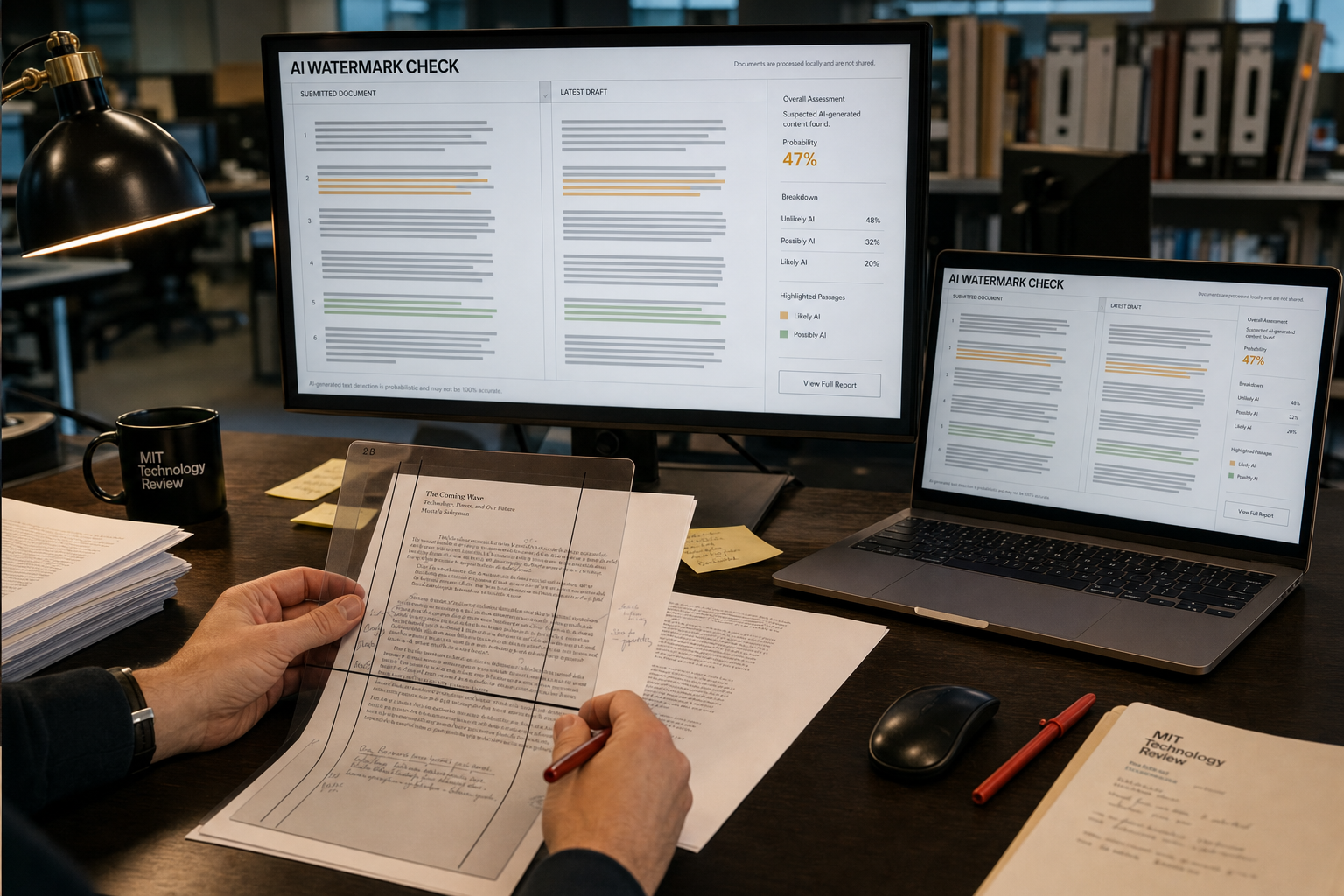
Recent public discussion around Anthropic has put AI text watermarking back in view. The specific claims are still not fully clear in public, and some of the reaction has been driven by reports, technical discussion, and online interpretation rather than a complete official product description. But the core idea is easy to understand: an AI system could generate text with a hidden statistical pattern, and later a detector could use that pattern to guess whether AI helped produce it.
This matters because the target is not just spam or disinformation. It is ordinary writing. A student essay, a job application, a customer email, a press release, a freelance article, even a rough draft shared with an editor could be judged by a signal the writer cannot see. That creates the real tension in this debate: watermarking promises accountability, but it can also turn authorship into a quiet technical verdict.
The case for watermarking is real
Supporters are not wrong to see value here. The internet is already crowded with synthetic text. Teachers want ways to enforce classroom rules. Platforms want better tools against content farms and automated propaganda. Publishers want to know what they are receiving. In some settings, a hidden signature could be more useful than a visible label, because visible labels are easy to delete.
There is also a practical argument. If companies release powerful writing systems at scale, it is reasonable to ask them to build some form of traceability. Watermarking can look like a middle path between a full ban and total opacity. It says: use the tool if you want, but leave some evidence behind.
That appeal should be taken seriously. A world where AI text is impossible to trace has its own risks. Fraud gets easier. Coordinated influence campaigns get cheaper. Schools and workplaces lose confidence in submitted work. Trust erodes not because every text is fake, but because nobody can tell what is what.
But hidden signatures change the balance of power
The trouble starts when watermarking moves from content management to human judgment. Once a hidden marker exists, people will use it to sort, punish, reject, or accuse. That is not a side effect. It is the likely outcome.
A teacher may treat a flagged paper as cheating. An employer may doubt a cover letter. An editor may assume a writer relied too heavily on a model. A platform may reduce reach or suspend an account. In each case, the writer may have no meaningful way to inspect the evidence, challenge the result, or explain how the text was produced.
This is why the question in the headline matters. The issue is not only legal ownership. A person may still hold copyright in some cases, or may have substantially rewritten a draft. But social ownership is different. If an invisible signal can override the reader’s trust, then the sentence no longer belongs fully to the person whose name is on it. It belongs partly to the detection system.
The sentence is not always purely human or purely machine
That is another reason this debate is harder than it first appears. Modern writing is often mixed. A person may ask a model for ten headline ideas, discard nine, and rewrite the tenth. A non-native English speaker may use AI to smooth grammar while keeping the argument, structure, and examples entirely their own. A reporter may use AI to summarize background notes, then independently verify every fact and write the final copy from scratch.
Should all of those cases carry the same hidden mark? If they do, the mark tells us very little about authorship. If they do not, then the system has to make fine judgments about creative contribution that many human institutions cannot even agree on.
This is where invisible watermarking becomes socially clumsy. It works best when the categories are simple: machine or human, assisted or not, original or not. Real writing is rarely that neat.
Detection is rarely as clean as people hope
There is also a basic reliability problem. Text detectors have a poor public track record. They can produce false positives, especially on short text, formulaic writing, or work by students and non-native English speakers. Hidden watermarking may perform better than generic detection, but it still does not solve the hardest parts of the problem.
For one thing, marked text can be edited. The more a person revises a draft, the less clear the signal may become. On the other hand, a strong watermark may pressure the model to choose awkward words or slightly unnatural phrasing to preserve the pattern. That raises a strange possibility: the hidden signature may not only identify the text, but subtly shape it.
If that happens, the writing process itself changes. The tool is no longer just helping with words. It is placing a technical interest inside the sentence.
Consent cannot be an afterthought
This is the point many technical debates skip. Writers deserve to know when their text is being marked. If a company embeds a hidden signature in generated output, users should be told plainly, before they rely on the tool for school, work, or publishing. That is not a minor terms-of-service issue. It is central to informed use.
Without disclosure, watermarking looks less like safety and more like surveillance by design. The company keeps the power to identify its own output later, while users carry the reputational risk. That is a poor ethical trade.
The problem becomes sharper when people use AI in sensitive contexts. Think about asylum applications, legal aid forms, medical complaint letters, or workplace grievances. People often turn to writing tools because they need help expressing themselves clearly under pressure. Hidden marking in these cases could expose vulnerable users to extra suspicion precisely when they are trying to be understood.
What defenders of watermarking will say
A fair editorial should acknowledge the strongest counterpoint. Critics of hidden signatures often ask for perfect certainty from watermarking while accepting deep uncertainty from the status quo. Right now, institutions are already making guesses about AI use, often based on style, intuition, or bad detectors. In that light, a built-in technical signal could be more accurate and more honest than what many schools or employers use today.
That is a serious argument. A disclosed, limited watermark may indeed be better than unreliable guesswork. It could help platform operators detect mass automation without forcing everyone to reveal private writing history. It could also help companies study misuse patterns in aggregate rather than rely on anecdote.
But that only supports narrow use. It does not justify turning invisible signals into general-purpose evidence against individuals.
Where the line should be drawn
My view is simple: hidden AI text watermarking should never be the basis for punishment, rejection, or public accusation on its own. If companies use it at all, they should disclose it clearly, document its limits, and restrict its use to specific contexts such as platform integrity and large-scale abuse detection.
That means several practical rules.
- No secret deployment. Users should know if generated text carries a hidden signature.
- No single-signal judgment. Schools, employers, publishers, and platforms should not treat a watermark hit as conclusive proof.
- A right to contest. Anyone affected by a detection result should be able to ask what standard was used and how to appeal.
- Clear scope limits. Watermarking meant for spam control should not quietly expand into hiring, grading, or moderation without public justification.
- Protection for assisted writing. Systems and policies should distinguish between full generation and light editing support where possible, and should not punish people simply for using tools to improve clarity.
Writers need trust more than they need labels
The deeper problem here is cultural, not only technical. We are entering a period where institutions are losing confidence in text itself. Watermarking responds to that fear by adding more measurement. Sometimes that will help. Often it will not. Writing is not only output. It is evidence of thought, labor, judgment, and voice. Those qualities do not map neatly onto a hidden statistical trace.
If we let invisible markers become the standard way to decide whose words count, we will make writing less trustworthy, not more. People will suspect clean prose. Non-native speakers will face new doubt. Honest users of AI tools will be lumped together with people trying to deceive. And companies will gain quiet influence over how authorship is defined.
The better question
The most useful question is not whether a sentence contains machine assistance. It is whether the named writer stands behind it. Did they verify the facts? Do they accept responsibility for the claim? Can they explain the argument? Those are human standards. They are slower than automated detection, but they are also fairer and more durable.
AI may help produce words. It should not get to decide, through a hidden signal, whose words those are. If a sentence carries a signature, the writer should know it, the reader should not over-trust it, and no institution should confuse detection with truth.