If AI Gets Cheaper to Run, Who Finally Gets to Use It?
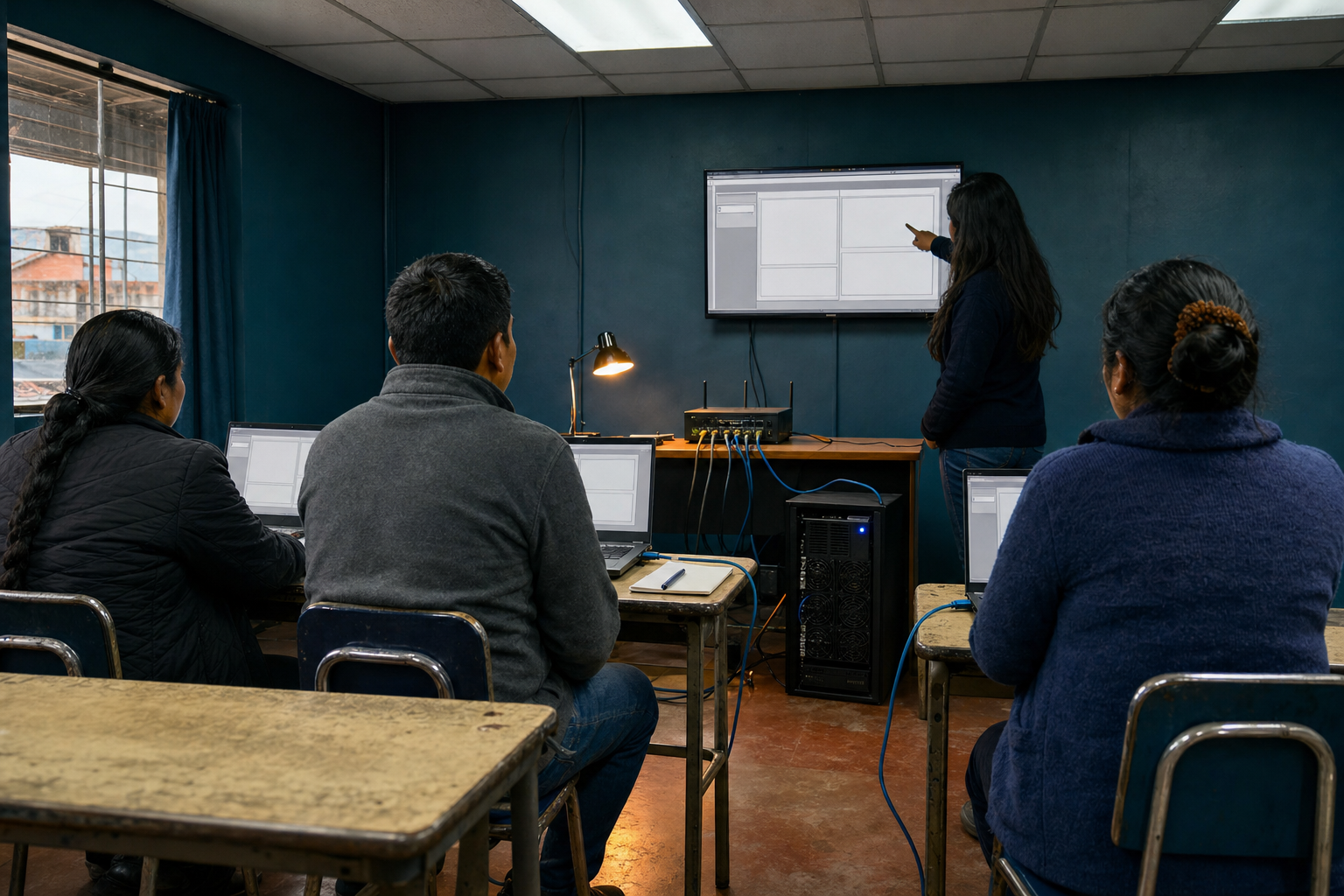
Recent discussion around DeepInfer and similar efforts to run DeepSeek-style models more efficiently has revived a familiar promise: powerful AI may soon become much cheaper to deploy. That promise still needs to prove itself outside demos, benchmarks, and early technical reports. But the direction matters. Inference cost, not just model training, is becoming one of the main places where the AI market will be won or lost.
Why does this matter beyond engineering circles? Because the next AI divide may not be about who knows these tools exist. It may be about who can afford to run them reliably, privately, and in the right language. The real debate is this: if AI becomes cheaper to serve, will smaller schools, Arabic creators, nonprofits, and local teams gain meaningful access, or will most of the benefit still flow to large companies with bigger budgets, stronger distribution, and better legal cover?
Cheaper matters. But cheaper is not the same as accessible.
My position is straightforward: lower AI costs are good news only if they reduce real barriers for smaller users. If the price of running a model drops but the tools remain hard to deploy, hard to govern, and weak in many local contexts, then the change will help incumbents more than everyone else.
That is not a small distinction. In AI, cost has several layers. There is the cost of the model itself. Then there is the hardware, the hosting, the integration work, the security review, the staff training, and the ongoing maintenance. A large company can absorb those layers. A small school or nonprofit often cannot.
So yes, cheaper inference is progress. But we should judge that progress by a simple test: does it let new kinds of users do useful work that was previously out of reach?
What lower costs could unlock
If model serving becomes substantially cheaper, three things could change for the better.
- Experimentation becomes realistic. A small team can test an idea without committing to a large cloud bill.
- Local deployment becomes more plausible. Some organizations may be able to run models on modest infrastructure instead of sending sensitive data to outside providers.
- Niche use cases become worth building. Products for smaller languages, local institutions, or specific professions can survive even with a limited user base.
That matters in very practical ways.
A smaller school may not need a frontier model for open-ended research. It may need a homework support tool, a translation assistant for parents, or a basic administrative helper that can run after hours without exposing student records. If the operating cost falls enough, that becomes a procurement decision, not a fantasy.
An Arabic creator may not be asking for a general-purpose chatbot first. They may need subtitling, archive search, transcription, moderation support, or help repurposing long-form content into short clips. Lower serving costs could make those tools affordable for independent media teams, not just large regional platforms.
A nonprofit may want to summarize case notes, sort incoming requests, draft grant materials, or translate field reports. But many nonprofits work with sensitive information and cannot simply copy everything into a public tool. Cheaper models that can be hosted privately or used through a controlled workflow could make a real difference.
Local businesses and civic teams also stand to gain. A municipality might use AI to classify service requests. A regional hospital might test documentation support. A small retailer might build customer-service automation in its own dialect. These are not glamorous use cases, but they are the ones that often matter most.
Why many people could still be left out
Here is the problem: lower inference cost does not automatically solve the harder parts.
First, many organizations still lack the technical capacity to deploy and maintain a model. Even if the software is cheaper, someone has to choose it, evaluate it, secure it, update it, and explain its limits to staff. That is manageable for a well-funded company. It is much harder for a school with one overworked IT manager.
Second, language coverage remains uneven. Cheaper AI will not help Arabic creators much if the model performs poorly on Arabic dialects, makes avoidable transcription errors, or cannot handle regional context. A low-cost system that works mainly for English users is not broad access. It is a discounted version of the same old imbalance.
Third, legal and governance costs often stay high even when computing costs fall. A hospital, public agency, or education provider cannot adopt AI casually. Privacy rules, procurement rules, record-keeping, and audit requirements all matter. If compliance remains expensive, the cheapest models may still be out of reach for the institutions that need them most.
Fourth, distribution power still counts. Large platforms can take any efficiency gain and turn it into lower prices, better bundling, and faster customer acquisition. Smaller actors may get cheaper tools, but still struggle to reach users, train staff, or compete with products already embedded in office software, search engines, and cloud platforms.
There is also a social risk. Cheap AI can lower the cost of useful services, but it can also lower the cost of spam, synthetic content farms, surveillance tools, and low-quality automation. A smaller local publisher may benefit from cheaper editing support. That same shift may also flood the market with disposable content and make it harder for serious work to stand out.
The strongest counterpoint
Supporters of the “cheaper is enough” view are not wrong about everything. In technology, falling costs often do expand access. Cloud computing helped startups. Smartphones spread because they became affordable enough for mass markets. Open-source software gave smaller teams tools they once could not afford.
The same could happen here. A lower AI bill is still a lower AI bill. Small companies already use APIs they never could have built themselves. Teachers already rely on affordable writing and planning tools. Cheaper inference could make those services more stable, more available, and less expensive for everyone.
That is a fair point, and it should not be dismissed. Cost reductions do matter directly.
But the lesson from past technology shifts is not that lower prices solve everything. It is that lower prices help most when they come with usable products, training, trust, and infrastructure. Cheap electricity changed society because it reached homes and factories through systems people could actually use. AI will be no different.
What real access would look like
If the industry wants to claim that cheaper AI expands opportunity, the proof should be visible outside the biggest companies.
- Pricing for small users: low-volume tiers that do not punish schools, nonprofits, and independent creators.
- Better local language support: strong Arabic benchmarks, dialect coverage, transcription quality, and interfaces designed for non-English workflows.
- Simpler deployment: reliable tools for local hosting, privacy controls, logging, and updates that do not require a full machine learning team.
- Practical procurement: public institutions need clearer ways to buy or deploy AI safely without enterprise-scale legal overhead.
- Training and support: staff need to understand what a system can do, where it fails, and how to review outputs responsibly.
These are not side issues. They are the difference between a technical advance and a social one.
The deeper question is who gets leverage
There is a temptation to treat cheaper AI as an automatic equalizer. It is not. Cost reductions can create leverage, but they do not decide who captures it.
If lower operating costs mainly help large firms serve more users at higher margins, then the public story about access will be overstated. If those same cost reductions help a community college build a tutoring assistant, a small Arabic newsroom search its own archive, or a nonprofit process applications without leaking sensitive data, then something more meaningful has happened.
That is the standard worth using. Not whether one more model became faster. Not whether a benchmark score improved. But whether the circle of practical users became wider.
Cheaper AI should be judged by who benefits next
The promise of cheaper AI is real. The social payoff is not guaranteed.
We should welcome technical work that makes strong models less expensive to run. But we should also be honest: lower inference cost alone will not fix weak language support, deployment complexity, market concentration, or institutional risk. Those problems decide who can actually use the tools.
The most useful question is also the simplest one: who benefits next? If the answer is smaller schools, Arabic creators, nonprofits, and local teams, then cheaper AI will deserve the excitement. If not, then AI did not truly become accessible. It only became cheaper for the people who were already inside the door.