Who Gets to Be Creative in AI? Arabic Dialects, Local Humor, and the Limits of Global Models
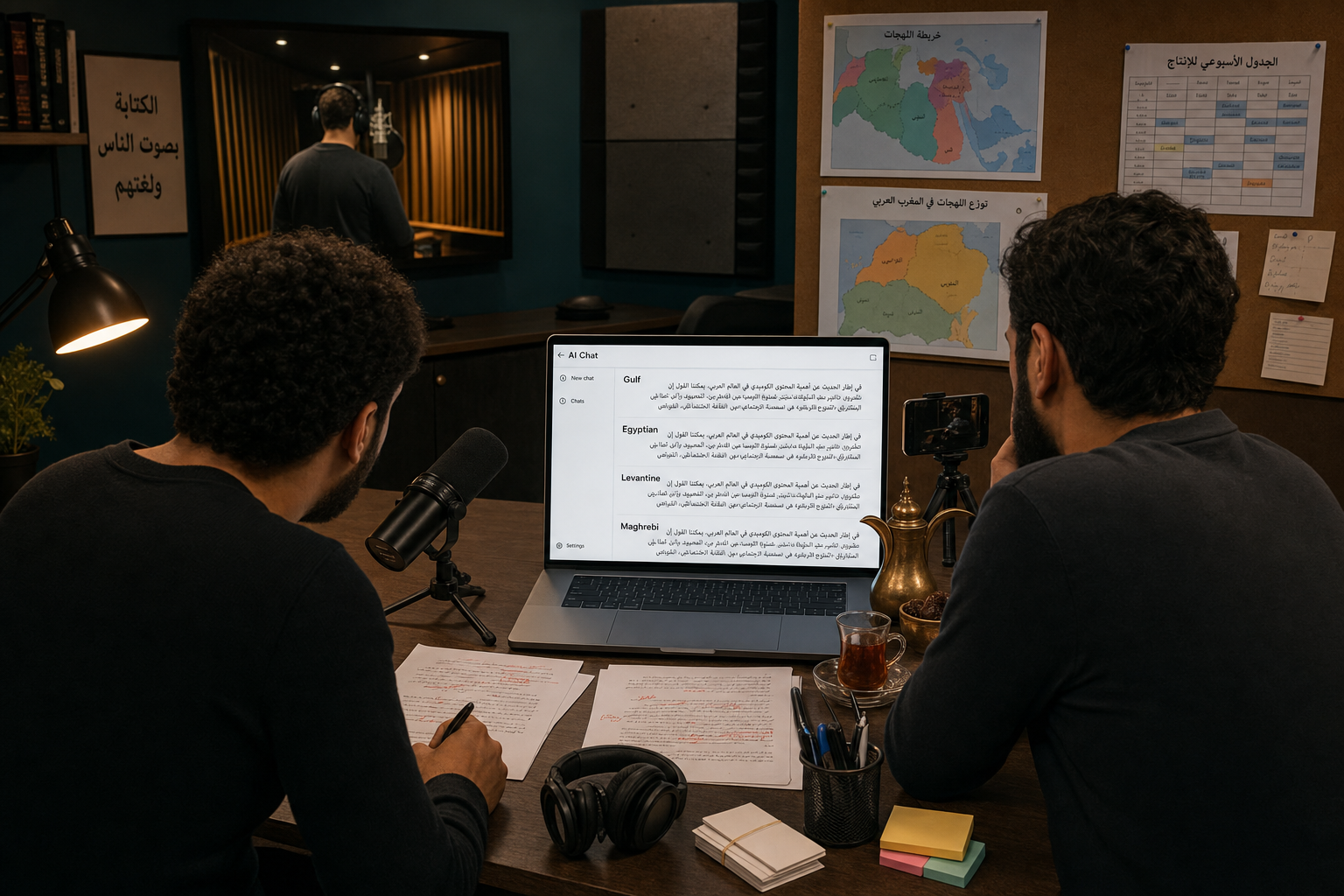
AI tools now write captions, scripts, ad copy, song lyrics, and jokes in seconds. But when users ask for Gulf warmth, Egyptian comic timing, Levantine sarcasm, or Maghrebi street language, the output often slips into flat Modern Standard Arabic or forced slang. That is the issue. Creative AI is improving fast, but its cultural range is still uneven.
Why does that matter? Because creativity is not only about producing text. It is about voice, rhythm, reference, and social meaning. The debate is not whether global AI models are useful. They clearly are. The real question is whether these systems expand creative access for Arabic speakers or quietly push them toward generic, safer, more globalized expression.
Creativity is not just language accuracy
Many AI discussions treat language as a technical problem: can the model translate, summarize, or answer questions correctly? Creative work is harder. A joke can be grammatically perfect and still feel dead. A marketing line can be clear and still sound imported. A poem can use Arabic words and still miss the emotional register that people actually use in daily life.
This is especially true in Arabic. People do not live only in formal Arabic. They move between dialects, English, French, emoji, memes, and references tied to city, class, generation, and platform. A student in Amman, a brand manager in Riyadh, and a comedian in Casablanca may all be speaking “Arabic,” but not in the same way. If a model handles only the formal layer well, it misses a large part of real creative expression.
Take a simple example. Ask a general model to write a funny wedding invitation in Egyptian Arabic. It may produce correct sentences, but the humor often feels mechanical. Ask it for a warm customer message in Gulf Arabic, and it may become either too stiff or too exaggerated. Ask it to rewrite a social post in a distinctly local voice, and it may rely on a few obvious words instead of the full tone. These are small failures on the surface, but they matter in creative work because tone is the work.
Why global models flatten Arabic
The reason is not mysterious. Most large models are trained on huge amounts of internet text, and the public internet does not represent all forms of Arabic equally. Modern Standard Arabic is more visible in news, formal writing, and published material. Dialects are more fragmented. They appear in short videos, comments, group chats, voice notes, memes, and spoken conversation. Much of that material is not well labeled, not easy to process, or not ethically available for training.
So the model learns what is abundant, searchable, and standardized. That gives it strong general abilities, but weaker local texture. It can often produce “Arabic enough” output while missing what makes a phrase feel Egyptian, Hijazi, Syrian, or Moroccan in real use.
There is another layer too: safety and product design. Many global AI systems are tuned to avoid risk, controversy, or offensive language. That makes sense in principle. But humor often depends on edge, timing, and social context. When models are heavily smoothed, creative output becomes polite, generic, and predictable. This affects all languages, but the effect is sharper in dialects that already have less representation.
To be fair, global models also bring real benefits. They lower the cost of drafting, brainstorming, translation, and editing. They can help a small business produce decent copy quickly. They can help students switch between Arabic and English. They can help writers get unstuck. The point is not that the tools are useless. The point is that their strengths are often strongest in the center and weakest at the edges, and for Arabic speakers the edges are often where real personality lives.
This is a power issue, not just a product issue
When AI becomes part of daily creative work, weak dialect support is not a minor quality problem. It becomes a distribution problem. People whose language is well represented get tools that feel natural and efficient. People whose language is poorly represented must either accept awkward output or spend extra time correcting it. Over time, that shapes who can create faster, publish more, and sound more polished online.
Large companies can still hire writers, editors, and agencies to localize content properly. Smaller businesses, students, independent creators, and nonprofit teams often cannot. They are the ones most likely to rely directly on AI tools. If those tools work best in English or in standardized Arabic, then the people with the fewest resources are also the ones most pushed toward generic language.
That has cultural consequences. Local humor gets flattened. Regional references are lost. Emotional tone becomes more uniform. And the market starts rewarding a narrower type of expression because it is easier for the tools to generate and easier for platforms to distribute.
In that sense, the question “who gets to be creative in AI?” is partly about representation, but it is also about economic access. If AI becomes the default assistant for writing and media, then poor support for dialects can quietly become a barrier to participation.
The counterpoint: no model can master every local nuance
There is a reasonable objection here. Arabic is not one simple linguistic field. Dialects vary widely, and they change fast. A single “authentic” local voice does not exist even within one city. Building strong support for every dialect is expensive. Evaluating humor is difficult. And if companies push too hard to imitate local speech, they risk producing stereotypes or cartoonish versions of real communities.
That is true. No one should expect perfect imitation. In fact, demanding perfect mimicry can create its own problems. A model that copies social style too aggressively may reproduce bias, class markers, or offensive speech without understanding context. It can also blur important boundaries between assistance and impersonation.
There is also a data ethics problem. The richest sources of dialect speech are often private or semi-private: chats, voice notes, livestreams, and informal videos. Companies should not solve the representation problem by vacuuming up personal language without clear consent. Better Arabic support is important, but not at any cost.
Still, these counterpoints do not cancel the main issue. They simply mean the goal should be responsible support, not fake perfection. The standard should be: can the system handle local language honestly, usefully, and without reducing it to a gimmick?
What better creative AI would look like
Improvement does not require magic. It requires priorities. If companies say they support Arabic, they should be judged on more than formal benchmarks and broad translation scores. They should show whether the system can deal with real variation inside Arabic.
- Measure dialect performance separately. “Supports Arabic” is too vague. Users need to know what works well and what does not.
- Handle code-switching naturally. Many Arabic speakers mix dialect with English or French. Creative tools should reflect that reality instead of forcing artificial purity.
- Be transparent about uncertainty. If the model is weak in a specific dialect or style, it should say so rather than producing confident nonsense.
- Use consent-based local data and evaluation. Writers, translators, comedians, educators, and regional creators should help test these systems. They should also be paid for that work.
- Give users control over tone. Practical options such as “more formal,” “less caricatured,” “closer to spoken Jordanian,” or “avoid heavy slang” are more useful than a vague promise of authenticity.
There is also room for regional players. Not every solution has to come from the largest global labs. Universities, startups, media organizations, and open-source communities in the Arab world can help build better benchmarks, safer datasets, and more context-aware tools. Local participation matters because the problem is not only computational. It is editorial and cultural.
The real test
The strongest case for AI in creativity is that it can widen access. It can help more people draft, experiment, and publish. That promise is worth taking seriously. But the promise is incomplete if it works best for already dominant languages and styles.
Creative AI should not ask Arabic speakers to trade local voice for convenience. It should not turn rich dialects into decorative slang attached to standard output. And it should not treat cultural nuance as a niche feature for later.
If these tools are becoming part of how people write, joke, sell, teach, and express themselves, then the standard is simple: they should help people sound more like themselves, not less. That is not a luxury feature. It is the difference between access and assimilation.