What Research Really Says About AI Tutors: Help, Harm, and the Human Teacher in the Loop
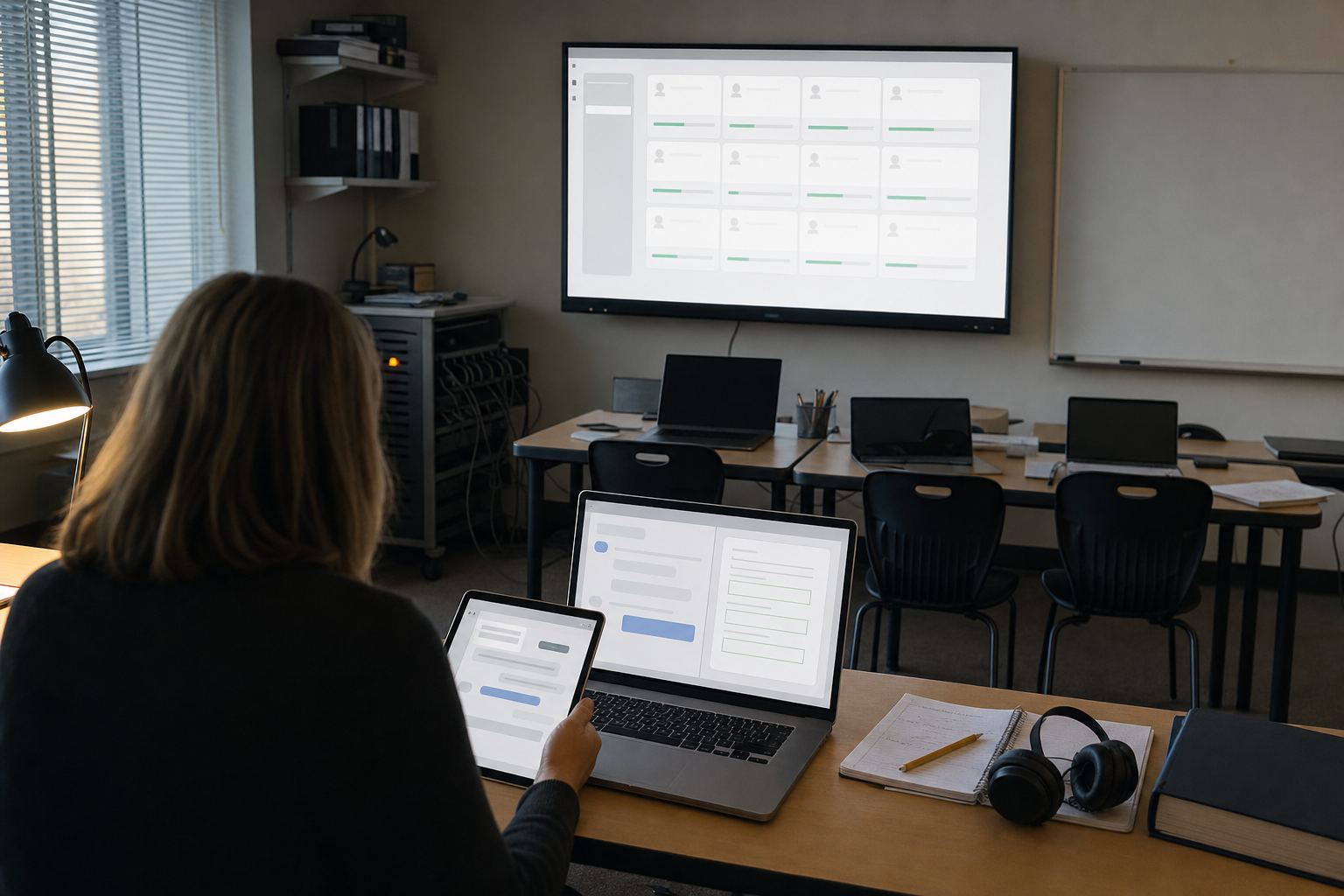
Since ChatGPT, schools, parents, and startups have rushed AI tutors into study apps, homework tools, and classroom platforms. The pitch is simple: every student can now get personal help at any hour. Research supports part of that claim, but not the whole thing. Evidence from older intelligent tutoring systems shows that well-designed AI can improve learning in some subjects. Evidence on newer chatbot-style tutors is much thinner, and far less settled.
This matters because adoption is moving faster than policy, teacher training, and long-term research. Students are already using these systems, whether schools plan for it or not. The main debate is not whether AI can help at all. It can. The real question is whether schools should use AI as extra support inside human teaching, or as a cheaper substitute for teachers. My view is clear: the research supports the first approach, not the second.
Not all AI tutors are the same
“AI tutor” now covers very different tools. Some systems are tightly designed for math steps, language drills, or science practice. They track a student’s answers, spot common mistakes, and give hints. Researchers have studied these systems for years.
Then there are large language model tutors: open-ended chatbots that can explain a concept, rewrite an essay paragraph, generate quiz questions, or walk through code. These are more flexible. They are also less predictable. That distinction matters because much of the strongest education research comes from the first category, while most public excitement now centers on the second.
Where the evidence is strongest
Across many studies, intelligent tutoring systems tend to produce small to moderate learning gains compared with regular instruction alone or unguided practice. The best results usually appear in structured subjects such as algebra, physics, and language learning, where the system can check answers against clear rules and give targeted feedback.
The reason is practical, not mysterious. These tools give immediate feedback. They allow more practice without waiting for a teacher to mark every step. They can adjust the level of difficulty. They can repeat explanations in simpler language. For a student stuck on fractions at 9 p.m., that kind of support can be genuinely useful.
They can also help with access. A student in a large class may not get much individual attention. A non-native English speaker may benefit from a simpler explanation or a quick translation. A shy student may ask a system a question they would not ask in front of classmates. These are real advantages, and schools should not dismiss them.
- Extra practice time
- Immediate feedback on routine work
- Support at different speeds
- Help outside school hours
- Useful scaffolding for revision and review
Where the evidence gets much weaker
The newer wave of conversational AI is promising, but the research base is still limited. There are early studies and pilots showing benefits for writing support, coding help, brainstorming, and short-term task performance. But there are far fewer rigorous, long-term classroom studies showing durable learning gains across subjects and age groups.
That gap matters. A student can complete an assignment faster with AI and still learn less. A system can produce a clear-sounding explanation that is partly wrong. It can adapt its wording, but still fail to diagnose the actual misconception. In open-ended subjects, the system often has no reliable way to know whether its explanation is accurate, appropriate, or pitched at the right level.
In other words, the more flexible tool is often the less dependable one. That does not make it useless. It does mean schools should be careful about turning short-term convenience into long-term policy.
The problem with too much help
One of the clearest lessons from learning research is simple: students need feedback, but they also need effort. Good teaching does not just remove difficulty. It uses difficulty in the right way. That is why strong teachers do not always give the answer as soon as a student gets stuck.
More help is not always better help.
AI tutors can cross that line easily. A chatbot may reveal the full solution too early. A writing assistant may rewrite weak sentences so smoothly that the student never learns how to revise. A coding tutor may fix the bug before the student has understood the logic error. The result can look impressive on the screen and still be thin learning underneath.
This is not only a cheating issue, though academic integrity is part of it. It is a design issue. If the tool rewards fast completion instead of understanding, it can train dependence. That risk is highest when students are new to a topic, under pressure, or working alone.
Accuracy is not a small detail
Supporters of AI tutors often say that human tutors make mistakes too. That is true. The difference is scale and detectability. A human teacher usually knows the course, the student, and the local context. A general-purpose AI system may generate an answer that looks confident but is factually wrong, poorly sourced, or misaligned with the curriculum.
For advanced students, an occasional mistake may be manageable because they can spot it. For younger students, struggling learners, or anyone new to a subject, the danger is larger. They may not know when the tutor is wrong. They may memorize the error.
That is why accuracy cannot be treated as a minor technical flaw that will sort itself out later. In education, bad feedback is not neutral. It teaches.
Why the teacher still matters
The strongest argument for keeping a human teacher in the loop is not sentimental. It is practical. Teachers do several jobs that current AI systems do poorly.
- They judge whether a student is confused, guessing, bored, or ready for a harder task.
- They connect today’s lesson to yesterday’s gaps and next week’s goals.
- They decide when a student needs a hint, a worked example, more practice, or a firm push to think alone.
- They notice social factors that affect learning, from confidence to classroom dynamics.
- They carry responsibility for fairness, grading, and care.
A “teacher in the loop” should mean more than a logo on a vendor slide. In practice, it means the teacher chooses where AI is useful, reviews outputs, corrects errors, sets the rules for when students may use it, and checks whether the student actually learned. It also means the teacher can say no when the tool does not fit the task.
That model is slower than full automation. It is also more credible. And schools should be honest about one more point: human oversight takes time. In some cases, AI can reduce routine work. In other cases, it creates new work because staff must check bad outputs, manage misuse, and explain the rules.
The fair case for wider AI tutoring
There is a serious counterargument, and it deserves respect. Many students do not have access to human tutors. Many teachers are managing large classes, limited time, and rising administrative demands. In that context, an imperfect AI tool may be better than no extra help at all.
That point is especially strong in low-resource settings. A student who can get instant practice questions, vocabulary help, or step-by-step math hints may gain something important, even if the system is far from perfect. Schools should not let fear of risk turn into a blanket rejection of useful support.
But this is exactly why the public conversation needs discipline. If AI is being offered as a supplement, the case is reasonable. If it is being sold as a reason to reduce teacher contact, cut tutoring staff, or outsource judgment to software, the evidence is not strong enough to justify that move.
What responsible use looks like
If schools want a research-based approach, they should start with narrow, testable uses rather than grand promises. The safest early use cases are usually low-stakes and structured: practice problems, vocabulary review, first-pass feedback, study guides, or revision support before teacher review.
Schools should be far more cautious with high-stakes use. That includes final grading, behavioral judgments, special education decisions, and open-ended tutoring that students may treat as expert truth without verification.
There is also a separate risk that often gets less attention than accuracy: surveillance. Many tutoring products log every question, error, and exchange. Schools should ask why that data is collected, who keeps it, and how long it lasts. Student convenience is not a blank check for data collection.
A sensible policy would include a few basic rules.
- Use AI where feedback can be checked and corrected.
- Prefer tools with evidence in a specific subject or age group.
- Teach students how to question outputs, not just accept them.
- Require human review for high-stakes tasks.
- Protect student data and limit unnecessary collection of chat logs and behavior data.
- Measure learning gains, not only usage, speed, or student enjoyment.
That last point is easy to miss. Engagement is not the same as learning. A tool can feel helpful and still leave weak retention a week later.
The position schools should take now
Schools do not need to choose between hype and panic. They need a standard: use AI tutors where the evidence is decent, the task is appropriate, and a human educator remains accountable. That is a practical position, not a fearful one.
Research so far does not support the fantasy of an autonomous digital teacher that can replace the work of teaching at scale. It does support something more modest and more useful: AI as an extra layer of practice, explanation, and feedback, especially when time and resources are short.
That may sound less exciting than the marketing pitch. It is also closer to the truth. In education, the tools that last are usually not the ones that promise everything. They are the ones that help real students learn a little better, under real classroom conditions, with a real teacher still in charge.