What Is an AI Model, Really? A Plain-Language Guide for Non-Technical Readers
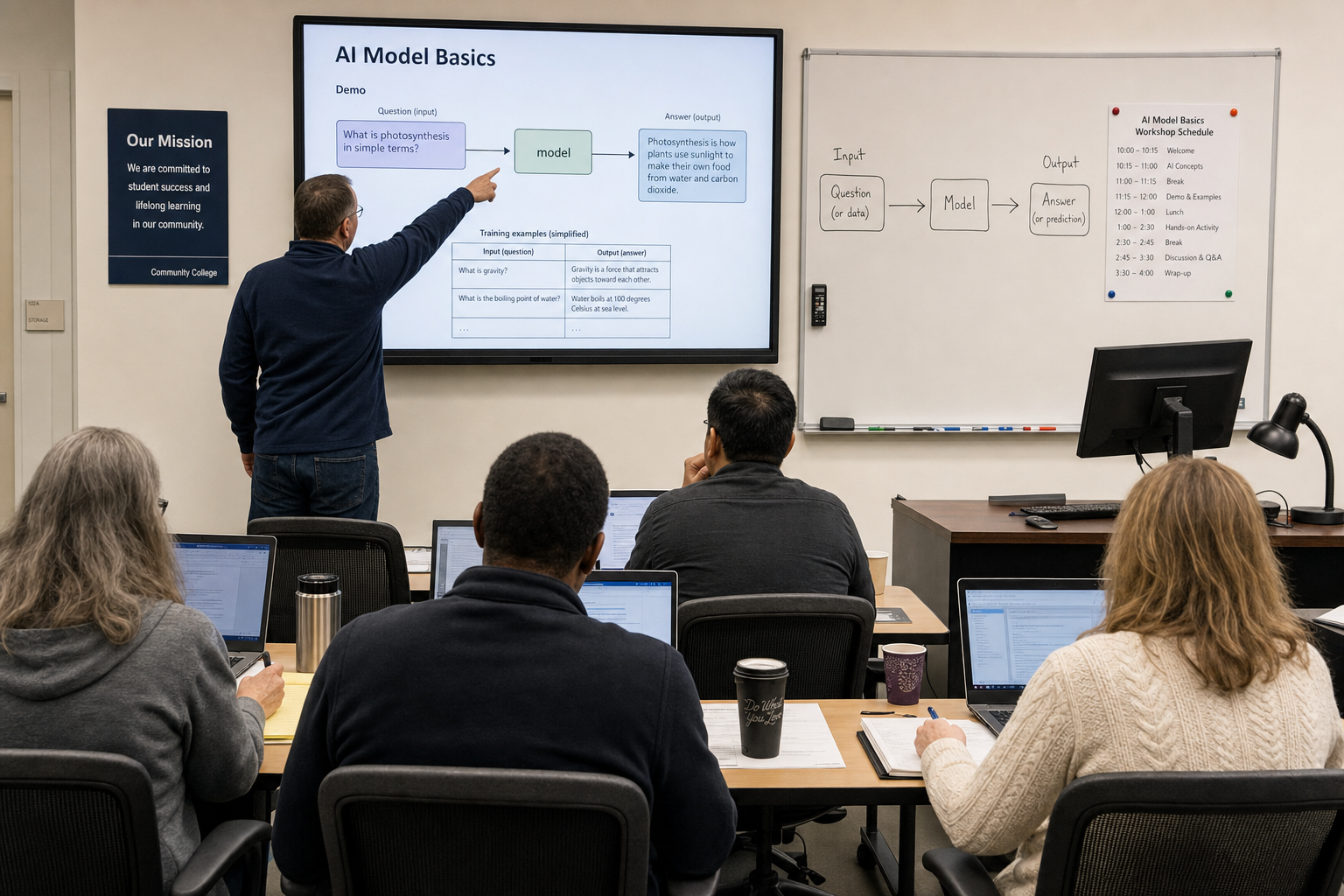
A wave of AI announcements has put the word model everywhere. Companies say they have released a new model, a smaller model, a faster model, or a model with better reasoning. The basic point is simpler than the marketing. An AI model is the trained prediction engine inside an AI system. It takes an input, such as a question, image, voice clip, or document, and generates an output based on patterns learned during training.
This matters because a model update can change what an AI product can do, how often it makes mistakes, how much it costs, and where it can be used. The main tension is that model announcements are often framed as breakthroughs, while many readers still do not have a clear way to judge what has actually improved. My view is simple: the most useful way to think about a model is not as a digital mind, but as a trained statistical system inside a larger product. That view is less exciting than the hype, but much closer to reality.
The simplest useful definition
If you remember one sentence, make it this:
An AI model is software trained on large amounts of data to predict useful outputs from new inputs.
For a text model, the output is usually the next word or piece of a word, one step at a time. For an image model, it may be pixels. For a speech model, it may be sound or text. The model does not pull a finished answer from a hidden library. It generates an answer by calculating what output is most likely to fit the prompt and the patterns it learned before.
That may sound technical, but the practical idea is straightforward. Show the system enough examples of language, code, images, or audio, and it gets better at producing similar patterns on demand. In many cases, that is powerful enough to summarize reports, draft emails, write software, translate text, or sort customer complaints. It can also be wrong in fluent, confident ways. That is part of the package.
What a model is not
Many people understandably confuse the model with the app they are using. They are not the same thing. A chatbot, search assistant, note-taking tool, customer service bot, or coding product may all use the same underlying model. And the same app may quietly switch from one model to another.
A model is also not the whole internet, and it is not the same as a database. If a system can answer questions about today’s news or your company files, that often means the product is combining the model with search, retrieval, or other tools. The model is the core generator. The full product may include memory, rules, filters, web access, document search, and human-designed workflows around it.
This distinction matters because users often credit or blame the wrong layer. If a chatbot gives stale information, the problem may be the date when its training data stopped, not the chat interface. If it cites your internal documents, that may be because the product connected the model to a private database. When companies announce a new model, they are usually talking about one important layer, not the entire system.
What training actually does
Training is the process that makes a model useful. Engineers feed the system enormous amounts of example data and adjust its internal settings, often called parameters, so that its predictions improve. You do not need the math to understand the result. Training changes the model from a mostly random generator into a system that can produce recognizable language, code, images, or other outputs.
A helpful way to think about those parameters is as a huge set of fine adjustments. After training, the model does not store every sentence in a neat file cabinet. Instead, it carries statistical traces of patterns: how words usually fit together, what a legal brief looks like, how recipes are structured, what common programming fixes look like, and much more.
This is why the phrase the model knows is both useful and misleading. It is useful shorthand. But it can make people imagine a human-style understanding that is not there. A model can capture patterns well enough to explain a tax form or debug a script. It can also invent a court case or misread a chart. Its outputs depend on training, prompt design, and the tools around it, not on judgment in the human sense.
Why people say “it’s just autocomplete”
Critics often say large language models are just very advanced autocomplete. That line is popular because it captures something real: these systems are trained to predict the next piece of text. On that narrow point, the critics are right.
But the phrase can also hide what scale changes. When a model has been trained on vast amounts of text and code, next-word prediction can produce abilities that feel surprisingly broad. It can follow instructions, keep track of a long conversation, generate usable software, or explain the same idea at different reading levels. Those behaviors are not magic, and they do not prove human-like intelligence. They do show that prediction at scale can do more than many people expected.
The fair position sits in the middle. Calling a model autocomplete is not wrong. It is just incomplete. It tells you the mechanism, not the full practical effect.
Why new model releases matter
Not every new model is a major leap. Some releases are mainly about lower cost, smaller size, or better marketing. Still, model updates can matter in concrete ways.
- Accuracy: A newer model may make fewer basic errors or follow instructions more reliably.
- Reasoning performance: It may handle longer chains of logic better, though claims here should be tested carefully.
- Speed and cost: Faster, cheaper models are easier to deploy at scale.
- Context length: Some models can process much longer documents or conversations in one go.
- Work across formats: A model may handle text, images, audio, and sometimes video.
- Safety behavior: It may be harder, or sometimes easier, to push into harmful or misleading outputs.
- Size and portability: Smaller models can run on laptops, phones, or private company servers.
These changes affect real decisions. A hospital might care about accuracy and clear records. A small business might care more about price and speed. A law firm might need strong document handling and fewer made-up claims. A school may value safer behavior and stronger support for different reading levels.
This is also where the risks rise. A more capable model can automate useful work, but it can also scale spam, generate more convincing falsehoods, or encourage people to trust outputs they have not checked. Better fluency is not the same as better truth.
Why benchmark headlines are not enough
Many model announcements are built around benchmark scores. Benchmarks can be useful. They give one way to compare systems on coding, math, reading, or other tasks. But they do not settle the question most users actually care about: Will this work better for my use case?
A model can score well on a public test and still disappoint in customer support, finance, healthcare, or multilingual work. It may be strong in English and weaker in Arabic, Spanish, or Hindi. It may perform well in a controlled demo and then drift in long, messy real conversations. It may be excellent when paired with search tools and much worse on its own.
There is also a basic reporting issue. Companies often publish the most favorable comparisons first. Independent evaluations arrive later. That does not make company claims false, but it does mean readers should treat early numbers as partial evidence, not final judgment.
The model is important, but the system around it is often decisive
One reason the public gets confused is that model quality is only part of AI performance. The surrounding system matters a great deal. The prompt design, the retrieval layer, the safety rules, the quality of the interface, and the human review process can all change results dramatically.
Consider a customer service assistant. A stronger model may write better replies. But if the knowledge base is out of date, the tool can still mislead customers. Or take a document assistant inside a company. A modest model connected to the right internal files may be more useful than a powerful model with no access to the documents employees actually need.
That is why a model release does not automatically translate into business value. Sometimes the real improvement comes from better product design around the model, not from the model alone.
A better mental model for non-technical readers
If you want a practical way to think about all this, use a simple three-part frame:
- The model is the trained engine that generates outputs.
- The tools around it give it access to search, documents, software, or workflows.
- The product layer is what you actually use: the app, interface, pricing, safeguards, and support.
This frame helps cut through both hype and dismissal. It avoids treating the model as a mysterious black box with human-like qualities. It also avoids pretending the model is trivial. A better engine can be a genuine improvement. It is just not the whole vehicle.
Questions worth asking when a company announces a new model
Instead of asking whether a new model is “smarter,” ask a few narrower questions:
- Better at what, exactly?
- Compared with which previous model?
- Tested by whom?
- At what speed and cost?
- In which languages or domains?
- With which tools attached?
- What kinds of mistakes did it reduce, and what new risks did it create?
Those questions are less flashy than a leaderboard chart. They are also more useful. They turn an AI announcement from a spectacle into something you can evaluate.
The plain truth
An AI model is not a person, and it is not the whole product. It is a trained system for generating likely outputs from inputs, based on patterns learned from data. That may sound modest. In practice, it is the reason today’s AI tools can be helpful, unreliable, cheap, expensive, impressive, and risky at the same time.
The most sensible position is neither awe nor dismissal. Understand the model for what it is, then judge it by what it actually changes: the quality of work, the cost of using it, and the kinds of errors it makes. If more readers adopt that simple frame, future model announcements will be much easier to read, and much harder to oversell.