If AI Can Write the Code, What Should Beginners Learn First?
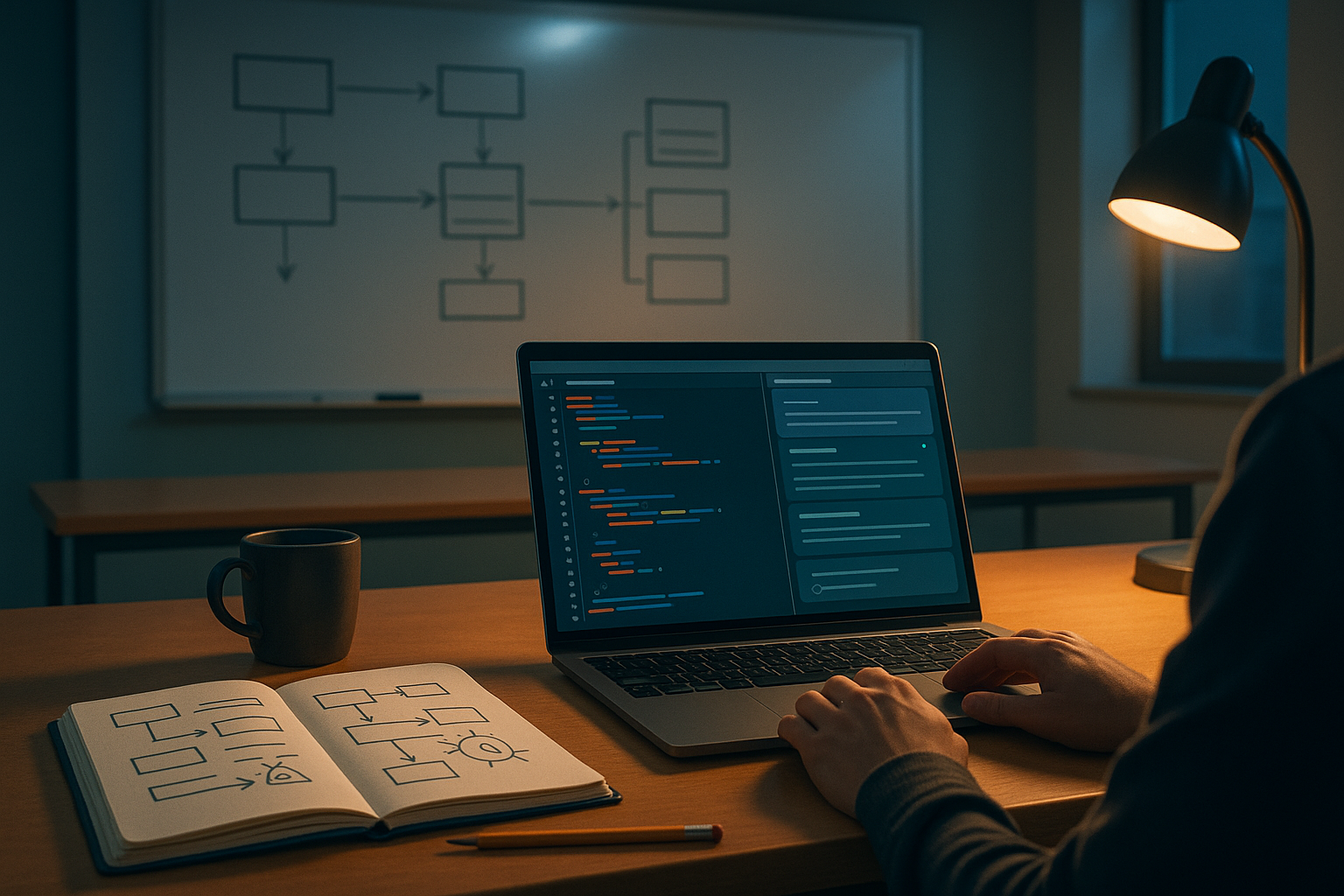
AI coding tools have changed a basic question in tech education. If a chatbot or code assistant can produce a working function in seconds, many beginners now ask: why spend months learning Python, JavaScript, or any language at all? That is not a fringe question. It shows up in online forums, classrooms, and career-switching communities. The confusion is real.
It matters because bad advice at the start can waste a year. The main tension is simple: should beginners focus less on writing code by hand and more on directing AI tools, or does that create a shallow kind of skill that breaks the moment the tool is wrong? My view is clear. Beginners should still learn to code, but the first lessons should shift. Logic, debugging, reading code, systems thinking, and judgment now matter more than memorizing syntax.
The wrong conclusion from better code generators
AI can now produce useful code drafts. That is a fact. It can also explain functions, translate between languages, generate tests, and help with documentation. For a learner, that can feel like a shortcut around the hardest parts of programming.
But the wrong lesson is that code itself no longer matters. The better lesson is that typing every line is no longer the main bottleneck. Understanding what the program should do, whether it actually does it, and what could go wrong is the bottleneck.
This is not a small distinction. A beginner who cannot read a loop, trace a variable, or spot a bad assumption is not really using AI well. They are accepting output. That may work on easy tasks. It fails on anything messy, ambiguous, or important.
In other words, AI reduces some forms of effort. It does not remove the need for technical judgment. In many cases, it increases that need.
What beginners should learn first
If the goal is to build real skill in an AI-assisted world, the order of learning should change. Here is what deserves priority.
- Logic and problem breakdown. Can you take a vague task and turn it into clear steps? Can you define inputs, outputs, and edge cases? This is the foundation of programming with or without AI.
- Reading code. Beginners often think coding means producing code. In practice, much of the job is understanding code that already exists, whether written by a colleague, an open-source library, or an AI tool.
- Debugging. The future will not be free of bugs. If anything, faster code generation may create more code to inspect. Beginners should learn how to test assumptions, isolate faults, read error messages, and verify fixes.
- Systems thinking. A program is not just a block of syntax. It runs inside a larger system: files, databases, APIs, memory limits, permissions, network delays, user behavior, and security rules. AI often handles the local snippet better than the full system.
- Judgment. Is the output correct, safe, maintainable, and appropriate for the task? Should this be automated at all? These questions are not extra. They are central.
- Basic computer science concepts. Variables, conditionals, loops, functions, data structures, scope, state, and complexity still matter. A beginner does not need a full theory course first, but they do need the core mental models.
These skills are durable. They transfer across tools, languages, and job titles. They also make AI more useful, because they help the learner ask better questions and catch bad answers.
Why syntax still matters, just less than before
Some readers will push back here. If syntax is no longer the main thing, does it still make sense to start with Python or another programming language? Yes. But the reason has changed.
Beginners should learn a language because it gives structure to thinking. Python is still a strong choice because the syntax is readable, the ecosystem is large, and there are examples for almost every basic concept. The point is not to become a human compiler. The point is to build a clear mental model of how instructions turn into behavior.
A learner who never writes code by hand often misses this. They may be able to prompt for a web scraper or a small app, but they struggle when the result needs a simple change, fails on unusual input, or behaves differently from what they expected.
Syntax matters most at the beginning as a way to make logic visible. After that, its relative importance drops. That is exactly why beginners should not spend all their energy memorizing language trivia. Learn enough syntax to express ideas, read examples, and fix problems. Then move quickly toward reasoning and verification.
Debugging is becoming a first-class skill
In many traditional coding courses, debugging was treated as a side effect. Students wrote programs, got errors, and gradually learned to fix them. That is no longer enough.
AI-generated code often looks polished even when it is wrong. It may pass a simple test but fail in production. It may use an outdated package, mishandle exceptions, leak data, or ignore performance costs. Beginners need to be trained to distrust smooth output until it has been checked.
This is one of the biggest educational shifts ahead. A strong beginner should know how to:
- run small tests before trusting a big answer
- change one thing at a time when investigating a bug
- read logs and error messages instead of panicking at them
- compare expected behavior with actual behavior
- ask whether the bug comes from the code, the data, the environment, or the prompt
That last point matters more than it used to. When AI is part of the workflow, the source of failure becomes less obvious. A beginner who can debug calmly has an advantage over someone who can only generate more code.
Systems thinking is what separates demos from useful software
AI is often impressive at producing isolated pieces of code. Many beginners are impressed for good reason. The tools can help people build sooner and experiment faster. That promise is real.
But beginners should also know where the tools are weakest. They are much less reliable when the task depends on context spread across many files, hidden business rules, deployment details, or trade-offs that were never stated clearly. Real software usually lives there.
That is why systems thinking should come early. A learner should understand that even a basic application is part of a chain. User input flows through a front end, into business logic, into storage, into output, and back into human decisions. Security, privacy, cost, and reliability sit across that chain. One clever function does not solve those issues.
This is also where career value lives. Many beginners worry that AI will erase junior roles. Some entry-level tasks will shrink. That risk should be stated plainly. But teams still need people who can understand how pieces connect, who can investigate failures, and who can maintain systems over time. Those are not luxury skills.
What AI is actually good for in learning
The answer is not to keep beginners away from AI. That would be unrealistic and, in many cases, unhelpful. Used well, AI can be a strong tutor and assistant.
For example, a beginner can ask an AI tool to:
- explain a short block of code line by line
- generate practice problems at the right difficulty
- suggest test cases for a function
- compare two ways to solve the same problem
- translate code from one language into another for learning purposes
- review a draft and point out likely bugs or security issues
These are useful learning patterns because they support understanding rather than replace it. The danger appears when beginners use AI as a slot machine: paste task, receive answer, move on. That creates the appearance of progress without much skill underneath.
The best use of AI for a beginner is not to avoid thinking. It is to get faster feedback while thinking.
The strongest counterargument
The strongest counterargument is practical. Many jobs do not reward deep manual coding in the early stages. Employers want people who can ship features quickly, use modern tools, and adapt. If AI can handle boilerplate, perhaps beginners should focus on product sense, communication, and domain knowledge, not programming fundamentals.
There is truth in that. Software work has never been only about code. Domain knowledge matters. Knowing what users need matters. Communication matters even more in teams using AI tools, because the work becomes more about specification and review.
But this is not a reason to skip foundations. It is a reason to combine them with a broader view of the job. A beginner who knows the business problem and can also inspect code, test outputs, and understand system behavior will be more useful than a beginner who can only prompt fluently.
Prompting is a tool skill. Foundations are leverage. Tool skills change fast. Leverage lasts longer.
A better beginner path
So what should a beginner actually do in the first months?
- Pick one readable language, such as Python or JavaScript.
- Learn core programming ideas: variables, conditions, loops, functions, lists, dictionaries, and basic input and output.
- Write small programs by hand first, even if they are simple.
- Use AI to explain, review, and test your work, not to replace every step.
- Practice reading code written by others.
- Learn debugging as a routine skill, not an emergency response.
- Build a few small projects that touch files, APIs, and data, so you see how parts connect.
- Learn basic version control and how to document what your code is supposed to do.
This path is less glamorous than the promise of “build anything with prompts.” It is also more reliable. It prepares beginners for tools that will keep changing.
Learn to think, then use the tools hard
The right message for beginners is not “ignore AI” and not “AI makes coding obsolete.” Both are too simple. AI changes what matters first. It moves value away from typing and toward understanding.
If AI can write some of the code, beginners should learn the parts AI does not reliably own: how to define the problem, how to check the answer, how to trace a failure, how to understand a system, and how to make sensible trade-offs. Learn enough syntax to think clearly. Then use the tools hard.
That is the practical answer to the confusion. In the age of AI-generated code, the first skill is not keystrokes. It is judgment.