How to Verify an AI Answer in 10 Minutes: A Beginner’s Fact-Checking Routine
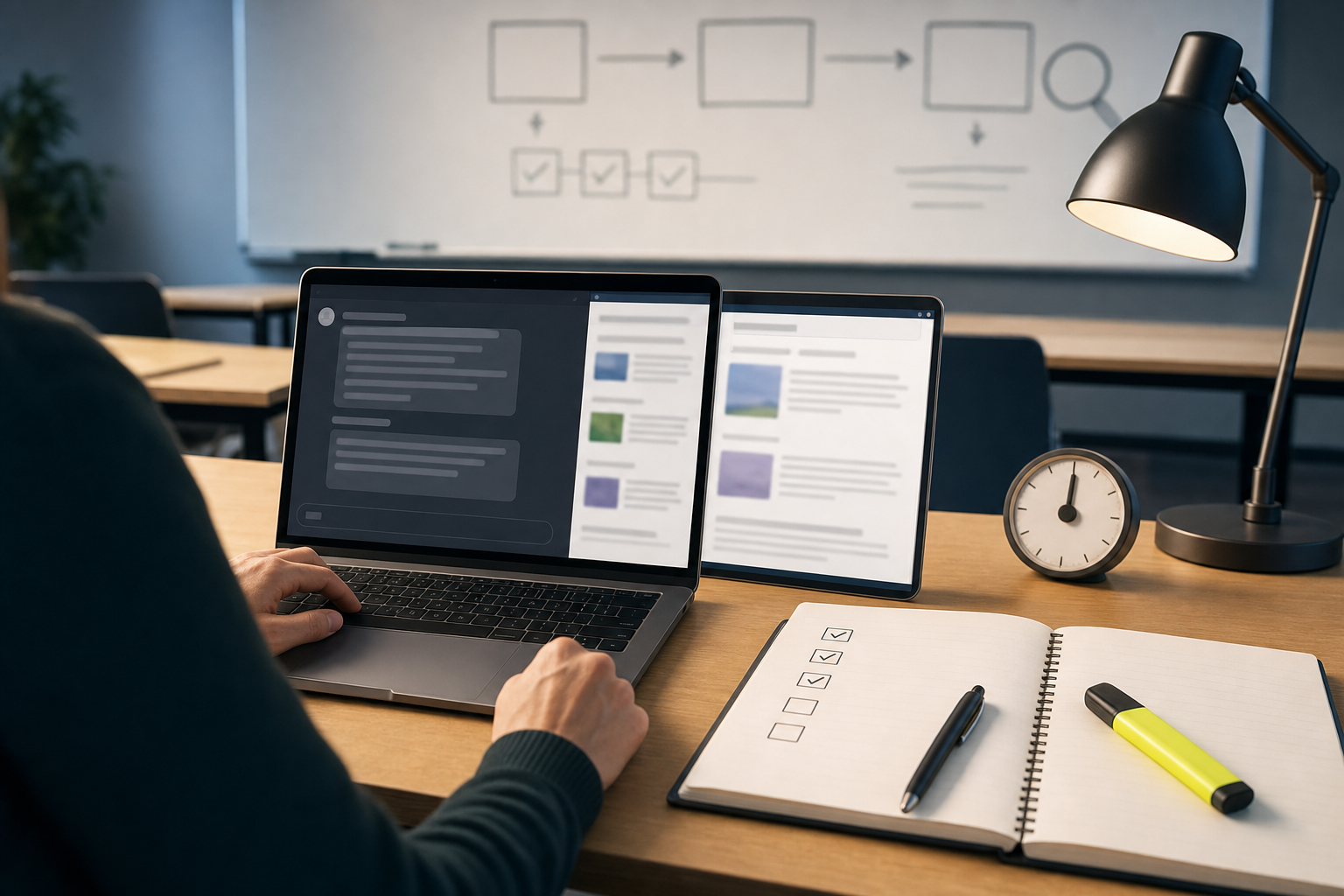
AI tools are now part of everyday study and work. People use them to summarize articles, explain concepts, draft reports, and answer practical questions. The problem is simple: an AI response can sound clear and confident while still being wrong, incomplete, outdated, or unsupported.
That matters because many readers now use AI as a first stop for information. The real debate is not whether AI is useful. It is whether speed should count as trust. My view is straightforward: for factual claims, a quick verification routine should be normal. You do not need to become a researcher. You do need a habit.
Why AI answers need checking
AI systems generate likely text, not guaranteed facts. That is why a response can mix strong information with weak information in the same paragraph.
The common failure modes are familiar:
- Invented details: a statistic, date, name, or quote that looks precise but has no real source.
- Outdated facts: laws change, prices change, company policies change, and some answers reflect older information.
- Blended sources: two separate studies or events get merged into one answer.
- Context mistakes: a true claim in one country, school system, or industry gets presented as universal.
- False confidence: the wording stays smooth even when the evidence is thin.
This is not a reason to reject AI. It is a reason to stop treating the first answer as final.
The 10-minute routine
This routine is designed for beginners. It works best for everyday factual questions: history, science basics, statistics, definitions, public policy, business facts, and cited claims. It is not enough on its own for medical, legal, financial, or safety-critical advice.
- Minute 1: Isolate the claim. Pull out the one sentence that must be true for the answer to be useful. If the answer says, “Remote work increases productivity by 13 percent,” the claim is not “remote work is good.” The claim is the specific number.
- Minutes 2 and 3: Identify the claim type. Ask what you are checking: a fact, a quote, a number, a summary, or an opinion. Facts, numbers, and quotes can usually be verified. Opinions should be labeled as opinions, not facts.
- Minutes 4 and 5: Find two reliable sources. Search the exact claim using plain language. Prefer official institutions, academic sources, major news organizations, recognized reference sources, or the original publisher of the data. Two independent sources are better than ten sites copying each other.
- Minutes 6 and 7: Check date, place, and scope. Ask whether the source is current, whether it applies to your country or field, and whether the AI answer overstated it. A claim can be technically true and still mislead if the context changed.
- Minutes 8 and 9: Go one layer deeper. If the answer includes a statistic, study, quote, or law, open the original document if you can. Confirm the wording, the number, and the conclusion. If you cannot find the original source, lower your confidence.
- Minute 10: Make a use-or-don’t-use decision. Put the answer in one of three buckets: usable, usable with correction, or not reliable enough. If needed, ask the AI to revise its answer using the sources you found.
The point of the routine is not perfection. It is to catch the most common errors before they travel into your paper, meeting, classroom, or social feed.
What counts as a reliable source?
Beginners often get stuck here. A useful shortcut is to ask who is most responsible for the information.
- For public health guidance, start with a health authority, major hospital, or peer-reviewed medical source.
- For laws and regulations, start with government sites or the text of the law.
- For company facts, start with the company itself, then check independent reporting.
- For research claims, look for the actual study, not just a social post about the study.
- For definitions and broad background, established encyclopedias and educational institutions are often fine as a starting point.
A source is less reassuring if it has no author, no date, no citation trail, or a clear interest in selling you something.
A quick example
Imagine an AI tool tells a student: “The Stanford Prison Experiment proved that people naturally become cruel when given power.” That answer sounds neat, but it compresses a messy subject into a slogan.
In ten minutes, a beginner can do better:
- Isolate the claim: did the experiment really “prove” that result?
- Search for two reliable sources: a university page, a reputable reference source, or major reporting on the study’s criticism.
- Check context: the experiment is famous, but also heavily debated for its methods, interpretation, and replicability.
- Go deeper: read one credible summary of the criticism.
The corrected takeaway is more useful: the experiment influenced public thinking, but it is not clean proof of a universal law of human behavior. That is exactly the kind of distortion a quick check can catch.
Red flags that should slow you down
Some AI answers deserve extra caution from the start. Slow down if you see any of these:
- Very specific numbers with no clear source
- Direct quotes from books, studies, interviews, or laws
- Breaking news claims that may have changed in the last hours or days
- Rankings such as “best,” “largest,” or “most effective,” which often depend on methodology
- Health, legal, or financial advice where small errors can have real consequences
- Citations that look real but lead nowhere
When those signs appear, ten minutes is still useful, but sometimes not enough.
The fair counterpoint
Some people will say this routine is too slow. If AI saves time, why add a manual checking step?
That objection is reasonable for low-stakes use. If you are brainstorming headlines, rewriting a paragraph, or asking for a simple explanation of a familiar topic, a full check may not be necessary. Not every sentence needs an audit.
But that is not how many people use AI now. Students submit summaries. Managers circulate briefing notes. Professionals copy claims into emails and presentations. Once an error leaves your screen, the time saved at the start can become time lost later, along with trust. A ten-minute check is often cheaper than a public correction.
What this routine cannot do
This method is a screening tool, not a guarantee. It can help you spot weak claims fast, but it cannot replace subject expertise, especially in technical or high-risk fields.
It also will not settle every disagreement. Some questions are genuinely contested. In those cases, the goal is not to force certainty. It is to describe the uncertainty honestly. If sources disagree, say they disagree.
Build the habit, not the anxiety
The best beginner practice is simple: do not fact-check every word, and do not trust every word. Check the parts that can cause the most damage if they are wrong.
A useful rule is this: the more specific the claim, the more important the source. A broad explanation may only need a quick scan. A number, quote, deadline, policy, or study claim deserves direct verification.
Over time, this becomes faster. You learn which sources to trust first. You learn which questions need extra care. And you stop confusing polished language with reliable information.
AI can speed up the first draft of understanding. It should not be the last draft of truth. If you remember one thing, make it this: isolate the claim, check two sources, confirm the context, and decide before you reuse it. In most everyday cases, that takes about ten minutes. That is not a burden. It is basic information hygiene.