The Work AI Does Not See: Judgment, Context, and Care in AI-Assisted Professions
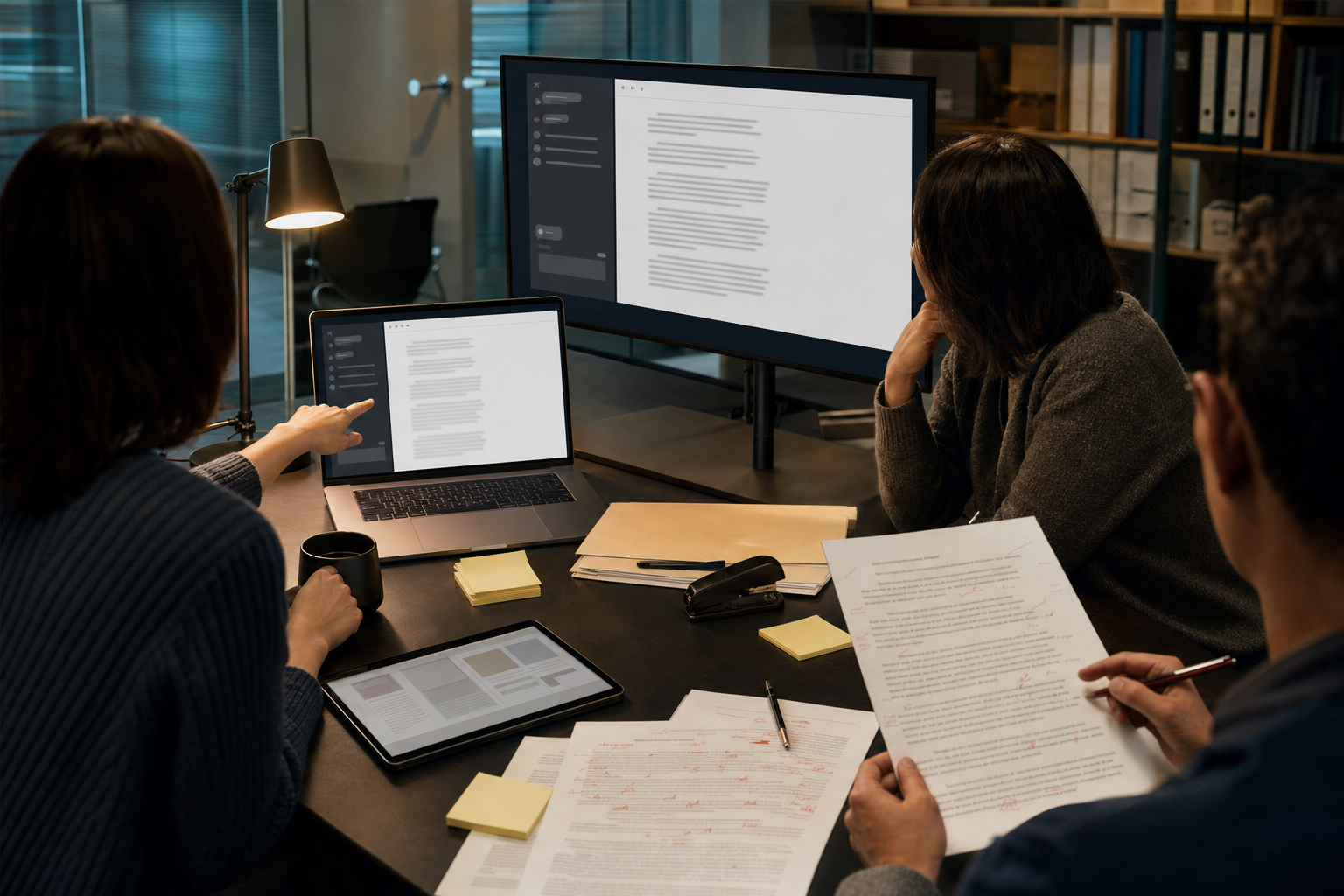
Recent discussion about large language models, including anxiety from software workers on forums like Hacker News, has pushed a simple fear into public view: if a system can write code, reports, emails, lesson plans, or marketing copy in seconds, what is left for people to do? That question is now spreading well beyond programming. Teachers, editors, translators, designers, and community workers are hearing the same message from product demos and workplace plans: production is getting cheaper.
This matters because employers may mistake faster output for a smaller profession. That is the real debate. Are AI tools replacing expertise, or are they mostly automating the most visible layer of work while leaving judgment, context, and responsibility with humans? My view is that many current arguments miss the core of the job. In a wide range of professions, the work that protects quality, trust, and fairness is the work AI does not see.
Drafting is not the job
Large language models are good at producing first drafts, summaries, options, and templates. That is not trivial. It can save time. It can reduce blank-page friction. It can help people explore ideas faster.
But in most professions, the draft is not the job. The job includes deciding what the real problem is, which details matter, what trade-offs are acceptable, and what should not be done at all. It includes checking whether a polished answer fits the situation, the audience, the risk level, and the human consequences.
That difference is easy to miss because AI works on the most visible part of knowledge work: the output. It generates text, code, images, or plans that look finished. But professional value often sits one layer deeper. It sits in framing, reviewing, refusing, prioritizing, and taking responsibility when the answer is wrong.
The question is not only whether AI can produce something usable. It is who will stand behind it when the stakes are real.
What this invisible work looks like
- Teachers can use AI to draft quizzes, worksheets, or class summaries. They still have to judge what a specific group of students is ready for, which example will confuse rather than clarify, and how to support a student who is disengaged, anxious, or falling behind.
- Editors can get headline options, summaries, or rewritten paragraphs quickly. They still decide what is accurate, what is fair, what creates legal risk, what harms trust, and what should not be published even if it attracts attention.
- Translators can use AI for rough versions and terminology help. They still have to choose register, preserve meaning across cultures, catch dangerous ambiguity, and know when a literal translation would distort the original message.
- Designers can generate layouts, concepts, and visual variations faster than before. They still have to balance accessibility, brand, user behavior, stakeholder politics, and the difference between a design that looks attractive and one that actually works.
- Community workers can use AI to summarize notes or draft routine messages. They still carry the hard part: reading a room, protecting confidentiality, sensing distrust, understanding local dynamics, and choosing language that helps rather than alienates.
None of this is decorative extra labor. It is the safety layer of the profession. It is where standards are applied, relationships are maintained, and harm is avoided.
Why organizations often miss it
Workplaces tend to reward what is easy to count. Pages written. Tickets closed. Assets delivered. Response time reduced. AI fits neatly into that logic because it produces visible output very quickly.
What is harder to count is often what matters most: the parent who trusts a teacher enough to share a problem early, the editor who prevents a costly error, the translator who avoids a legal misunderstanding, the designer who spots an accessibility barrier before launch, the community worker who keeps a fragile relationship from breaking.
When leaders confuse output with value, AI looks more complete than it is. A tool that helps create a draft starts to look like a system that can replace the professional around the draft. That is not a technical misunderstanding. It is a management mistake.
In many jobs, the visible product is only the surface. The real work is deciding whether the product is right for this person, this moment, and this consequence.
Judgment is not a luxury feature
There is a common habit in AI debates: treat judgment, context, and care as soft qualities that matter only at the margins. That is wrong. In many professions, they are the main source of value.
A teacher is not just a lesson generator. An editor is not just a sentence improver. A translator is not just a language converter. A designer is not just a visual producer. A community worker is not just an information processor.
These roles involve selective attention. What should be emphasized? What should be omitted? Which rule applies here, and which exception matters more? What risk is acceptable? What tone builds trust? What detail changes the meaning of the whole task?
AI systems can assist with those decisions indirectly by surfacing options or patterns. But the responsibility for the final call does not disappear. In regulated, sensitive, or trust-based work, that responsibility is often the profession.
The counterpoint is real
It would be comforting, and false, to say that judgment and care will protect everyone. Some work will shrink. Routine production tasks are already being compressed. Some clients and employers will accept lower quality if it is cheaper and faster. Some roles were built around standard outputs, and those outputs are becoming easier to automate.
There is another serious issue: entry-level work. Many professions train people through smaller, lower-stakes tasks. Junior editing, early teaching support, basic design production, first-pass research, routine translation, administrative community work. If organizations automate those layers without redesigning training, they may weaken their future talent pipeline.
That matters because judgment does not appear fully formed. It develops through supervised practice, feedback, and exposure to mistakes. If AI takes away the work where people learn to notice nuance, the long-term result may be fewer experienced professionals, not just fewer junior tasks.
So the impact of AI is still uncertain. The tools are improving. The labor effects will depend less on the model alone and more on how institutions choose to use it, what quality they are willing to sacrifice, and whether they preserve human accountability.
What smarter AI adoption looks like
If organizations want the benefits of AI without hollowing out their own standards, they need a better approach than simple headcount logic.
- Use AI to reduce repetitive drafting and administrative burden, especially where it gives professionals more time for review, support, and decision-making.
- Keep human review where consequences are real, especially in education, health, law, public communication, hiring, and community-facing work.
- Measure outcomes, not just speed. A faster answer is not better if it causes confusion, unfairness, reputational damage, or loss of trust.
- Protect training pathways so junior workers still learn the craft instead of being locked out by automation at the bottom.
- Make hidden work visible by naming the judgment calls, risk checks, and relationship labor that go into a good result.
For workers, the lesson is also practical. Do not define your value only by how much raw output you can produce. Explain your reasoning. Show how you adapt to context. Point to the errors you catch, the risks you reduce, the relationships you maintain, and the choices you make that a generic draft cannot make on its own.
In an AI-assisted workplace, hidden work has to be named if it is going to be valued.
The right question
The promise of AI is real. It can remove drudgery, speed up rough work, and help more people get started. The risk is real too. Used badly, it can turn serious professions into output factories, erode training, and hide responsibility behind fluent text and quick results.
The right question is not whether AI can produce a draft. It is whether an institution still understands the full job around that draft. Where work depends on judgment, context, and care, the human role is not an old leftover waiting to be automated away. It is the part that makes the work accountable.
If we forget that, we will make jobs cheaper and services worse. If we remember it, AI can be useful without becoming an excuse to stop seeing the people who carry the real responsibility.