Small Models, Big Human Questions: Why Smaller AI Could Matter More for Arabic Learners and Local Communities
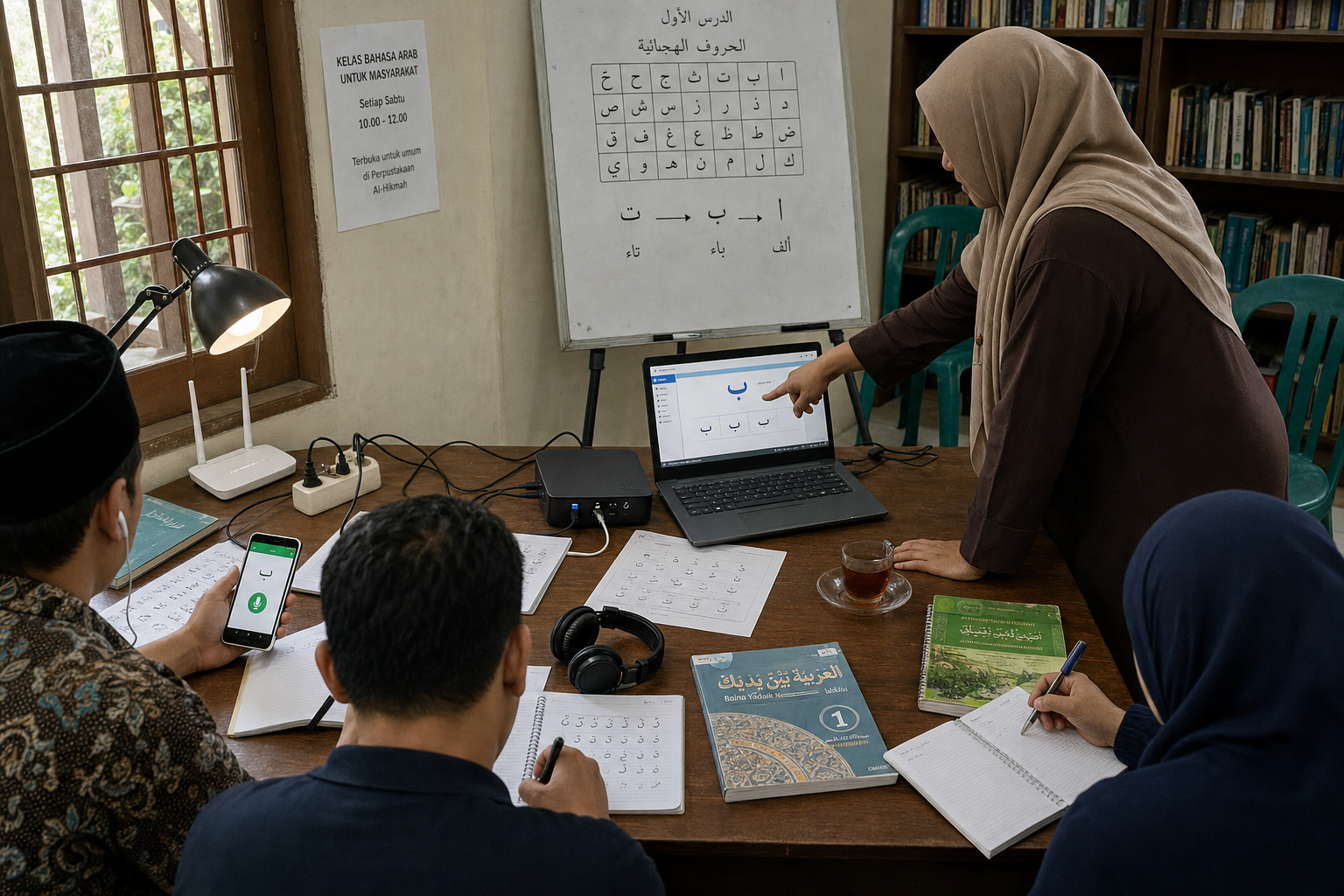
The AI conversation is starting to shift. For the past two years, most attention went to giant cloud models built by a few large companies. Now smaller language models are getting serious interest because they can be cheaper, faster, and light enough to run on local servers, laptops, and sometimes even phones. That matters because it changes a basic question: who can actually use AI in daily life, and on what terms?
My view is simple. For many Arabic learners, schools, community groups, and local institutions, smaller models may matter more than the most advanced systems. Not because they are better at everything. Often they are not. But because a tool that is affordable, private, adaptable, and available with weak internet can be more useful than a stronger tool that is expensive, remote, and hard to control. The real debate is no longer just about raw performance. It is about access, language fit, and power.
The important change is practical, not symbolic
Smaller models reduce some of the biggest barriers to AI use. They usually need less computing power. They can respond faster for simple tasks. They may cost less to deploy over time. And they can be run closer to the user, instead of sending every request to a distant cloud service.
That sounds technical, but the human impact is straightforward. A public school with a limited budget does not care mainly about benchmark rankings. It cares whether the system works on ordinary hardware, whether student data leaves the school, and whether teachers can use it without waiting for an unstable connection. A community organization helping migrants or low-income families has similar concerns. Reliability, cost, and privacy are not side issues. They are the whole issue.
This is why smaller models deserve more attention than they often get in mainstream AI coverage. The biggest systems still dominate headlines. But a modest model that can be deployed in a school, library, municipality, or local newsroom may have wider social value than a more powerful system that only wealthy institutions can afford to use regularly.
Why this matters especially for Arabic
Arabic is not one simple market. It is a language with many forms, registers, and local realities. Modern Standard Arabic matters in education, media, and official documents. But daily life often moves through dialects, mixed language, and code-switching with English or French. In some places, local users move between all three in the same conversation.
That creates a real problem for AI systems. A model may look strong in “Arabic” on paper and still perform poorly when the task involves regional vocabulary, local institutional language, or student writing that mixes formal and informal usage. This is one reason local adaptation matters so much.
Here, smaller models offer a serious advantage. They are often easier to fine-tune or adapt for narrow tasks. A school could tune a model on its own curriculum and past exam formats. A municipality could build a local question-answering system around public service documents. A community center could create a reading support tool based on trusted educational material instead of the open internet.
That does not guarantee quality. But it does create a path to relevance. For many users, a smaller model trained on the right local material may be more helpful than a larger general model trained mostly for everyone and therefore perfectly fitted to no one.
Control matters as much as intelligence
There is another reason smaller models matter: they can give institutions more control over data and workflow. That is especially important in education and community services, where the information involved may be sensitive.
If a school uses an external AI service, student prompts, drafts, and questions may pass through systems the school does not fully control. If a legal aid group or mental health nonprofit uses AI to organize notes or translate intake forms, the privacy stakes are even higher. Local deployment does not solve every security problem, but it can reduce exposure.
Control also matters for language quality. If a local institution owns the process, it can test outputs against local needs. It can build a glossary. It can correct recurring mistakes. It can limit the tool to approved documents. That is much harder when the system is a black box delivered from elsewhere, updated on someone else’s schedule, and priced on someone else’s terms.
In that sense, smaller models are not just a technical trend. They are part of a broader question about digital dependence. Do Arabic-speaking communities only consume AI made for them by others, or can they shape useful systems themselves?
The case for bigger models is still strong
A fair editorial has to admit the limits. Smaller models are not magic. In many tasks, the largest models still perform better. They often have stronger reasoning, broader world knowledge, better multilingual coverage, and more polished outputs. For complex research, advanced coding, high-stakes translation, or difficult edge cases, bigger systems may be the better choice.
This point matters for Arabic too. Some smaller models still struggle with dialect variation, spelling inconsistency, and low-resource domains. A local school or nonprofit may not have the technical staff to evaluate and maintain a model responsibly. Fine-tuning can improve relevance, but it can also introduce new errors if the data is narrow or low quality.
There is also a real risk of lowering standards. If “small and local” becomes a slogan, institutions may adopt weak tools simply because they are cheap. That would be a mistake. Communities with fewer resources should not be treated as testing grounds for second-rate systems.
So the goal should not be to replace every large model with a smaller one. The goal is to match the tool to the task, and to stop assuming that the most impressive demo automatically serves the public best.
Where smaller models could make a real difference
The strongest case for smaller models is in narrow, repeated, local tasks. That is where cost, privacy, and customisation matter most.
- Classroom support: reading practice, vocabulary help, quiz generation, and explanation of school material in simpler Arabic.
- Local document assistance: summarising school notices, municipal forms, health information, and service instructions.
- Community help desks: question-answering systems built only on verified local information.
- Teacher and staff productivity: drafting routine messages, sorting feedback, or organising internal material without exposing sensitive data externally.
- Low-connectivity settings: places where cloud access is unreliable, expensive, or politically sensitive.
Notice what these examples have in common. They are not trying to build a universal machine that can do everything. They focus on specific jobs where accuracy can be checked, the source material is known, and the user can remain in control.
What institutions should ask before adoption
The better test is not “Is this model small or large?” It is “Is this model useful, safe, and realistic for our setting?” Before any rollout, schools and community groups should ask basic questions:
- Does it work well in the kind of Arabic our users actually write and speak?
- Can it run within our budget, hardware, and internet limits?
- Where does the data go, and who can access it?
- Can we restrict it to trusted material for sensitive tasks?
- Who checks the answers when it makes mistakes?
- Will this save staff time, or just create a new layer of supervision?
These are not glamorous questions, but they are the ones that decide whether a system helps real people or just adds noise.
The bigger question behind the smaller model
What makes this moment important is not just that smaller models exist. It is that they challenge a habit in AI policy and media coverage: the habit of measuring progress only by the most powerful model in the room.
For Arabic learners and local communities, that habit misses the point. A school in a low-resource setting does not need a model that can win arguments on the internet. It needs one that can support reading, respect privacy, and run next week without a large monthly bill. A community organization does not need artificial generality. It needs dependable help on narrow tasks in the language people really use.
That is why smaller AI could matter more than it first appears. It brings the debate back to people, institutions, and local conditions. The most important model is not always the largest one. Sometimes it is the one that fits inside a classroom, a community office, or a public budget, and still does the job well enough to be worth trusting.