The Real Risks of AI: What to Worry About, and What Not To
AI risk is now a public argument, not a niche one. In a short time, AI tools moved from research labs into search engines, offices, classrooms, hospitals, call centers, and police departments. Companies are shipping products fast. Governments are trying to catch up. The result is a confused debate: some people warn about human extinction, while others talk as if AI is just another software upgrade.
What matters is not whether AI is “good” or “bad.” It is both useful and risky, often at the same time. The real tension is this: should we focus on dramatic future scenarios, or on the harms already showing up in everyday systems? My view is simple. The biggest AI dangers today are not killer robots or conscious machines. They are misinformation, fraud, bad automated decisions, labor disruption, privacy loss, and the growing power of a few firms and states. Longer-term catastrophic risks should not be ignored, but they should not distract from the damage already being done.
The first mistake: treating all AI risks as one thing
“AI risk” sounds like a single category, but it is not. It includes many different problems with different timelines.
- Current risks: false information, deepfakes, biased systems, unreliable outputs, workplace monitoring, privacy violations, and unsafe use in high-stakes settings.
- Near-term risks: large job shifts, cheaper cybercrime, stronger surveillance, and market concentration.
- Long-term risks: advanced systems being used in warfare, biological misuse, or other severe harms that are still debated and uncertain.
When these categories get mixed together, the public conversation gets worse. A company can point to a distant hypothetical threat to avoid discussing a real failure today. Critics can do the reverse and dismiss all long-term concerns as fantasy. Neither approach is serious.
What we should worry about now
The most immediate AI problem is not intelligence in the abstract. It is deployment without enough safeguards.
Take reliability. Generative AI systems can produce fluent answers that are wrong. In a low-stakes setting, that may be annoying. In medicine, law, hiring, or public services, it can do real damage. A chatbot that invents a court case is embarrassing. A system that gives a patient unsafe advice is much worse.
This matters because people trust polished language. Many users do not know when a system is guessing, summarizing badly, or making things up. And many organizations still use AI outputs as if they were evidence instead of drafts.
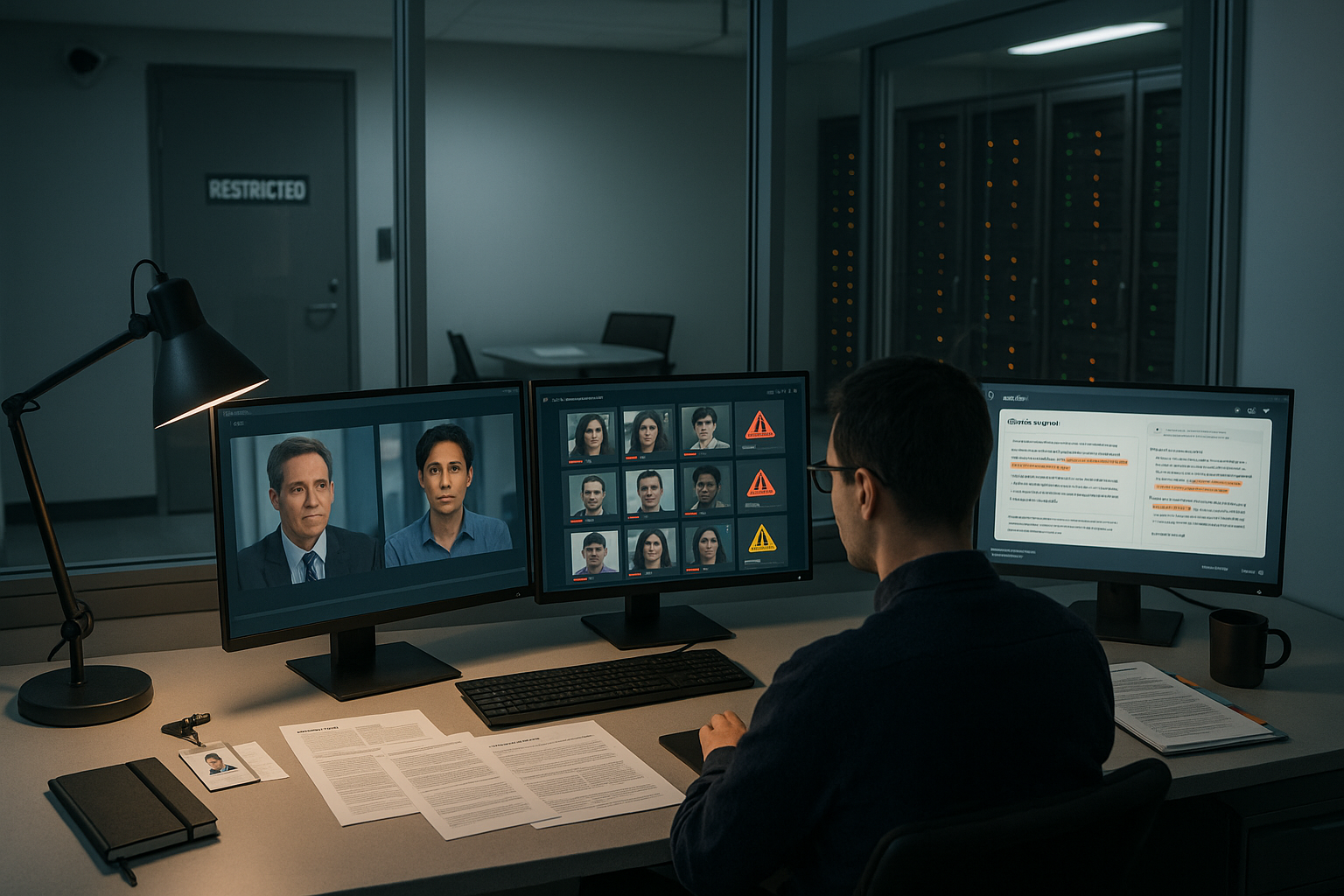
The second major risk is manipulation at scale. AI makes it cheaper to create fake images, cloned voices, fake reviews, spam campaigns, and persuasive scam messages. A parent who hears a child’s cloned voice asking for money may not stop to verify. A voter who sees realistic fake footage may not learn it was false until later. The danger is not only that people believe lies. It is also that people stop trusting real evidence.
The third risk is bad automation in systems that already hold power over people. Hiring tools can screen out qualified applicants. Predictive policing systems can repeat past bias. School monitoring tools can over-flag students. Insurance or welfare systems can make errors hard to challenge. In these cases, AI does not create unfairness from nothing. But it can hide unfairness behind a technical process and make it harder to contest.
Then there is labor. AI will not erase all work, but it is likely to change a lot of it. Some jobs will be cut. Many more will be reshaped. Entry-level office work, customer support, translation, basic design, and routine coding are all under pressure. That does not mean every worker will be replaced. It does mean employers may ask fewer people to do more, faster, with AI tools filling the gaps.
That shift has social consequences. If companies use AI mainly to reduce headcount and increase output, the gains may flow upward while workers absorb the instability. A technology can be productive and still be socially damaging if the transition is handled badly.
The risk behind many other risks: concentration of power
One AI danger gets less attention than it should: power is concentrating in too few hands. Training and deploying advanced models requires large amounts of data, compute, talent, and capital. That gives a small number of firms unusual influence over infrastructure, public information, business tools, and research agendas.
This is not only a market issue. It is a civic one. If a few companies control the systems that summarize information, filter content, generate software, and mediate digital work, they gain quiet power over what people see and how institutions operate. If states use the same tools for surveillance, censorship, or automated enforcement, the democratic risk grows.
In other words, AI risk is not just about what the systems can do. It is also about who gets to decide how they are used, who profits, and who carries the downside.
What people often worry about too much
There is a reason extreme AI scenarios get attention: they are dramatic, they raise real questions, and some respected researchers take them seriously. It would be foolish to say advanced AI could never become a severe long-term danger. No one knows that.
But public debate often jumps too quickly to the most cinematic version of the problem. Machines do not need intentions, feelings, or a desire for control to cause harm. Most AI failures come from ordinary things: poor data, weak oversight, careless deployment, commercial pressure, and humans trusting systems beyond their limits.
That is why talk of “sentient AI” is usually a distraction. Today’s systems generate patterns from data. They can be impressive, useful, and at times unpredictable, but that is not the same as understanding, judgment, or moral agency. Treating software as if it has motives can blur responsibility. The people and institutions deploying it remain responsible.
Another overstated fear is that AI will make human skill worthless across the board. It will reduce demand for some tasks. It will also create demand for new ones and increase the value of roles that require judgment, trust, accountability, field experience, and human interaction. History does not guarantee a happy outcome, but it does suggest that “everything disappears” is too simple.
Why the benefits still matter
A balanced view has to include AI benefits, because they are real. AI can help doctors summarize records, help scientists analyze large datasets, help people write and translate, help programmers find errors, and help small businesses do work they could not otherwise afford.
For many users, the benefit is not brilliance. It is speed. Drafting, searching, sorting, tagging, transcribing, and explaining can be done faster. That can free up time for higher-value work. In education, AI can offer extra practice and language support. In accessibility, it can improve transcription, captioning, and text assistance. In medicine and science, it may help find patterns that humans would miss.
These gains are worth protecting. The answer to AI risk is not panic or blanket rejection. It is better governance, better product design, better incentives, and clearer limits.
The strongest counterpoint
The strongest argument against focusing mainly on present harms is that frontier AI could create extreme risks before society is ready. Some experts worry that more capable models could meaningfully assist cyberattacks, biological research misuse, military targeting, or dangerous forms of autonomous decision-making. Those concerns are not imaginary, and some of them are hard to test in public.
That is exactly why they should be studied seriously. Safety research, access controls, model evaluations, and international coordination all matter. But “seriously” does not mean “exclusively.” It should not take a speculative future disaster to justify basic protections against harms we can already see.
What better AI policy looks like
If the goal is to reduce dangerous AI while keeping useful AI benefits, the policy agenda is not mysterious.
- Set rules for high-stakes uses. Systems used in healthcare, hiring, education, policing, finance, and welfare need stricter testing, documentation, and human accountability.
- Demand transparency where it counts. People should know when AI is being used to make or shape important decisions.
- Limit deepfake abuse and fraud. Authentication tools, platform enforcement, and legal penalties should target impersonation and deceptive synthetic media.
- Protect workers during transition. That means retraining, fair consultation, and measuring productivity gains against job quality, not just payroll savings.
- Strengthen privacy rules. Data collection and model training cannot remain a legal gray zone forever.
- Keep competition alive. AI should not become an excuse for permanent dominance by a handful of firms.
None of this requires treating AI as magic. It requires treating it as powerful infrastructure with uneven benefits and uneven harms.
The right level of concern
The real risks of AI are serious enough without exaggeration. We should worry less about science-fiction stories and more about systems that are already shaping jobs, trust, access, and power. We should be open to the technology’s benefits without accepting the idea that speed is more important than safety.
The practical test is simple. Ask three questions every time AI is introduced into an important setting: Who benefits? Who bears the risk? Who is accountable when it fails? If those questions do not have clear answers, the problem is not that the future is coming too fast. It is that the present is being managed badly.