Open-Weights AI Is Becoming the Default Debate: What It Means for Arabic Learners and Local Creators
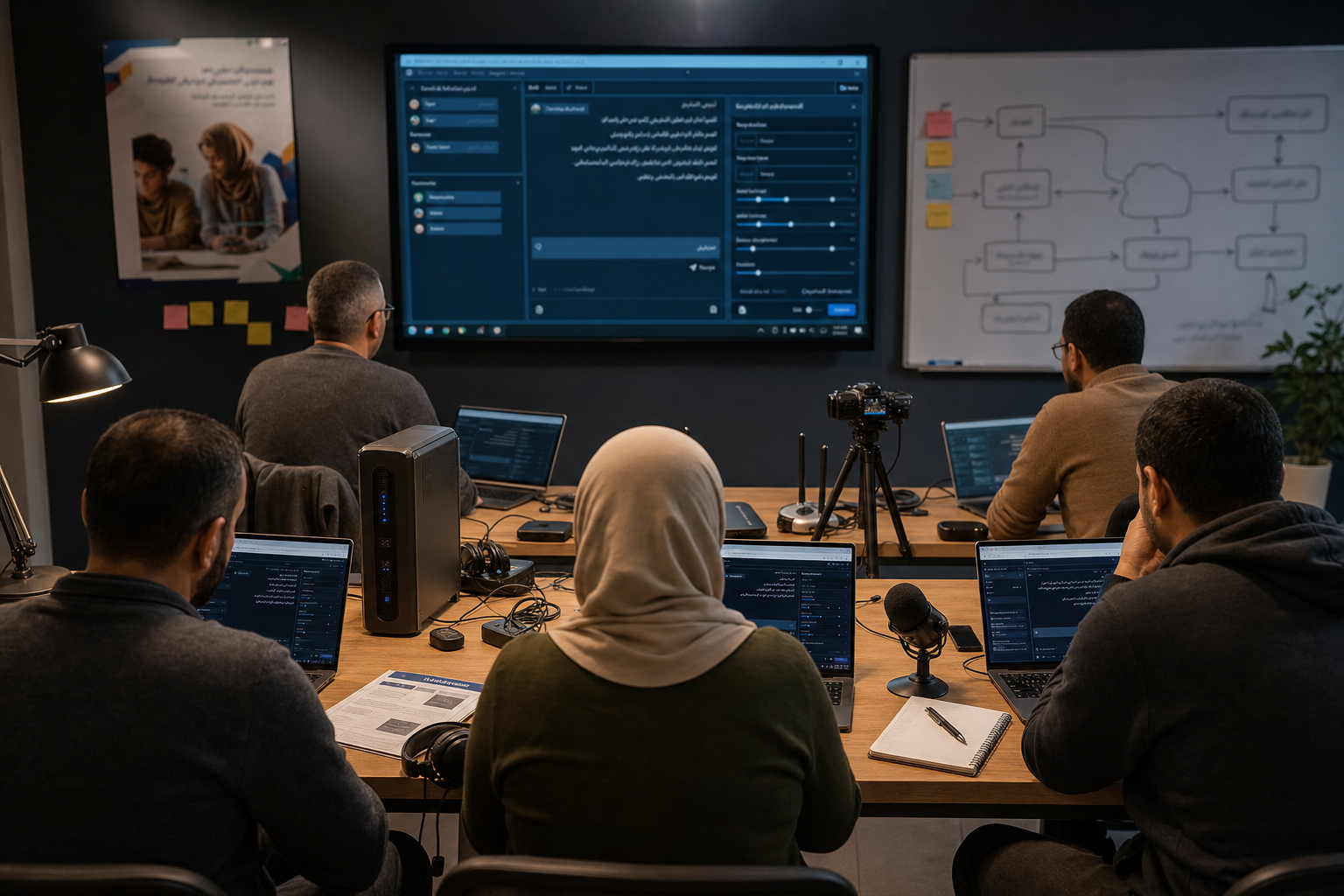
Open-weight AI has moved from a technical niche to a central argument in the industry. Recent model releases and the reaction around them have shifted attention from a simple question, who has the strongest model?, to a harder one: who gets to use, adapt, and improve AI locally? That matters for Arabic-speaking markets because language support is not just about Modern Standard Arabic. It includes dialects, school contexts, cultural references, privacy needs, and tight budgets. The tension is clear: wider access can produce better local tools, but it can also spread weak systems, legal uncertainty, and safety problems.
This is still a live debate, and some of the loudest claims are exactly that: claims. Commentators now argue that open-weight strategies, including several recent releases and the broader approach taken by some Chinese companies, are starting to reshape the market. That may prove true in some segments, but it is not settled. What is already clear is the local question. If model weights are available, Arabic educators, developers, publishers, and small organizations have more room to adapt AI to their own needs. If they are not, they remain dependent on a few outside providers to decide what Arabic quality, pricing, and access should look like.
What open weights actually change
In simple terms, model weights are the learned parameters that make an AI system useful. When those weights are released, outside teams can often run the model on their own hardware, fine-tune it for a specific task, or inspect its behavior more closely.
That is important, but it is not the same as full openness. An open-weight model may still come with license limits. Its training data may remain undisclosed. Its setup may still require costly hardware and engineering skill. So the right way to think about open weights is not as a moral label, but as a practical shift in who can build on top of a model.
Why Arabic users have a strong case for local adaptation
Arabic is one of the clearest examples of why local adaptation matters. The distance between formal written Arabic and everyday speech is wide. A model that performs well in Modern Standard Arabic can still struggle when a student writes in Egyptian Arabic, a customer asks a question in Moroccan Darija, or a creator uses Gulf dialect in a transcript.
Global models often improve Arabic support over time, but their priorities are usually broad and commercial. They target the largest markets and the most common use cases. That can leave Arabic users with tools that look impressive in a demo but fail in ordinary local tasks.
For learners, this shows up quickly. A study assistant may explain a science concept clearly in formal Arabic, then stumble when a student phrases the same question in a regional dialect. A writing tool may correct grammar well but miss the tone expected in a local classroom. A reading assistant may summarize a text accurately yet ignore the curriculum behind it.
For creators, the same problem appears in different forms. A small media team may need better transcription for regional speech. A publisher may want search and summarization across Arabic archives. A nonprofit may need a support bot that understands local terminology. A small business may want internal document search without sending sensitive files to a foreign API. Open weights do not solve these problems by themselves, but they make it far easier to try.
The promise is real, but so are the limits
The promise of open-weight AI for Arabic users is straightforward. It can lower dependency on a small number of global platforms. It can make privacy-sensitive use cases more realistic. It can support models tuned for local dialects, local exams, local legal language, or local media archives. It can also help universities and startups build expertise instead of only buying access.
But openness is not automatically inclusion. A downloadable model still needs compute, storage, technical talent, and maintenance. Many schools, small companies, and cultural institutions do not have those resources. In practice, this means open weights can expand opportunity while still leaving weaker organizations behind.
There is also a quality issue. Many open-weight models remain weaker than the top closed systems in reliability, tool use, and reasoning. Fine-tuning can improve local performance, but it can also make a model worse if the process is rushed or the data is poor. In education, that matters a great deal. A confident but inaccurate Arabic tutor is not progress.
The risks are not theoretical
It is easy to talk about openness as if it only benefits researchers and builders. That is too simple. Easier model access can also lower the cost of spam, propaganda, abusive automation, and low-quality synthetic content. It can make it easier for bad actors to generate convincing text in local dialects that is harder for moderators to track.
There are quieter risks too. Small organizations may deploy models without proper testing, security review, or human oversight. They may assume that because a model is available to download, the legal status of its training data is settled. Often it is not. They may underestimate how much work is needed to monitor output quality over time.
For Arabic contexts, evaluation is an especially weak point. Many benchmark sets do not reflect dialect variation, classroom language, religious sensitivity, or the difference between formal and informal communication. Without better testing, local teams may mistake partial fluency for real usefulness.
The fair case for closed models
Supporters of closed models are not wrong about everything. Centralized services are often easier to use, better documented, and faster to deploy. A small school or newsroom may not need the burden of managing its own models. In some cases, a paid API with strong Arabic performance, clear support, and predictable security may be the better choice.
Closed systems can also reduce some operational risks. The vendor handles updates, scaling, and parts of safety management. For busy organizations, that convenience is valuable.
That is why the best local strategy is not ideological. It is mixed. Use closed services when they clearly offer better quality or lower operational risk. Use open-weight models when privacy, local adaptation, cost control, or long-term independence matter enough to justify the effort.
What responsible adoption should look like
If Arabic institutions want the benefits of open-weight AI without repeating old mistakes, they need a more disciplined approach.
- Start with a real problem. Better Arabic search in a digital library is a stronger goal than simply saying, “we need our own model.”
- Test with actual users. A model should be evaluated with teachers, students, editors, or customer service teams, not only with benchmark scores.
- Check dialect performance early. Formal Arabic results are not enough if the tool will be used in everyday speech.
- Review licensing and data rights. Open-weight access does not remove legal responsibility.
- Keep humans in the loop. Education, public information, health, and legal use all need review mechanisms.
- Budget for maintenance. A local model is not a one-time download. It needs monitoring, updates, and support.
What the region should build next
The biggest opportunity is not one model release. It is the ecosystem around it. Arabic-speaking markets need stronger evaluation sets, better dialect data collected with consent, more shared compute for researchers, and more local service providers that can help small organizations deploy models safely.
Universities, ministries, publishers, and startups all have a role here. A university can help build benchmarks. A ministry can support public-interest datasets and procurement standards. A publisher can open structured archives for language tools. A startup can turn a raw model into a reliable product. That work is less glamorous than internet debates about which camp is winning, but it matters far more.
Open-weight AI matters for Arabic learners and local creators because it can shift them from passive users to active adapters. That is a serious opportunity. It is also a serious responsibility. The sensible position is simple: support open weights where they expand local capability, demand safeguards where they increase risk, and judge every model by whether it genuinely helps people work, learn, and create in Arabic.