Open Models, Local Voices: Why the Mistral Moment Matters for Arabic Educators and Creators
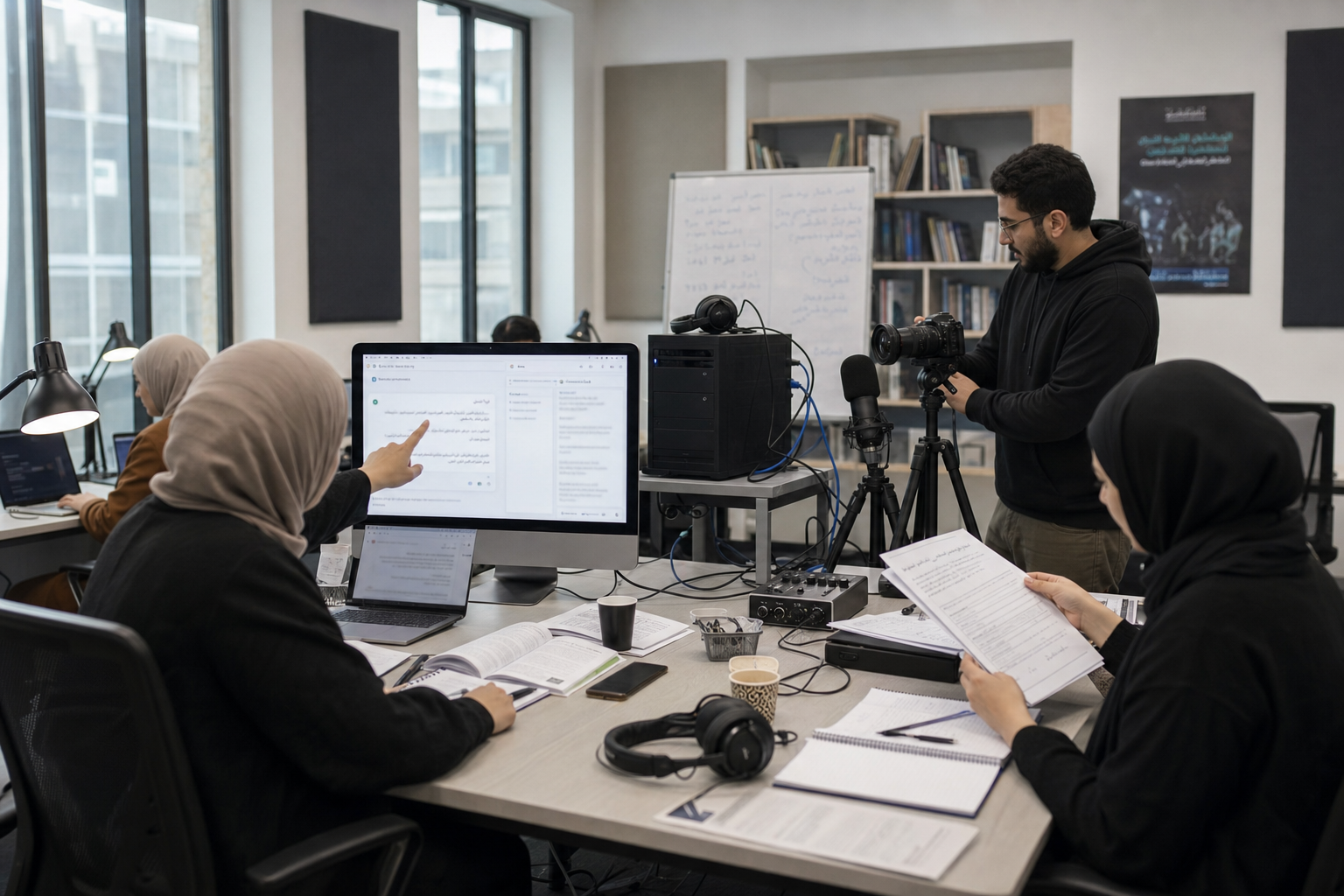
Based on summit notes and limited reporting around Mistral’s recent public conversation, the main signal is not just that another model company wants attention. It is that the AI race is still open to approaches built around smaller, more deployable, and sometimes open-weight models rather than only giant closed systems. That matters because model access shapes who gets to experiment, teach, translate, and build in their own language.
For Arabic educators and creators, this is more than a technical story. It is a question of control. The debate is straightforward: can more accessible models give schools, publishers, studios, and independent creators real local usefulness without sacrificing too much quality, safety, or convenience? My view is yes, with an important warning: open access is not a solution by itself, but it is a necessary condition if Arabic users want more than borrowed tools built for English first.
The real issue is not benchmarks. It is who gets to adapt AI.
Most AI coverage still treats model releases like a sports league. One system is “ahead.” Another “catches up.” A third wins on price. That framing misses the point for much of the Arabic-speaking world.
An educator in Cairo or Muscat does not mainly need a model that beats another model by a few points on a leaderboard. They need a system that can work with local curricula, local privacy needs, and local budgets. A creator in Beirut or Casablanca does not need another abstract promise about the future of AI. They need tools that can help with subtitling, drafting, tagging archives, or bilingual publishing without forcing every workflow through an expensive foreign platform.
This is where the Mistral conversation matters. When a model is lighter to run, easier to deploy, or open enough to inspect and adapt, more people can try practical use cases. They can test it on Arabic teaching materials. They can connect it to a school knowledge base. They can see whether it handles Modern Standard Arabic, and where it fails on dialects. That is how real language infrastructure gets built.
Why Arabic education has more at stake than many model announcements admit
Arabic education faces a familiar problem in digital tools: support often arrives late, feels partial, and is designed around English assumptions. That shows up in user interfaces, search quality, translation quality, and content moderation. It also shows up in pedagogy.
A school assistant built for English may do a decent job summarizing a science chapter. But can it explain the same topic in clear Arabic for different age levels? Can it switch between formal classroom Arabic and simpler language for younger students? Can it handle a teacher’s worksheet, a ministry PDF, and a local exam format without breaking the layout or losing meaning?
Closed commercial tools can sometimes do this well. But they usually offer limited visibility into how they were tuned, what data they work best on, and how institutions can adapt them. They also raise obvious concerns around cost and data handling. A university may not want student records, internal lectures, or copyrighted course material flowing into an external API.
More accessible models create another option. A university in Amman could test an on-premise assistant for course support. A vocational institute in Rabat could build bilingual training materials in Arabic and French. A nonprofit working on literacy could adapt a model for short reading passages and teacher prompts instead of waiting for a global vendor to care about that niche.
None of this means Mistral, or any similar company, has solved Arabic education. It means the door is more open for others to do the solving.
Creators need flexibility, not just a chatbot
The same logic applies to creative work. Arabic creators often work across formats and language varieties at the same time. A podcaster may need transcripts, summaries, social clips, titles, and translation. A publisher may need metadata, archive search, and content classification. A small video studio may need draft captions in Modern Standard Arabic, then manual edits for Egyptian, Levantine, or Gulf phrasing.
General-purpose AI tools can help, but they often flatten style. They also tend to perform best when the input looks like the data they already know well: standard web English, common software workflows, and mainstream media formats. Arabic creators regularly operate outside that center.
Open or more deployable models make experimentation cheaper. A magazine can build an internal search assistant across years of Arabic articles. A documentary team can process interview transcripts without sending sensitive raw material to a third-party service. A children’s publisher can test whether a model can simplify prose for different reading levels, then keep only the pieces that human editors approve.
The key word here is test. Accessible models lower the cost of trying these workflows. That may sound modest, but it is a big shift. Many important creative tools do not begin as polished products. They begin as small internal experiments.
Open is useful, but the word can hide real limits
There is also a reason to be careful. “Open” has become a loose marketing term. Not every model described as open is fully open-source in the strict sense. Some are open-weight but carry usage limits. Some are cheap to access but not easy to modify. Some are technically available but still difficult for a school or small company to run.
Licensing matters. Hardware requirements matter. Documentation matters. Arabic evaluation matters. If a model is open in theory but comes with unclear terms, weak Arabic support, and little implementation guidance, then most educators and creators still cannot use it well.
This is especially important in Arabic because the language problem is not one problem. It is many. Modern Standard Arabic is not the same as Moroccan Darija, Egyptian Arabic, or Gulf speech. Classical texts, school textbooks, legal Arabic, news Arabic, and social media Arabic all behave differently. A model that looks strong on a generic multilingual benchmark may still be unreliable in the exact setting where a teacher or editor needs it.
So the right response is not cheerleading. It is scrutiny. If the Mistral moment matters, it matters because it makes adaptation possible, not because any single release deserves automatic trust.
The strongest counterargument is also the most practical one
The case for closed systems is not hard to understand. Many proprietary models are still better out of the box. They come with polished interfaces, enterprise support, safety layers, and predictable uptime. Most schools do not want to manage infrastructure. Most creators do not want to fine-tune models. They want something that works tomorrow.
That is a fair point. In many real settings, the fastest path will still be a commercial platform.
But that is not a reason to dismiss accessible models. It is a reason to avoid false choices. Arabic institutions need a mixed ecosystem. They need some premium tools for convenience and some adaptable tools for independence. If every useful system is closed, then local users remain price takers and policy takers. They cannot inspect how the tool behaves. They cannot adapt it to local norms. They cannot build lasting capability around it.
Even when open models are not the final product, they create leverage. They give universities, startups, ministries, and cultural organizations a fallback option. That alone can improve the market.
What would make this moment count for Arabic users
If companies like Mistral want this conversation to matter outside AI circles, the next step is not another abstract promise about efficiency. It is practical support for real language communities.
- Better Arabic evaluation: not just standard benchmarks, but tests across dialects, classroom tasks, translation quality, and factual reliability.
- Clear licensing: educators and publishers need to know what they can legally build.
- Lower-friction deployment: tools should be usable by institutions without large engineering teams.
- Local partnerships: universities, edtech firms, publishers, and archives should be able to shape adaptation work.
- Human review by design: Arabic educational and creative workflows need editing, verification, and cultural judgment, not blind automation.
If those pieces do not appear, then “access” will remain mostly symbolic. If they do appear, then the effect could be significant, especially in sectors that have long been underserved by mainstream AI products.
The larger point
The promise of open and accessible models is not that they will replace every closed system or suddenly fix Arabic AI. The promise is simpler and more important: they widen the circle of people who can build.
That is why the Mistral moment matters. It suggests that the future of AI may not be decided only by the companies with the biggest clouds and the most expensive APIs. It may also be shaped by who can adapt models to local language, local classrooms, local media, and local budgets.
For Arabic educators and creators, that is the real opportunity. Not to wait for better support from somewhere else, but to gain tools that can finally be tested, challenged, improved, and made useful closer to home.