Before the Ban: What Norway’s Elementary School AI Move Teaches Parents and Teachers
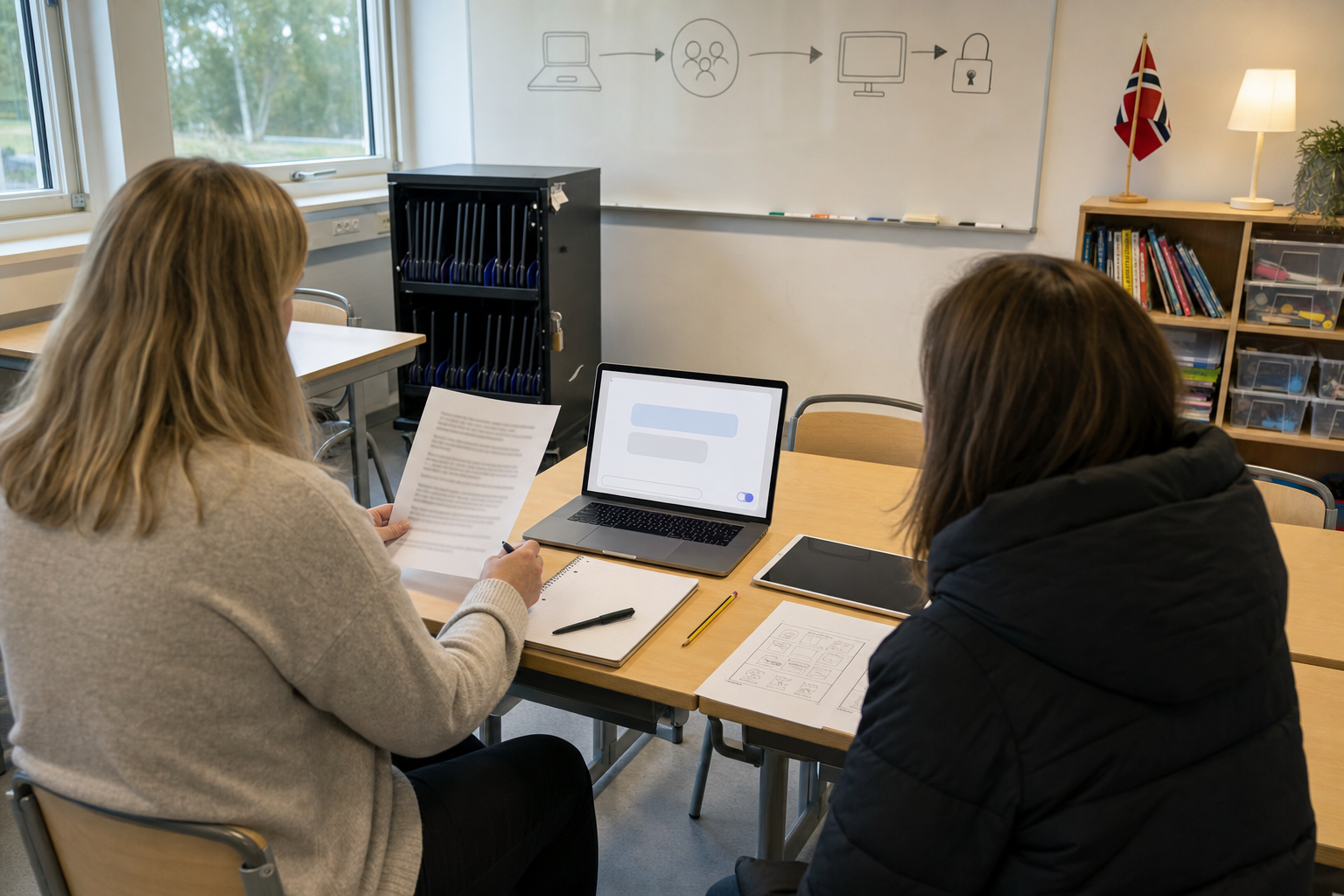
Recent reporting has described Norway as moving toward a near ban, or at least very tight restrictions, on AI use in elementary schools. The exact scope may still depend on how the rules are written and applied. But the message is clear enough: policymakers are starting to treat young children as a special case, not as early users of every new classroom tool.
That matters far beyond Norway. For the past two years, many schools have rushed from curiosity to adoption without settling basic questions about age, privacy, learning, and dependency. The real debate is not whether AI has value. It is whether children in the earliest years of school should be using general-purpose AI systems at all. My view is simple: strong caution is justified, and elementary schools should limit student-facing AI much more than they currently do.
Why elementary school is different
Elementary school is where children build the habits that later learning depends on. They are learning to read with focus, write with effort, solve problems step by step, and sit with confusion long enough to improve. Those are not small skills. They are the base layer.
General-purpose AI tools can interfere with that process, even when they seem helpful. A chatbot can suggest a sentence, rewrite a paragraph, answer a question, or generate ideas instantly. For an older student with a solid foundation, that may sometimes be useful. For a child who is still building the foundation, it can remove the very struggle that teaches the skill.
That is the first lesson from Norway’s reported move: in early education, speed is not always progress. A tool that makes tasks easier can also make learning thinner.
Attention is part of the curriculum
Parents and teachers often think about AI as a knowledge tool. But in elementary school, attention may be the bigger issue. Young children are still learning how to listen, persist, and finish a task without constant stimulation or instant rescue.
If every moment of difficulty can be solved by a prompt, children may learn the wrong lesson about thinking. They may start to expect immediate assistance instead of building internal patience. That is not a moral failure. It is a design problem. Many AI products are built to reduce friction. Good early education sometimes needs friction.
A child writing a short story, for example, is not only producing text. The child is learning how to choose a topic, remember sequence, shape a sentence, and revise weak parts. If an AI system supplies the opening, fixes the grammar, and suggests the ending, the page may look better. The learning may be worse.
Privacy is not a side issue
The second reason for caution is data. Children’s data deserves a higher level of protection than adult data. That should not be controversial.
Many AI systems collect prompts, usage patterns, and sometimes voice or behavioral information. Even when a school avoids obvious personal details, educational data can still reveal a great deal: reading level, language weaknesses, emotional patterns, and special learning needs. That is sensitive information.
Schools are rarely in a strong position when dealing with large technology vendors. They may not fully know where the data goes, how long it is stored, whether it is used to improve models, or what happens when systems change. In many countries, including parts of the Arab world, procurement rules and enforcement are not yet strong enough to manage that risk well.
So when Norway reportedly draws a hard line for younger children, it is not only reacting to classroom behavior. It is also recognizing that minors should not become easy sources of data in the name of innovation.
Dependency starts quietly
One common mistake in this debate is to imagine dependency as something dramatic. Usually it is not. It starts with convenience.
A child asks the tool for one better sentence. Then for three ideas. Then for a summary. Then for help understanding the question itself. None of these steps seems serious on its own. Over time, however, the child may practice less independent recall, less planning, and less self-correction.
Adults can sometimes use AI as a scaffold because they already know what good work looks like. Many children do not. They may accept plausible but wrong answers. They may copy the tone of the tool without understanding the content. And because the output often looks polished, teachers may find it harder to see what the child actually knows.
This is one of the strongest arguments for delaying direct AI use in elementary school. The risk is not only cheating. The deeper risk is weakened ownership of learning.
The case for AI is real, but it is narrower than some schools claim
Fairness matters here. There are real benefits to some AI-related tools in education.
Teachers can use AI to draft worksheets, simplify reading passages, or prepare different versions of the same lesson for different ability levels. Translation tools can help schools communicate with families. Accessibility tools can support students with disabilities, especially when they are carefully chosen and supervised. Some speech and reading supports may be genuinely useful.
But these examples do not automatically support open-ended chatbot use by young children. Teacher-facing tools are different from student-facing tools. Accessibility software is different from a general-purpose assistant. A tightly controlled feature inside a school platform is different from a commercial system that invites free-form prompting and broad data collection.
This is where the public conversation often becomes sloppy. “AI in schools” sounds like one thing. It is not one thing.
What schools should ban, limit, and still teach
If Norway’s approach becomes a wider model, the smartest version of it would not be a blind rejection of all AI. It would be a clear ordering of priorities.
Elementary schools should strongly limit direct student use of general-purpose AI systems. That includes tools that generate answers, essays, stories, or explanations on demand. Younger children do not need these systems as routine learning companions.
At the same time, schools should still teach basic AI literacy in age-appropriate ways. Children should learn that digital systems can produce mistakes, reflect bias, and sound confident without being correct. They should learn not to share personal information with such tools. They should learn that convenience and truth are not the same thing.
In other words, children do not need everyday use in order to receive basic education about the technology around them.
What parents and teachers should ask now
For parents and school leaders, Norway’s reported move offers a useful checklist. Before accepting AI in elementary classrooms, ask a few direct questions:
- Does this tool collect child data, and where is that data stored?
- Is it helping a child practice a skill, or replacing the skill itself?
- Can a teacher easily verify and explain the output?
- Is this tool necessary, or is it being adopted mainly because it sounds modern?
- Would we still want it if the label “AI” were removed?
Those questions sound basic, but many schools still cannot answer them clearly.
The wider lesson for Arab parents and educators
For readers in Arab countries, the lesson is especially important. Many schools are under pressure to appear advanced. “AI-powered” can quickly become a marketing phrase. But a school does not become better because it adds chatbots before it fixes reading gaps, trains teachers well, or sets strong data rules.
Children need certain things first: strong literacy, number sense, attention, safe relationships with adults, and the confidence to think before outsourcing thinking. Those needs are not old-fashioned. They are what make later technology use safer and more useful.
The right question is not, “Will my child fall behind without AI in grade school?” The better question is, “What skills must my child build first so that future AI use does not weaken them?”
A sensible line
Norway’s reported near ban should not be read as panic. It should be read as a decision about sequence. In elementary school, the job is not to give children every powerful tool as early as possible. The job is to help them become capable enough to use powerful tools later without becoming dependent on them.
That is a position worth taking seriously. Protect attention. Protect data. Let teachers use carefully chosen tools where the case is strong. But do not confuse early exposure with educational progress. Sometimes the most responsible use of AI is knowing when to wait.