The New Digital Divide Is Judgment: Teaching People When Not to Use AI
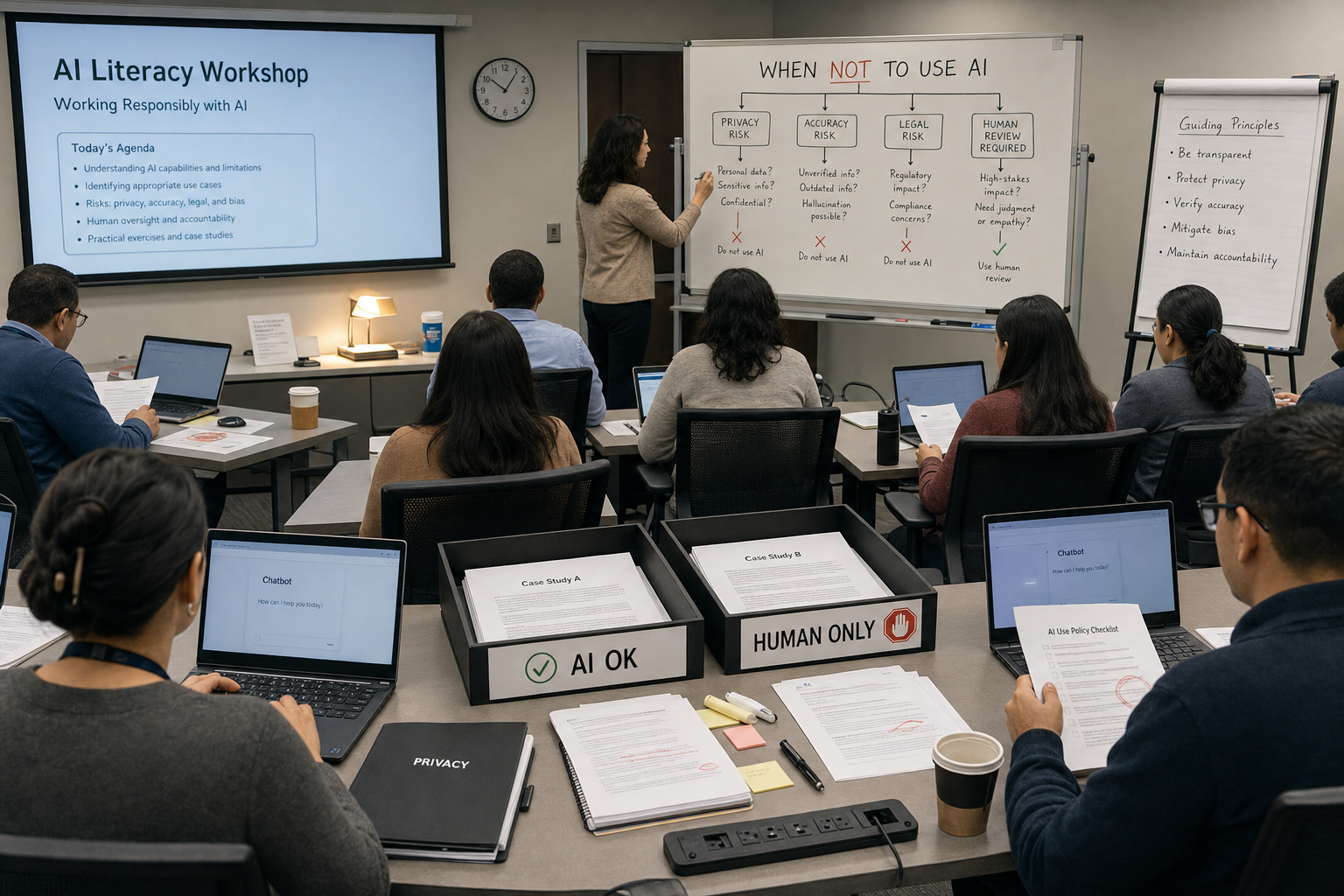
Generative AI has moved quickly from specialist software to everyday utility. Chatbots now sit inside search engines, office tools, study apps, and customer platforms. In many schools and workplaces, people are no longer just allowed to use AI. They are increasingly expected to use it.
That is why the real divide is changing. It is no longer only about who has access to AI, or even who knows the best prompts. It is about who can judge when AI is helpful, when it is risky, and when it should stay out of the task entirely. The main tension is clear: AI can save time and lower barriers, but overuse can weaken learning, blur accountability, expose private data, and flatten work that requires human care.
Access is getting easier. Judgment is not.
The old digital divide was mostly about infrastructure and basic skills. Who had a computer? Who had internet access? Who knew how to use common software?
Those questions still matter. But with AI, many of the most popular tools are cheap, free, or built into products people already use. That changes the problem. When access becomes easier, the advantage shifts to something less visible: good judgment.
Some people will learn that judgment through strong teachers, careful managers, and clear institutional rules. Others will get access without guidance. They will be told to use AI faster, more often, and with less reflection. That is where the new divide opens up.
A student with a thoughtful teacher may learn that AI can help review grammar but should not write the lab conclusion. A junior employee with a careful manager may learn that AI is fine for summarizing notes but not for pasting in confidential client material. Another person may learn only one lesson: use the tool everywhere.
AI literacy is not just knowing how to ask for an answer. It is knowing when not to ask.
What “when not to use AI” really means
This is not an argument for fear, and it is not an argument for blanket bans. It is an argument for limits that match the task.
There are a few clear cases where AI use should raise caution.
- When the point of the task is learning. If a student is supposed to practice analysis, writing, or problem-solving, outsourcing the core thinking defeats the purpose.
- When the cost of error is high. If the result affects health, legal rights, safety, grades, or money, convenience is not enough.
- When private or sensitive data is involved. Many users still do not fully understand what should never be pasted into public or poorly governed tools.
- When accountability must stay personal. Recommendation letters, performance reviews, disciplinary decisions, and other trust-based judgments should not be casually automated.
- When verification is weak or unrealistic. If you cannot check the output carefully, you should not rely on it.
These are not fringe cases. They are daily situations in schools, offices, and professional life.
Students need more than prompt skills
Students are often told that AI is a productivity tool. That is true, up to a point. It can explain a difficult concept in simpler language, suggest study questions, or help a non-native English speaker revise a draft they have already written. Used carefully, it can widen access to support that was once expensive or unavailable.
But students also need a blunt truth: if AI does the thinking that the course is meant to teach, the tool is not helping. It is replacing the practice.
A literature student who asks AI for a summary before reading may save time and lose the text. A history student who asks for thesis ideas may receive plausible arguments without learning how to build one. A science student who pastes in raw results and asks for a conclusion may produce neat language without understanding the experiment.
The risk here is not only cheating. It is shallower learning dressed up as efficiency. A student can sound more polished and still understand less.
Educators should teach boundaries, not just detection
Teachers and universities face a difficult problem. They know students are using AI. They also know outright bans are often unrealistic. In many cases, bans simply push use underground and make honest discussion harder.
Still, the wrong response is to swing to the other extreme and treat AI use as automatically modern or desirable. Educators should be building clear norms around purpose.
AI can be useful for administrative work, draft rubrics, translation, or generating practice questions. But it should be handled far more carefully in areas that shape student trust and evaluation. Using AI to write sensitive feedback, to make assumptions about a student’s understanding, or to rely heavily on AI detectors can create unfair outcomes. Tools can be wrong. Teachers remain responsible.
The best classroom policies are usually specific. They explain what kind of help is allowed, what kind is not, and why. “You may use AI to brainstorm examples, but not to write your analysis” is more useful than either a total ban or a vague permission slip.
Professionals need restraint as much as speed
In workplaces, the pressure to use AI is rising fast. Teams are told to draft faster, answer faster, summarize faster. That pressure is understandable. There are real gains in handling repetitive tasks.
AI can help turn rough notes into a cleaner memo. It can suggest alternate wording for a customer reply. It can organize meeting points into a usable outline. These are practical benefits, and it would be foolish to deny them.
But professionals also need to know when speed creates a hidden cost.
Pasting confidential data into a public tool can create privacy and compliance problems. Using AI to draft a performance review can make a sensitive judgment feel generic or evasive. Letting AI generate material you do not fully check can damage credibility with clients, colleagues, or the public.
In many fields, the real issue is not whether AI was involved. It is whether the user remained accountable for the result.
The counterpoint is real: over-warning can become its own problem
There is a fair objection to all this. If institutions focus too much on when not to use AI, they may slow useful adoption, protect old gatekeepers, or make people afraid of a tool that could genuinely help them.
That concern matters. AI can support people with disabilities. It can help non-native English speakers express ideas more clearly. It can give beginners a starting point when they would otherwise have none. In overstretched classrooms and workplaces, it can reduce routine burden.
There is also a social risk in vague moralizing. “Use judgment” sounds wise, but it can become a fuzzy standard that is applied unevenly. Senior people may get flexibility while students or junior workers get punished for the same behavior.
That is exactly why the answer cannot be instinct, stigma, or blanket warning. The answer is explicit criteria. People need examples, red lines, and shared language. Judgment should be taught, not assumed.
What better AI literacy looks like
Most AI training still focuses on technique. How to prompt. How to summarize. How to automate. Those lessons are useful, but incomplete.
A better model of AI literacy would teach people to pause before they use the tool. At minimum, schools and employers should train people to ask five questions:
- What is the real purpose of this task? Is it to learn, decide, communicate, or simply save time?
- What happens if the output is wrong? Is the risk trivial, or could it affect someone’s grade, rights, privacy, safety, or reputation?
- Whose data is involved? Is there anything sensitive, private, or confidential in the material?
- Am I supposed to provide my own reasoning or voice? If so, AI may undermine the point of the exercise.
- Can I verify the result fully? If I cannot check it, I should not depend on it.
These questions are simple, but they change behavior. They move AI use from habit to decision.
The skill that will matter most
The next generation will not be divided neatly into people who use AI and people who do not. Most people will use it in some form. The sharper divide will be between those who treat AI as a universal shortcut and those who understand its place, its limits, and its trade-offs.
That is why teaching people when not to use AI is not a side lesson. It is the core of responsible AI literacy. We do not need more people using AI automatically. We need more people using it deliberately.
The strongest AI habit is not constant use. It is the ability to stop, assess the task, and decide whether the tool belongs there at all.